Jacobi-Matrix
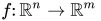
Die Jacobi-Matrix (benannt nach Carl Gustav Jacob Jacobi; auch Funktionalmatrix, Ableitungsmatrix oder Jacobische genannt) einer differenzierbaren Funktion f : R n → R m {\displaystyle f\colon {\mathbb {R} ^{n}}\to {\mathbb {R} ^{m}}\,\!} ist die m × n {\displaystyle m\times n} -Matrix sämtlicher erster partieller Ableitungen. Im Falle der totalen Differenzierbarkeit bildet sie die Matrix-Darstellung der als lineare Abbildung aufgefassten ersten Ableitung der Funktion f {\displaystyle f} bezüglich der Standardbasen des R n {\displaystyle \mathbb {R} ^{n}} und des R m {\displaystyle \mathbb {R} ^{m}} . Genutzt wird die Jacobi-Matrix zum Beispiel zur annähernden Berechnung (Approximation) oder Minimierung mehrdimensionaler Funktionen in der Mathematik.

Die Jacobi-Matrix (benannt nach Carl Gustav Jacob Jacobi; auch Funktionalmatrix, Ableitungsmatrix oder Jacobische genannt) einer differenzierbaren Funktion
f
:
R
n
→
R
m
{\displaystyle f\colon {\mathbb {R} ^{n}}\to {\mathbb {R} ^{m}}\,\!}


Genutzt wird die Jacobi-Matrix zum Beispiel zur annähernden Berechnung (Approximation) oder Minimierung mehrdimensionaler Funktionen in der Mathematik.
Definition
[Bearbeiten | Quelltext bearbeiten]Sei
f
:
U
⊂
R
n
→
R
m
{\displaystyle f\colon U\subset \mathbb {R} ^{n}\to \mathbb {R} ^{m}}



Dann ist für
a
∈
U
{\displaystyle a\in U}


-
J
f
(
a
)
:=
(
∂
f
i
∂
x
j
(
a
)
)
i
=
1
,
…
,
m
;
j
=
1
,
…
,
n
=
(
∂
f
1
∂
x
1
(
a
)
∂
f
1
∂
x
2
(
a
)
…
∂
f
1
∂
x
n
(
a
)
⋮
⋮
⋱
⋮
∂
f
m
∂
x
1
(
a
)
∂
f
m
∂
x
2
(
a
)
…
∂
f
m
∂
x
n
(
a
)
)
{\displaystyle J_{f}(a):=\left({\frac {\partial f_{i}}{\partial x_{j}}}(a)\right)_{i=1,\ldots ,m;\ j=1,\ldots ,n}={\begin{pmatrix}{\frac {\partial f_{1}}{\partial x_{1}}}(a)&{\frac {\partial f_{1}}{\partial x_{2}}}(a)&\ldots &{\frac {\partial f_{1}}{\partial x_{n}}}(a)\\\vdots &\vdots &\ddots &\vdots \\{\frac {\partial f_{m}}{\partial x_{1}}}(a)&{\frac {\partial f_{m}}{\partial x_{2}}}(a)&\ldots &{\frac {\partial f_{m}}{\partial x_{n}}}(a)\end{pmatrix}}}
.
In den Zeilen der Jacobi-Matrix stehen also gerade die (transponierten) Gradienten der Komponentenfunktionen
f
1
,
…
,
f
m
{\displaystyle f_{1},\dots ,f_{m}}

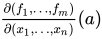
Andere übliche Schreibweisen für die Jacobi-Matrix
J
f
(
a
)
{\displaystyle J_{f}(a)}


Beispiel
[Bearbeiten | Quelltext bearbeiten]Die Funktion
f
:
R
3
→
R
2
{\displaystyle f\colon \mathbb {R} ^{3}\to \mathbb {R} ^{2}}

-
f
(
x
,
y
,
z
)
=
(
x
2
+
y
2
+
z
⋅
sin
x
z
2
+
z
⋅
sin
y
)
{\displaystyle f(x,y,z)={\binom {x^{2}+y^{2}+z\cdot \sin x}{z^{2}+z\cdot \sin y}}}

Dann ist
-
∂
∂
x
f
(
x
,
y
,
z
)
=
(
2
x
+
z
⋅
cos
x
0
)
∂
∂
y
f
(
x
,
y
,
z
)
=
(
2
y
z
⋅
cos
y
)
∂
∂
z
f
(
x
,
y
,
z
)
=
(
sin
x
2
z
+
sin
y
)
{\displaystyle {\begin{aligned}{\frac {\partial }{\partial x}}f(x,y,z)&={\binom {2x+z\cdot \cos x}{0}}\\{\frac {\partial }{\partial y}}f(x,y,z)&={\binom {2y}{z\cdot \cos y}}\\{\frac {\partial }{\partial z}}f(x,y,z)&={\binom {\sin x}{2z+\sin y}}\end{aligned}}}
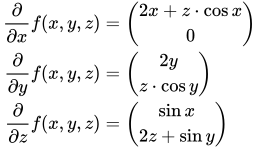
und damit die Jacobi-Matrix
-
J
f
(
x
,
y
,
z
)
=
(
2
x
+
z
⋅
cos
x
2
y
sin
x
0
z
⋅
cos
y
2
z
+
sin
y
)
{\displaystyle J_{f}(x,y,z)=\left({\begin{array}{ccc}2x+z\cdot \cos x&2y&\sin x\\0&z\cdot \cos y\,&2z+\sin y\end{array}}\right)}

Anwendungen
[Bearbeiten | Quelltext bearbeiten]- Ist die Funktion
f
:
U
⊂
R
n
→
R
m
{\displaystyle f\colon U\subset \mathbb {R} ^{n}\to \mathbb {R} ^{m}}
an der Stelle a = ( a 1 , … , a n ) ∈ U {\displaystyle a=(a_{1},\dots ,a_{n})\in U}
die lineare Abbildung
-
D
f
a
:
R
n
→
R
m
,
D
f
a
(
h
)
=
J
f
(
a
)
⋅
h
{\displaystyle Df_{a}\colon \mathbb {R} ^{n}\to \mathbb {R} ^{m},\quad Df_{a}(h)=J_{f}(a)\cdot h}
.
-
D
f
a
:
R
n
→
R
m
,
D
f
a
(
h
)
=
J
f
(
a
)
⋅
h
{\displaystyle Df_{a}\colon \mathbb {R} ^{n}\to \mathbb {R} ^{m},\quad Df_{a}(h)=J_{f}(a)\cdot h}
- Die Jacobi-Matrix an der Stelle
a
{\displaystyle a}
- Für
m
=
1
{\displaystyle m=1}
entspricht die Jacobi-Matrix dem transponierten Gradienten von f {\displaystyle f}
- Die Jacobi-Matrix kann, wenn man sie für eine Stelle
a
=
(
a
1
,
…
,
a
n
)
{\displaystyle a=(a_{1},\dots ,a_{n})}
ausrechnet, zur Näherung der Funktionswerte von f {\displaystyle f}
-
f
(
x
)
≈
f
(
a
)
+
J
f
(
a
)
⋅
(
x
−
a
)
.
{\displaystyle f(x)\approx f(a)+J_{f}(a)\cdot (x-a).}
-
f
(
x
)
≈
f
(
a
)
+
J
f
(
a
)
⋅
(
x
−
a
)
.
{\displaystyle f(x)\approx f(a)+J_{f}(a)\cdot (x-a).}
- Diese affine Abbildung entspricht der Taylor-Approximation erster Ordnung (Linearisierung).

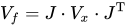
- Die Fortpflanzung von Messfehlern in Form einer Kovarianzmatrix geschieht durch die Jacobi-Matrix:
V
f
=
J
⋅
V
x
⋅
J
T
{\displaystyle V_{f}=J\cdot V_{x}\cdot J^{\text{T}}}
Determinante der Jacobi-Matrix
[Bearbeiten | Quelltext bearbeiten]Sei
m
=
n
{\displaystyle m=n}




Jacobi-Matrix einer holomorphen Funktion
[Bearbeiten | Quelltext bearbeiten]Neben Funktionen
f
:
U
⊂
R
n
→
R
m
{\displaystyle f\colon U\subset \mathbb {R} ^{n}\to \mathbb {R} ^{m}}





-
J
h
C
(
z
)
:=
(
∂
h
1
(
z
)
∂
z
1
⋯
∂
h
1
(
z
)
∂
z
n
⋮
⋱
⋮
∂
h
m
(
z
)
∂
z
1
⋯
∂
h
m
(
z
)
∂
z
n
)
{\displaystyle J_{h}^{\mathbb {C} }(z):={\begin{pmatrix}{\frac {\partial h_{1}(z)}{\partial z_{1}}}&\cdots &{\frac {\partial h_{1}(z)}{\partial z_{n}}}\\\vdots &\ddots &\vdots \\{\frac {\partial h_{m}(z)}{\partial z_{1}}}&\cdots &{\frac {\partial h_{m}(z)}{\partial z_{n}}}\end{pmatrix}}}
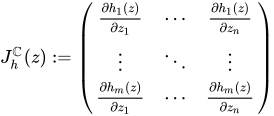
definiert.
Jede komplexwertige Funktion kann in zwei reellwertige Funktionen aufgespalten werden. Das heißt, es existieren Funktionen
u
,
v
:
C
n
→
R
m
{\displaystyle u,v\colon \mathbb {C} ^{n}\to \mathbb {R} ^{m}}





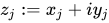


-
J
h
R
(
z
)
:=
(
∂
u
1
(
z
)
∂
x
1
⋯
∂
u
1
(
z
)
∂
x
n
∂
u
1
(
z
)
∂
y
1
⋯
∂
u
1
(
z
)
∂
y
n
⋮
⋱
⋮
⋮
⋱
⋮
∂
u
m
(
z
)
∂
x
1
⋯
∂
u
m
(
z
)
∂
x
n
∂
u
m
(
z
)
∂
y
1
⋯
∂
u
m
(
z
)
∂
y
n
∂
v
1
(
z
)
∂
x
1
⋯
∂
v
1
(
z
)
∂
x
n
∂
v
1
(
z
)
∂
y
1
⋯
∂
v
1
(
z
)
∂
y
n
⋮
⋱
⋮
⋮
⋱
⋮
∂
v
m
(
z
)
∂
x
1
⋯
∂
v
m
(
z
)
∂
x
n
∂
v
m
(
z
)
∂
y
1
⋯
∂
v
m
(
z
)
∂
y
n
)
{\displaystyle J_{h}^{\mathbb {R} }(z):={\begin{pmatrix}{\frac {\partial u_{1}(z)}{\partial x_{1}}}&\cdots &{\frac {\partial u_{1}(z)}{\partial x_{n}}}&{\frac {\partial u_{1}(z)}{\partial y_{1}}}&\cdots &{\frac {\partial u_{1}(z)}{\partial y_{n}}}\\\vdots &\ddots &\vdots &\vdots &\ddots &\vdots \\{\frac {\partial u_{m}(z)}{\partial x_{1}}}&\cdots &{\frac {\partial u_{m}(z)}{\partial x_{n}}}&{\frac {\partial u_{m}(z)}{\partial y_{1}}}&\cdots &{\frac {\partial u_{m}(z)}{\partial y_{n}}}\\{\frac {\partial v_{1}(z)}{\partial x_{1}}}&\cdots &{\frac {\partial v_{1}(z)}{\partial x_{n}}}&{\frac {\partial v_{1}(z)}{\partial y_{1}}}&\cdots &{\frac {\partial v_{1}(z)}{\partial y_{n}}}\\\vdots &\ddots &\vdots &\vdots &\ddots &\vdots \\{\frac {\partial v_{m}(z)}{\partial x_{1}}}&\cdots &{\frac {\partial v_{m}(z)}{\partial x_{n}}}&{\frac {\partial v_{m}(z)}{\partial y_{1}}}&\cdots &{\frac {\partial v_{m}(z)}{\partial y_{n}}}\end{pmatrix}}}
.
Gilt bei den Jacobi-Matrizen für holomorphe Funktionen
m
=
n
{\displaystyle m=n}
-
det
(
J
h
R
(
z
)
)
=
|
det
(
J
h
C
(
z
)
)
|
2
{\displaystyle \det \left(J_{h}^{\mathbb {R} }(z)\right)=\left|\det(J_{h}^{\mathbb {C} }(z))\right|^{2}}
.
Siehe auch
[Bearbeiten | Quelltext bearbeiten]Literatur
[Bearbeiten | Quelltext bearbeiten]- Konrad Königsberger: Analysis 2. Springer-Verlag, Berlin/Heidelberg, 2000, ISBN 3-540-43580-8. (für Jacobi-Matrizen reeller Funktionen).
- Klaus Fritzsche, Hans Grauert: From Holomorphic Functions to Complex Manifolds. Springer-Verlag, ISBN 0-387-95395-7. (S. 30–31; für Jacobi-Matrizen holomorpher Funktionen).