Complex random vector

In probability theory and statistics, a complex random vector is typically a tuple of complex-valued random variables, and generally is a random variable taking values in a vector space over the field of complex numbers. If Z 1 , … , Z n {\displaystyle Z_{1},\ldots ,Z_{n}} are complex-valued random variables, then the n-tuple ( Z 1 , … , Z n ) {\displaystyle \left(Z_{1},\ldots ,Z_{n}\right)} is a complex random vector. Complex random variables can always be considered as pairs of real random vectors: their real and imaginary parts. Some concepts of real random vectors have a straightforward generalization to complex random vectors. For example, the definition of the mean of a complex random vector. Other concepts are unique to complex random vectors. Applications of complex random vectors are found in digital signal processing.
In probability theory and statistics, a complex random vector is typically a tuple of complex-valued random variables, and generally is a random variable taking values in a vector space over the field of complex numbers. If
Z
1
,
…
,
Z
n
{\displaystyle Z_{1},\ldots ,Z_{n}}


Some concepts of real random vectors have a straightforward generalization to complex random vectors. For example, the definition of the mean of a complex random vector. Other concepts are unique to complex random vectors.
Applications of complex random vectors are found in digital signal processing.
| Part of a series on statistics |
| Probability theory |
|---|
 |
Definition
[edit]A complex random vector
Z
=
(
Z
1
,
…
,
Z
n
)
T
{\displaystyle \mathbf {Z} =(Z_{1},\ldots ,Z_{n})^{T}}






Cumulative distribution function
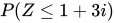
[edit]The generalization of the cumulative distribution function from real to complex random variables is not obvious because expressions of the form
P
(
Z
≤
1
+
3
i
)
{\displaystyle P(Z\leq 1+3i)}

![{\displaystyle F_{\mathbf {Z} }:\mathbb {C} ^{n}\mapsto [0,1]}](https://wikimedia.org/api/rest_v1/media/math/render/svg/8661e6d29a4d779324e5c3978506838f8c244b65)

F
Z
(
z
)
=
P
(
ℜ
(
Z
1
)
≤
ℜ
(
z
1
)
,
ℑ
(
Z
1
)
≤
ℑ
(
z
1
)
,
…
,
ℜ
(
Z
n
)
≤
ℜ
(
z
n
)
,
ℑ
(
Z
n
)
≤
ℑ
(
z
n
)
)
{\displaystyle F_{\mathbf {Z} }(\mathbf {z} )=\operatorname {P} (\Re {(Z_{1})}\leq \Re {(z_{1})},\Im {(Z_{1})}\leq \Im {(z_{1})},\ldots ,\Re {(Z_{n})}\leq \Re {(z_{n})},\Im {(Z_{n})}\leq \Im {(z_{n})})}
 | Eq.1 |
where
z
=
(
z
1
,
.
.
.
,
z
n
)
T
{\displaystyle \mathbf {z} =(z_{1},...,z_{n})^{T}}

Expectation
[edit]As in the real case the expectation (also called expected value) of a complex random vector is taken component-wise.[1]: p. 293
E
[
Z
]
=
(
E
[
Z
1
]
,
…
,
E
[
Z
n
]
)
T
{\displaystyle \operatorname {E} [\mathbf {Z} ]=(\operatorname {E} [Z_{1}],\ldots ,\operatorname {E} [Z_{n}])^{T}}
![{\displaystyle \operatorname {E} [\mathbf {Z} ]=(\operatorname {E} [Z_{1}],\ldots ,\operatorname {E} [Z_{n}])^{T}}](https://wikimedia.org/api/rest_v1/media/math/render/svg/9bad8687a134b34189596765316018f79fdca495) | Eq.2 |
Covariance matrix and pseudo-covariance matrix
[edit]The covariance matrix (also called second central moment)
K
Z
Z
{\displaystyle \operatorname {K} _{\mathbf {Z} \mathbf {Z} }}


|
K
Z
Z
=
cov
[
Z
,
Z
]
=
E
[
(
Z
−
E
[
Z
]
)
(
Z
−
E
[
Z
]
)
H
]
=
E
[
Z
Z
H
]
−
E
[
Z
]
E
[
Z
H
]
{\displaystyle {\begin{aligned}&\operatorname {K} _{\mathbf {Z} \mathbf {Z} }=\operatorname {cov} [\mathbf {Z} ,\mathbf {Z} ]=\operatorname {E} [(\mathbf {Z} -\operatorname {E} [\mathbf {Z} ]){(\mathbf {Z} -\operatorname {E} [\mathbf {Z} ])}^{H}]=\operatorname {E} [\mathbf {Z} \mathbf {Z} ^{H}]-\operatorname {E} [\mathbf {Z} ]\operatorname {E} [\mathbf {Z} ^{H}]\\[12pt]\end{aligned}}}
| Eq.3 |
![{\displaystyle {\begin{aligned}&\operatorname {K} _{\mathbf {Z} \mathbf {Z} }=\operatorname {cov} [\mathbf {Z} ,\mathbf {Z} ]=\operatorname {E} [(\mathbf {Z} -\operatorname {E} [\mathbf {Z} ]){(\mathbf {Z} -\operatorname {E} [\mathbf {Z} ])}^{H}]=\operatorname {E} [\mathbf {Z} \mathbf {Z} ^{H}]-\operatorname {E} [\mathbf {Z} ]\operatorname {E} [\mathbf {Z} ^{H}]\\[12pt]\end{aligned}}}](https://wikimedia.org/api/rest_v1/media/math/render/svg/ebd5472da7a2129480754c26bf1527c36e0e1aef)
-
K
Z
Z
=
[
E
[
(
Z
1
−
E
[
Z
1
]
)
(
Z
1
−
E
[
Z
1
]
)
¯
]
E
[
(
Z
1
−
E
[
Z
1
]
)
(
Z
2
−
E
[
Z
2
]
)
¯
]
⋯
E
[
(
Z
1
−
E
[
Z
1
]
)
(
Z
n
−
E
[
Z
n
]
)
¯
]
E
[
(
Z
2
−
E
[
Z
2
]
)
(
Z
1
−
E
[
Z
1
]
)
¯
]
E
[
(
Z
2
−
E
[
Z
2
]
)
(
Z
2
−
E
[
Z
2
]
)
¯
]
⋯
E
[
(
Z
2
−
E
[
Z
2
]
)
(
Z
n
−
E
[
Z
n
]
)
¯
]
⋮
⋮
⋱
⋮
E
[
(
Z
n
−
E
[
Z
n
]
)
(
Z
1
−
E
[
Z
1
]
)
¯
]
E
[
(
Z
n
−
E
[
Z
n
]
)
(
Z
2
−
E
[
Z
2
]
)
¯
]
⋯
E
[
(
Z
n
−
E
[
Z
n
]
)
(
Z
n
−
E
[
Z
n
]
)
¯
]
]
{\displaystyle \operatorname {K} _{\mathbf {Z} \mathbf {Z} }={\begin{bmatrix}\mathrm {E} [(Z_{1}-\operatorname {E} [Z_{1}]){\overline {(Z_{1}-\operatorname {E} [Z_{1}])}}]&\mathrm {E} [(Z_{1}-\operatorname {E} [Z_{1}]){\overline {(Z_{2}-\operatorname {E} [Z_{2}])}}]&\cdots &\mathrm {E} [(Z_{1}-\operatorname {E} [Z_{1}]){\overline {(Z_{n}-\operatorname {E} [Z_{n}])}}]\\\\\mathrm {E} [(Z_{2}-\operatorname {E} [Z_{2}]){\overline {(Z_{1}-\operatorname {E} [Z_{1}])}}]&\mathrm {E} [(Z_{2}-\operatorname {E} [Z_{2}]){\overline {(Z_{2}-\operatorname {E} [Z_{2}])}}]&\cdots &\mathrm {E} [(Z_{2}-\operatorname {E} [Z_{2}]){\overline {(Z_{n}-\operatorname {E} [Z_{n}])}}]\\\\\vdots &\vdots &\ddots &\vdots \\\\\mathrm {E} [(Z_{n}-\operatorname {E} [Z_{n}]){\overline {(Z_{1}-\operatorname {E} [Z_{1}])}}]&\mathrm {E} [(Z_{n}-\operatorname {E} [Z_{n}]){\overline {(Z_{2}-\operatorname {E} [Z_{2}])}}]&\cdots &\mathrm {E} [(Z_{n}-\operatorname {E} [Z_{n}]){\overline {(Z_{n}-\operatorname {E} [Z_{n}])}}]\end{bmatrix}}}
![{\displaystyle \operatorname {K} _{\mathbf {Z} \mathbf {Z} }={\begin{bmatrix}\mathrm {E} [(Z_{1}-\operatorname {E} [Z_{1}]){\overline {(Z_{1}-\operatorname {E} [Z_{1}])}}]&\mathrm {E} [(Z_{1}-\operatorname {E} [Z_{1}]){\overline {(Z_{2}-\operatorname {E} [Z_{2}])}}]&\cdots &\mathrm {E} [(Z_{1}-\operatorname {E} [Z_{1}]){\overline {(Z_{n}-\operatorname {E} [Z_{n}])}}]\\\\\mathrm {E} [(Z_{2}-\operatorname {E} [Z_{2}]){\overline {(Z_{1}-\operatorname {E} [Z_{1}])}}]&\mathrm {E} [(Z_{2}-\operatorname {E} [Z_{2}]){\overline {(Z_{2}-\operatorname {E} [Z_{2}])}}]&\cdots &\mathrm {E} [(Z_{2}-\operatorname {E} [Z_{2}]){\overline {(Z_{n}-\operatorname {E} [Z_{n}])}}]\\\\\vdots &\vdots &\ddots &\vdots \\\\\mathrm {E} [(Z_{n}-\operatorname {E} [Z_{n}]){\overline {(Z_{1}-\operatorname {E} [Z_{1}])}}]&\mathrm {E} [(Z_{n}-\operatorname {E} [Z_{n}]){\overline {(Z_{2}-\operatorname {E} [Z_{2}])}}]&\cdots &\mathrm {E} [(Z_{n}-\operatorname {E} [Z_{n}]){\overline {(Z_{n}-\operatorname {E} [Z_{n}])}}]\end{bmatrix}}}](https://wikimedia.org/api/rest_v1/media/math/render/svg/445eafa0ab8d1d761c1c34d3bb993b4598ec4b15)
The pseudo-covariance matrix (also called relation matrix) is defined replacing Hermitian transposition by transposition in the definition above.
|
J
Z
Z
=
cov
[
Z
,
Z
¯
]
=
E
[
(
Z
−
E
[
Z
]
)
(
Z
−
E
[
Z
]
)
T
]
=
E
[
Z
Z
T
]
−
E
[
Z
]
E
[
Z
T
]
{\displaystyle \operatorname {J} _{\mathbf {Z} \mathbf {Z} }=\operatorname {cov} [\mathbf {Z} ,{\overline {\mathbf {Z} }}]=\operatorname {E} [(\mathbf {Z} -\operatorname {E} [\mathbf {Z} ]){(\mathbf {Z} -\operatorname {E} [\mathbf {Z} ])}^{T}]=\operatorname {E} [\mathbf {Z} \mathbf {Z} ^{T}]-\operatorname {E} [\mathbf {Z} ]\operatorname {E} [\mathbf {Z} ^{T}]}
| Eq.4 |
![{\displaystyle \operatorname {J} _{\mathbf {Z} \mathbf {Z} }=\operatorname {cov} [\mathbf {Z} ,{\overline {\mathbf {Z} }}]=\operatorname {E} [(\mathbf {Z} -\operatorname {E} [\mathbf {Z} ]){(\mathbf {Z} -\operatorname {E} [\mathbf {Z} ])}^{T}]=\operatorname {E} [\mathbf {Z} \mathbf {Z} ^{T}]-\operatorname {E} [\mathbf {Z} ]\operatorname {E} [\mathbf {Z} ^{T}]}](https://wikimedia.org/api/rest_v1/media/math/render/svg/073e290548d019170600567c2a29b7feaaf98a51)
-
J
Z
Z
=
[
E
[
(
Z
1
−
E
[
Z
1
]
)
(
Z
1
−
E
[
Z
1
]
)
]
E
[
(
Z
1
−
E
[
Z
1
]
)
(
Z
2
−
E
[
Z
2
]
)
]
⋯
E
[
(
Z
1
−
E
[
Z
1
]
)
(
Z
n
−
E
[
Z
n
]
)
]
E
[
(
Z
2
−
E
[
Z
2
]
)
(
Z
1
−
E
[
Z
1
]
)
]
E
[
(
Z
2
−
E
[
Z
2
]
)
(
Z
2
−
E
[
Z
2
]
)
]
⋯
E
[
(
Z
2
−
E
[
Z
2
]
)
(
Z
n
−
E
[
Z
n
]
)
]
⋮
⋮
⋱
⋮
E
[
(
Z
n
−
E
[
Z
n
]
)
(
Z
1
−
E
[
Z
1
]
)
]
E
[
(
Z
n
−
E
[
Z
n
]
)
(
Z
2
−
E
[
Z
2
]
)
]
⋯
E
[
(
Z
n
−
E
[
Z
n
]
)
(
Z
n
−
E
[
Z
n
]
)
]
]
{\displaystyle \operatorname {J} _{\mathbf {Z} \mathbf {Z} }={\begin{bmatrix}\mathrm {E} [(Z_{1}-\operatorname {E} [Z_{1}])(Z_{1}-\operatorname {E} [Z_{1}])]&\mathrm {E} [(Z_{1}-\operatorname {E} [Z_{1}])(Z_{2}-\operatorname {E} [Z_{2}])]&\cdots &\mathrm {E} [(Z_{1}-\operatorname {E} [Z_{1}])(Z_{n}-\operatorname {E} [Z_{n}])]\\\\\mathrm {E} [(Z_{2}-\operatorname {E} [Z_{2}])(Z_{1}-\operatorname {E} [Z_{1}])]&\mathrm {E} [(Z_{2}-\operatorname {E} [Z_{2}])(Z_{2}-\operatorname {E} [Z_{2}])]&\cdots &\mathrm {E} [(Z_{2}-\operatorname {E} [Z_{2}])(Z_{n}-\operatorname {E} [Z_{n}])]\\\\\vdots &\vdots &\ddots &\vdots \\\\\mathrm {E} [(Z_{n}-\operatorname {E} [Z_{n}])(Z_{1}-\operatorname {E} [Z_{1}])]&\mathrm {E} [(Z_{n}-\operatorname {E} [Z_{n}])(Z_{2}-\operatorname {E} [Z_{2}])]&\cdots &\mathrm {E} [(Z_{n}-\operatorname {E} [Z_{n}])(Z_{n}-\operatorname {E} [Z_{n}])]\end{bmatrix}}}
![{\displaystyle \operatorname {J} _{\mathbf {Z} \mathbf {Z} }={\begin{bmatrix}\mathrm {E} [(Z_{1}-\operatorname {E} [Z_{1}])(Z_{1}-\operatorname {E} [Z_{1}])]&\mathrm {E} [(Z_{1}-\operatorname {E} [Z_{1}])(Z_{2}-\operatorname {E} [Z_{2}])]&\cdots &\mathrm {E} [(Z_{1}-\operatorname {E} [Z_{1}])(Z_{n}-\operatorname {E} [Z_{n}])]\\\\\mathrm {E} [(Z_{2}-\operatorname {E} [Z_{2}])(Z_{1}-\operatorname {E} [Z_{1}])]&\mathrm {E} [(Z_{2}-\operatorname {E} [Z_{2}])(Z_{2}-\operatorname {E} [Z_{2}])]&\cdots &\mathrm {E} [(Z_{2}-\operatorname {E} [Z_{2}])(Z_{n}-\operatorname {E} [Z_{n}])]\\\\\vdots &\vdots &\ddots &\vdots \\\\\mathrm {E} [(Z_{n}-\operatorname {E} [Z_{n}])(Z_{1}-\operatorname {E} [Z_{1}])]&\mathrm {E} [(Z_{n}-\operatorname {E} [Z_{n}])(Z_{2}-\operatorname {E} [Z_{2}])]&\cdots &\mathrm {E} [(Z_{n}-\operatorname {E} [Z_{n}])(Z_{n}-\operatorname {E} [Z_{n}])]\end{bmatrix}}}](https://wikimedia.org/api/rest_v1/media/math/render/svg/50248ec68758163e693b5fa474537f0d953110ee)
- Properties
The covariance matrix is a hermitian matrix, i.e.[1]: p. 293
-
K
Z
Z
H
=
K
Z
Z
{\displaystyle \operatorname {K} _{\mathbf {Z} \mathbf {Z} }^{H}=\operatorname {K} _{\mathbf {Z} \mathbf {Z} }}
.
The pseudo-covariance matrix is a symmetric matrix, i.e.
-
J
Z
Z
T
=
J
Z
Z
{\displaystyle \operatorname {J} _{\mathbf {Z} \mathbf {Z} }^{T}=\operatorname {J} _{\mathbf {Z} \mathbf {Z} }}
.
The covariance matrix is a positive semidefinite matrix, i.e.
-
a
H
K
Z
Z
a
≥
0
for all
a
∈
C
n
{\displaystyle \mathbf {a} ^{H}\operatorname {K} _{\mathbf {Z} \mathbf {Z} }\mathbf {a} \geq 0\quad {\text{for all }}\mathbf {a} \in \mathbb {C} ^{n}}
.
Covariance matrices of real and imaginary parts
[edit]By decomposing the random vector
Z
{\displaystyle \mathbf {Z} }


-
[
K
X
X
K
X
Y
K
Y
X
K
Y
Y
]
{\displaystyle {\begin{bmatrix}\operatorname {K} _{\mathbf {X} \mathbf {X} }&\operatorname {K} _{\mathbf {X} \mathbf {Y} }\\\operatorname {K} _{\mathbf {Y} \mathbf {X} }&\operatorname {K} _{\mathbf {Y} \mathbf {Y} }\end{bmatrix}}}

The matrices
K
Z
Z
{\displaystyle \operatorname {K} _{\mathbf {Z} \mathbf {Z} }}


-
K
X
X
=
E
[
(
X
−
E
[
X
]
)
(
X
−
E
[
X
]
)
T
]
=
1
2
Re
(
K
Z
Z
+
J
Z
Z
)
K
Y
Y
=
E
[
(
Y
−
E
[
Y
]
)
(
Y
−
E
[
Y
]
)
T
]
=
1
2
Re
(
K
Z
Z
−
J
Z
Z
)
K
Y
X
=
E
[
(
Y
−
E
[
Y
]
)
(
X
−
E
[
X
]
)
T
]
=
1
2
Im
(
J
Z
Z
+
K
Z
Z
)
K
X
Y
=
E
[
(
X
−
E
[
X
]
)
(
Y
−
E
[
Y
]
)
T
]
=
1
2
Im
(
J
Z
Z
−
K
Z
Z
)
{\displaystyle {\begin{aligned}&\operatorname {K} _{\mathbf {X} \mathbf {X} }=\operatorname {E} [(\mathbf {X} -\operatorname {E} [\mathbf {X} ])(\mathbf {X} -\operatorname {E} [\mathbf {X} ])^{\mathrm {T} }]={\tfrac {1}{2}}\operatorname {Re} (\operatorname {K} _{\mathbf {Z} \mathbf {Z} }+\operatorname {J} _{\mathbf {Z} \mathbf {Z} })\\&\operatorname {K} _{\mathbf {Y} \mathbf {Y} }=\operatorname {E} [(\mathbf {Y} -\operatorname {E} [\mathbf {Y} ])(\mathbf {Y} -\operatorname {E} [\mathbf {Y} ])^{\mathrm {T} }]={\tfrac {1}{2}}\operatorname {Re} (\operatorname {K} _{\mathbf {Z} \mathbf {Z} }-\operatorname {J} _{\mathbf {Z} \mathbf {Z} })\\&\operatorname {K} _{\mathbf {Y} \mathbf {X} }=\operatorname {E} [(\mathbf {Y} -\operatorname {E} [\mathbf {Y} ])(\mathbf {X} -\operatorname {E} [\mathbf {X} ])^{\mathrm {T} }]={\tfrac {1}{2}}\operatorname {Im} (\operatorname {J} _{\mathbf {Z} \mathbf {Z} }+\operatorname {K} _{\mathbf {Z} \mathbf {Z} })\\&\operatorname {K} _{\mathbf {X} \mathbf {Y} }=\operatorname {E} [(\mathbf {X} -\operatorname {E} [\mathbf {X} ])(\mathbf {Y} -\operatorname {E} [\mathbf {Y} ])^{\mathrm {T} }]={\tfrac {1}{2}}\operatorname {Im} (\operatorname {J} _{\mathbf {Z} \mathbf {Z} }-\operatorname {K} _{\mathbf {Z} \mathbf {Z} })\\\end{aligned}}}
![{\displaystyle {\begin{aligned}&\operatorname {K} _{\mathbf {X} \mathbf {X} }=\operatorname {E} [(\mathbf {X} -\operatorname {E} [\mathbf {X} ])(\mathbf {X} -\operatorname {E} [\mathbf {X} ])^{\mathrm {T} }]={\tfrac {1}{2}}\operatorname {Re} (\operatorname {K} _{\mathbf {Z} \mathbf {Z} }+\operatorname {J} _{\mathbf {Z} \mathbf {Z} })\\&\operatorname {K} _{\mathbf {Y} \mathbf {Y} }=\operatorname {E} [(\mathbf {Y} -\operatorname {E} [\mathbf {Y} ])(\mathbf {Y} -\operatorname {E} [\mathbf {Y} ])^{\mathrm {T} }]={\tfrac {1}{2}}\operatorname {Re} (\operatorname {K} _{\mathbf {Z} \mathbf {Z} }-\operatorname {J} _{\mathbf {Z} \mathbf {Z} })\\&\operatorname {K} _{\mathbf {Y} \mathbf {X} }=\operatorname {E} [(\mathbf {Y} -\operatorname {E} [\mathbf {Y} ])(\mathbf {X} -\operatorname {E} [\mathbf {X} ])^{\mathrm {T} }]={\tfrac {1}{2}}\operatorname {Im} (\operatorname {J} _{\mathbf {Z} \mathbf {Z} }+\operatorname {K} _{\mathbf {Z} \mathbf {Z} })\\&\operatorname {K} _{\mathbf {X} \mathbf {Y} }=\operatorname {E} [(\mathbf {X} -\operatorname {E} [\mathbf {X} ])(\mathbf {Y} -\operatorname {E} [\mathbf {Y} ])^{\mathrm {T} }]={\tfrac {1}{2}}\operatorname {Im} (\operatorname {J} _{\mathbf {Z} \mathbf {Z} }-\operatorname {K} _{\mathbf {Z} \mathbf {Z} })\\\end{aligned}}}](https://wikimedia.org/api/rest_v1/media/math/render/svg/02b2d81c9eb40be718176122b197e7384c6ca81c)
Conversely:
-
K
Z
Z
=
K
X
X
+
K
Y
Y
+
i
(
K
Y
X
−
K
X
Y
)
J
Z
Z
=
K
X
X
−
K
Y
Y
+
i
(
K
Y
X
+
K
X
Y
)
{\displaystyle {\begin{aligned}&\operatorname {K} _{\mathbf {Z} \mathbf {Z} }=\operatorname {K} _{\mathbf {X} \mathbf {X} }+\operatorname {K} _{\mathbf {Y} \mathbf {Y} }+i(\operatorname {K} _{\mathbf {Y} \mathbf {X} }-\operatorname {K} _{\mathbf {X} \mathbf {Y} })\\&\operatorname {J} _{\mathbf {Z} \mathbf {Z} }=\operatorname {K} _{\mathbf {X} \mathbf {X} }-\operatorname {K} _{\mathbf {Y} \mathbf {Y} }+i(\operatorname {K} _{\mathbf {Y} \mathbf {X} }+\operatorname {K} _{\mathbf {X} \mathbf {Y} })\end{aligned}}}

Cross-covariance matrix and pseudo-cross-covariance matrix
[edit]The cross-covariance matrix between two complex random vectors
Z
,
W
{\displaystyle \mathbf {Z} ,\mathbf {W} }

K
Z
W
=
cov
[
Z
,
W
]
=
E
[
(
Z
−
E
[
Z
]
)
(
W
−
E
[
W
]
)
H
]
=
E
[
Z
W
H
]
−
E
[
Z
]
E
[
W
H
]
{\displaystyle \operatorname {K} _{\mathbf {Z} \mathbf {W} }=\operatorname {cov} [\mathbf {Z} ,\mathbf {W} ]=\operatorname {E} [(\mathbf {Z} -\operatorname {E} [\mathbf {Z} ]){(\mathbf {W} -\operatorname {E} [\mathbf {W} ])}^{H}]=\operatorname {E} [\mathbf {Z} \mathbf {W} ^{H}]-\operatorname {E} [\mathbf {Z} ]\operatorname {E} [\mathbf {W} ^{H}]}
![{\displaystyle \operatorname {K} _{\mathbf {Z} \mathbf {W} }=\operatorname {cov} [\mathbf {Z} ,\mathbf {W} ]=\operatorname {E} [(\mathbf {Z} -\operatorname {E} [\mathbf {Z} ]){(\mathbf {W} -\operatorname {E} [\mathbf {W} ])}^{H}]=\operatorname {E} [\mathbf {Z} \mathbf {W} ^{H}]-\operatorname {E} [\mathbf {Z} ]\operatorname {E} [\mathbf {W} ^{H}]}](https://wikimedia.org/api/rest_v1/media/math/render/svg/9844313bcca0b6e7e67e2c61bae3559a8714b4e4) | Eq.5 |
-
K
Z
W
=
[
E
[
(
Z
1
−
E
[
Z
1
]
)
(
W
1
−
E
[
W
1
]
)
¯
]
E
[
(
Z
1
−
E
[
Z
1
]
)
(
W
2
−
E
[
W
2
]
)
¯
]
⋯
E
[
(
Z
1
−
E
[
Z
1
]
)
(
W
n
−
E
[
W
n
]
)
¯
]
E
[
(
Z
2
−
E
[
Z
2
]
)
(
W
1
−
E
[
W
1
]
)
¯
]
E
[
(
Z
2
−
E
[
Z
2
]
)
(
W
2
−
E
[
W
2
]
)
¯
]
⋯
E
[
(
Z
2
−
E
[
Z
2
]
)
(
W
n
−
E
[
W
n
]
)
¯
]
⋮
⋮
⋱
⋮
E
[
(
Z
n
−
E
[
Z
n
]
)
(
W
1
−
E
[
W
1
]
)
¯
]
E
[
(
Z
n
−
E
[
Z
n
]
)
(
W
2
−
E
[
W
2
]
)
¯
]
⋯
E
[
(
Z
n
−
E
[
Z
n
]
)
(
W
n
−
E
[
W
n
]
)
¯
]
]
{\displaystyle \operatorname {K} _{\mathbf {Z} \mathbf {W} }={\begin{bmatrix}\mathrm {E} [(Z_{1}-\operatorname {E} [Z_{1}]){\overline {(W_{1}-\operatorname {E} [W_{1}])}}]&\mathrm {E} [(Z_{1}-\operatorname {E} [Z_{1}]){\overline {(W_{2}-\operatorname {E} [W_{2}])}}]&\cdots &\mathrm {E} [(Z_{1}-\operatorname {E} [Z_{1}]){\overline {(W_{n}-\operatorname {E} [W_{n}])}}]\\\\\mathrm {E} [(Z_{2}-\operatorname {E} [Z_{2}]){\overline {(W_{1}-\operatorname {E} [W_{1}])}}]&\mathrm {E} [(Z_{2}-\operatorname {E} [Z_{2}]){\overline {(W_{2}-\operatorname {E} [W_{2}])}}]&\cdots &\mathrm {E} [(Z_{2}-\operatorname {E} [Z_{2}]){\overline {(W_{n}-\operatorname {E} [W_{n}])}}]\\\\\vdots &\vdots &\ddots &\vdots \\\\\mathrm {E} [(Z_{n}-\operatorname {E} [Z_{n}]){\overline {(W_{1}-\operatorname {E} [W_{1}])}}]&\mathrm {E} [(Z_{n}-\operatorname {E} [Z_{n}]){\overline {(W_{2}-\operatorname {E} [W_{2}])}}]&\cdots &\mathrm {E} [(Z_{n}-\operatorname {E} [Z_{n}]){\overline {(W_{n}-\operatorname {E} [W_{n}])}}]\end{bmatrix}}}
![{\displaystyle \operatorname {K} _{\mathbf {Z} \mathbf {W} }={\begin{bmatrix}\mathrm {E} [(Z_{1}-\operatorname {E} [Z_{1}]){\overline {(W_{1}-\operatorname {E} [W_{1}])}}]&\mathrm {E} [(Z_{1}-\operatorname {E} [Z_{1}]){\overline {(W_{2}-\operatorname {E} [W_{2}])}}]&\cdots &\mathrm {E} [(Z_{1}-\operatorname {E} [Z_{1}]){\overline {(W_{n}-\operatorname {E} [W_{n}])}}]\\\\\mathrm {E} [(Z_{2}-\operatorname {E} [Z_{2}]){\overline {(W_{1}-\operatorname {E} [W_{1}])}}]&\mathrm {E} [(Z_{2}-\operatorname {E} [Z_{2}]){\overline {(W_{2}-\operatorname {E} [W_{2}])}}]&\cdots &\mathrm {E} [(Z_{2}-\operatorname {E} [Z_{2}]){\overline {(W_{n}-\operatorname {E} [W_{n}])}}]\\\\\vdots &\vdots &\ddots &\vdots \\\\\mathrm {E} [(Z_{n}-\operatorname {E} [Z_{n}]){\overline {(W_{1}-\operatorname {E} [W_{1}])}}]&\mathrm {E} [(Z_{n}-\operatorname {E} [Z_{n}]){\overline {(W_{2}-\operatorname {E} [W_{2}])}}]&\cdots &\mathrm {E} [(Z_{n}-\operatorname {E} [Z_{n}]){\overline {(W_{n}-\operatorname {E} [W_{n}])}}]\end{bmatrix}}}](https://wikimedia.org/api/rest_v1/media/math/render/svg/9941690a38b08ff9f3b9be4bd1de0bb2fb9a67b5)
And the pseudo-cross-covariance matrix is defined as:
J
Z
W
=
cov
[
Z
,
W
¯
]
=
E
[
(
Z
−
E
[
Z
]
)
(
W
−
E
[
W
]
)
T
]
=
E
[
Z
W
T
]
−
E
[
Z
]
E
[
W
T
]
{\displaystyle \operatorname {J} _{\mathbf {Z} \mathbf {W} }=\operatorname {cov} [\mathbf {Z} ,{\overline {\mathbf {W} }}]=\operatorname {E} [(\mathbf {Z} -\operatorname {E} [\mathbf {Z} ]){(\mathbf {W} -\operatorname {E} [\mathbf {W} ])}^{T}]=\operatorname {E} [\mathbf {Z} \mathbf {W} ^{T}]-\operatorname {E} [\mathbf {Z} ]\operatorname {E} [\mathbf {W} ^{T}]}
![{\displaystyle \operatorname {J} _{\mathbf {Z} \mathbf {W} }=\operatorname {cov} [\mathbf {Z} ,{\overline {\mathbf {W} }}]=\operatorname {E} [(\mathbf {Z} -\operatorname {E} [\mathbf {Z} ]){(\mathbf {W} -\operatorname {E} [\mathbf {W} ])}^{T}]=\operatorname {E} [\mathbf {Z} \mathbf {W} ^{T}]-\operatorname {E} [\mathbf {Z} ]\operatorname {E} [\mathbf {W} ^{T}]}](https://wikimedia.org/api/rest_v1/media/math/render/svg/3e6a151a8db17da379cb32babce0e737bca9a8b9) | Eq.6 |
-
J
Z
W
=
[
E
[
(
Z
1
−
E
[
Z
1
]
)
(
W
1
−
E
[
W
1
]
)
]
E
[
(
Z
1
−
E
[
Z
1
]
)
(
W
2
−
E
[
W
2
]
)
]
⋯
E
[
(
Z
1
−
E
[
Z
1
]
)
(
W
n
−
E
[
W
n
]
)
]
E
[
(
Z
2
−
E
[
Z
2
]
)
(
W
1
−
E
[
W
1
]
)
]
E
[
(
Z
2
−
E
[
Z
2
]
)
(
W
2
−
E
[
W
2
]
)
]
⋯
E
[
(
Z
2
−
E
[
Z
2
]
)
(
W
n
−
E
[
W
n
]
)
]
⋮
⋮
⋱
⋮
E
[
(
Z
n
−
E
[
Z
n
]
)
(
W
1
−
E
[
W
1
]
)
]
E
[
(
Z
n
−
E
[
Z
n
]
)
(
W
2
−
E
[
W
2
]
)
]
⋯
E
[
(
Z
n
−
E
[
Z
n
]
)
(
W
n
−
E
[
W
n
]
)
]
]
{\displaystyle \operatorname {J} _{\mathbf {Z} \mathbf {W} }={\begin{bmatrix}\mathrm {E} [(Z_{1}-\operatorname {E} [Z_{1}])(W_{1}-\operatorname {E} [W_{1}])]&\mathrm {E} [(Z_{1}-\operatorname {E} [Z_{1}])(W_{2}-\operatorname {E} [W_{2}])]&\cdots &\mathrm {E} [(Z_{1}-\operatorname {E} [Z_{1}])(W_{n}-\operatorname {E} [W_{n}])]\\\\\mathrm {E} [(Z_{2}-\operatorname {E} [Z_{2}])(W_{1}-\operatorname {E} [W_{1}])]&\mathrm {E} [(Z_{2}-\operatorname {E} [Z_{2}])(W_{2}-\operatorname {E} [W_{2}])]&\cdots &\mathrm {E} [(Z_{2}-\operatorname {E} [Z_{2}])(W_{n}-\operatorname {E} [W_{n}])]\\\\\vdots &\vdots &\ddots &\vdots \\\\\mathrm {E} [(Z_{n}-\operatorname {E} [Z_{n}])(W_{1}-\operatorname {E} [W_{1}])]&\mathrm {E} [(Z_{n}-\operatorname {E} [Z_{n}])(W_{2}-\operatorname {E} [W_{2}])]&\cdots &\mathrm {E} [(Z_{n}-\operatorname {E} [Z_{n}])(W_{n}-\operatorname {E} [W_{n}])]\end{bmatrix}}}
![{\displaystyle \operatorname {J} _{\mathbf {Z} \mathbf {W} }={\begin{bmatrix}\mathrm {E} [(Z_{1}-\operatorname {E} [Z_{1}])(W_{1}-\operatorname {E} [W_{1}])]&\mathrm {E} [(Z_{1}-\operatorname {E} [Z_{1}])(W_{2}-\operatorname {E} [W_{2}])]&\cdots &\mathrm {E} [(Z_{1}-\operatorname {E} [Z_{1}])(W_{n}-\operatorname {E} [W_{n}])]\\\\\mathrm {E} [(Z_{2}-\operatorname {E} [Z_{2}])(W_{1}-\operatorname {E} [W_{1}])]&\mathrm {E} [(Z_{2}-\operatorname {E} [Z_{2}])(W_{2}-\operatorname {E} [W_{2}])]&\cdots &\mathrm {E} [(Z_{2}-\operatorname {E} [Z_{2}])(W_{n}-\operatorname {E} [W_{n}])]\\\\\vdots &\vdots &\ddots &\vdots \\\\\mathrm {E} [(Z_{n}-\operatorname {E} [Z_{n}])(W_{1}-\operatorname {E} [W_{1}])]&\mathrm {E} [(Z_{n}-\operatorname {E} [Z_{n}])(W_{2}-\operatorname {E} [W_{2}])]&\cdots &\mathrm {E} [(Z_{n}-\operatorname {E} [Z_{n}])(W_{n}-\operatorname {E} [W_{n}])]\end{bmatrix}}}](https://wikimedia.org/api/rest_v1/media/math/render/svg/240fc2c9717f84911d95a271d7ca87595b185cc5)
Two complex random vectors
Z
{\displaystyle \mathbf {Z} }

-
K
Z
W
=
J
Z
W
=
0
{\displaystyle \operatorname {K} _{\mathbf {Z} \mathbf {W} }=\operatorname {J} _{\mathbf {Z} \mathbf {W} }=0}
.
Independence
[edit]Two complex random vectors
Z
=
(
Z
1
,
.
.
.
,
Z
m
)
T
{\displaystyle \mathbf {Z} =(Z_{1},...,Z_{m})^{T}}


F
Z
,
W
(
z
,
w
)
=
F
Z
(
z
)
⋅
F
W
(
w
)
for all
z
,
w
{\displaystyle F_{\mathbf {Z,W} }(\mathbf {z,w} )=F_{\mathbf {Z} }(\mathbf {z} )\cdot F_{\mathbf {W} }(\mathbf {w} )\quad {\text{for all }}\mathbf {z} ,\mathbf {w} }
 | Eq.7 |
where
F
Z
(
z
)
{\displaystyle F_{\mathbf {Z} }(\mathbf {z} )}


-
F
Z
1
,
…
,
Z
m
,
W
1
,
…
,
W
n
(
z
1
,
…
,
z
m
,
w
1
,
…
,
w
n
)
=
F
Z
1
,
…
,
Z
m
(
z
1
,
…
,
z
m
)
⋅
F
W
1
,
…
,
W
n
(
w
1
,
…
,
w
n
)
for all
z
1
,
…
,
z
m
,
w
1
,
…
,
w
n
{\displaystyle F_{Z_{1},\ldots ,Z_{m},W_{1},\ldots ,W_{n}}(z_{1},\ldots ,z_{m},w_{1},\ldots ,w_{n})=F_{Z_{1},\ldots ,Z_{m}}(z_{1},\ldots ,z_{m})\cdot F_{W_{1},\ldots ,W_{n}}(w_{1},\ldots ,w_{n})\quad {\text{for all }}z_{1},\ldots ,z_{m},w_{1},\ldots ,w_{n}}
.
Circular symmetry
[edit]A complex random vector
Z
{\displaystyle \mathbf {Z} }


- Properties
- The expectation of a circularly symmetric complex random vector is either zero or it is not defined.[3]: p. 500
- The pseudo-covariance matrix of a circularly symmetric complex random vector is zero.[3]: p. 584
Proper complex random vectors
[edit]A complex random vector
Z
{\displaystyle \mathbf {Z} }
-
E
[
Z
]
=
0
{\displaystyle \operatorname {E} [\mathbf {Z} ]=0}
(zero mean)
-
var
[
Z
1
]
<
∞
,
…
,
var
[
Z
n
]
<
∞
{\displaystyle \operatorname {var} [Z_{1}]<\infty ,\ldots ,\operatorname {var} [Z_{n}]<\infty }
(all components have finite variance)
-
E
[
Z
Z
T
]
=
0
{\displaystyle \operatorname {E} [\mathbf {Z} \mathbf {Z} ^{T}]=0}
![{\displaystyle \operatorname {E} [\mathbf {Z} \mathbf {Z} ^{T}]=0}](https://wikimedia.org/api/rest_v1/media/math/render/svg/e567ff4fa3785973cc8d53106ec6a0e075d969e9)
Two complex random vectors
Z
,
W
{\displaystyle \mathbf {Z} ,\mathbf {W} }

- Properties
- A complex random vector
Z
{\displaystyle \mathbf {Z} }
the complex random variable c T Z {\displaystyle \mathbf {c} ^{T}\mathbf {Z} }
is proper.[1]: p. 293
- Linear transformations of proper complex random vectors are proper, i.e. if
Z
{\displaystyle \mathbf {Z} }
components and A {\displaystyle A}
is a deterministic m × n {\displaystyle m\times n}
matrix, then the complex random vector A Z {\displaystyle A\mathbf {Z} }
is also proper.[1]: p. 295
- Every circularly symmetric complex random vector with finite variance of all its components is proper.[1]: p. 295
- There are proper complex random vectors that are not circularly symmetric.[1]: p. 504
- A real random vector is proper if and only if it is constant.
- Two jointly proper complex random vectors are uncorrelated if and only if their covariance matrix is zero, i.e. if
K
Z
W
=
0
{\displaystyle \operatorname {K} _{\mathbf {Z} \mathbf {W} }=0}
.
Cauchy–Schwarz inequality
[edit]The Cauchy–Schwarz inequality for complex random vectors is
-
|
E
[
Z
H
W
]
|
2
≤
E
[
Z
H
Z
]
E
[
|
W
H
W
|
]
{\displaystyle \left|\operatorname {E} [\mathbf {Z} ^{H}\mathbf {W} ]\right|^{2}\leq \operatorname {E} [\mathbf {Z} ^{H}\mathbf {Z} ]\operatorname {E} [|\mathbf {W} ^{H}\mathbf {W} |]}
.
Characteristic function
[edit]The characteristic function of a complex random vector
Z
{\displaystyle \mathbf {Z} }

-
φ
Z
(
ω
)
=
E
[
e
i
ℜ
(
ω
H
Z
)
]
=
E
[
e
i
(
ℜ
(
ω
1
)
ℜ
(
Z
1
)
+
ℑ
(
ω
1
)
ℑ
(
Z
1
)
+
⋯
+
ℜ
(
ω
n
)
ℜ
(
Z
n
)
+
ℑ
(
ω
n
)
ℑ
(
Z
n
)
)
]
{\displaystyle \varphi _{\mathbf {Z} }(\mathbf {\omega } )=\operatorname {E} \left[e^{i\Re {(\mathbf {\omega } ^{H}\mathbf {Z} )}}\right]=\operatorname {E} \left[e^{i(\Re {(\omega _{1})}\Re {(Z_{1})}+\Im {(\omega _{1})}\Im {(Z_{1})}+\cdots +\Re {(\omega _{n})}\Re {(Z_{n})}+\Im {(\omega _{n})}\Im {(Z_{n})})}\right]}
![{\displaystyle \varphi _{\mathbf {Z} }(\mathbf {\omega } )=\operatorname {E} \left[e^{i\Re {(\mathbf {\omega } ^{H}\mathbf {Z} )}}\right]=\operatorname {E} \left[e^{i(\Re {(\omega _{1})}\Re {(Z_{1})}+\Im {(\omega _{1})}\Im {(Z_{1})}+\cdots +\Re {(\omega _{n})}\Re {(Z_{n})}+\Im {(\omega _{n})}\Im {(Z_{n})})}\right]}](https://wikimedia.org/api/rest_v1/media/math/render/svg/55ef4b68890cb6b51eea0081d9a757a4c9f88849)
See also
[edit]- Complex normal distribution
- Complex random variable (scalar case)
References
[edit]- ^ a b c d e f g h i j Lapidoth, Amos (2009). A Foundation in Digital Communication. Cambridge University Press. ISBN 978-0-521-19395-5.
- ^ Gubner, John A. (2006). Probability and Random Processes for Electrical and Computer Engineers. Cambridge University Press. ISBN 978-0-521-86470-1.
- ^ a b c Tse, David (2005). Fundamentals of Wireless Communication. Cambridge University Press.