Complex normal distribution
In probability theory, the family of complex normal distributions, denoted C N {\displaystyle {\mathcal {CN}}} or N C {\displaystyle {\mathcal {N}}_{\mathcal {C}}} , characterizes complex random variables whose real and imaginary parts are jointly normal. The complex normal family has three parameters: location parameter μ, covariance matrix Γ {\displaystyle \Gamma } , and the relation matrix C {\displaystyle C} . The standard complex normal is the univariate distribution with μ = 0 {\displaystyle \mu =0} , Γ = 1 {\displaystyle \Gamma =1} , and C = 0 {\displaystyle C=0} . An important subclass of complex normal family is called the circularly-symmetric (central) complex normal and corresponds to the case of zero relation matrix and zero mean: μ = 0 {\displaystyle \mu =0} and C = 0 {\displaystyle C=0} . This case is used extensively in signal processing, where it is sometimes referred to as just complex normal in the literature.
| Complex normal | |||
|---|---|---|---|
| Parameters |
— location | ||
| Support | |||
| complicated, see text | |||
| Mean | |||
| Mode | |||
| Variance | |||
| CF | |||



In probability theory, the family of complex normal distributions, denoted or , characterizes complex random variables whose real and imaginary parts are jointly normal.[1] The complex normal family has three parameters: location parameter μ, covariance matrix , and the relation matrix . The standard complex normal is the univariate distribution with , , and .


An important subclass of complex normal family is called the circularly-symmetric (central) complex normal and corresponds to the case of zero relation matrix and zero mean: and .[2] This case is used extensively in signal processing, where it is sometimes referred to as just complex normal in the literature.
Definitions
[edit]Complex standard normal random variable
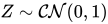
[edit]The standard complex normal random variable or standard complex Gaussian random variable is a complex random variable whose real and imaginary parts are independent normally distributed random variables with mean zero and variance .[3]: p. 494 [4]: pp. 501 Formally,


| Eq.1 |

where denotes that is a standard complex normal random variable.
Complex normal random variable
[edit]Suppose and are real random variables such that is a 2-dimensional normal random vector. Then the complex random variable is called complex normal random variable or complex Gaussian random variable.[3]: p. 500


| Eq.2 |

Complex standard normal random vector
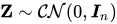
[edit]A n-dimensional complex random vector is a complex standard normal random vector or complex standard Gaussian random vector if its components are independent and all of them are standard complex normal random variables as defined above.[3]: p. 502 [4]: pp. 501 That is a standard complex normal random vector is denoted .


| Eq.3 |

Complex normal random vector
[edit]If and are random vectors in such that is a normal random vector with components. Then we say that the complex random vector



![{\displaystyle [\mathbf {X} ,\mathbf {Y} ]}](https://wikimedia.org/api/rest_v1/media/math/render/svg/39633a1d2cf0edd432b5ceee258360ac47ebf9db)


is a complex normal random vector or a complex Gaussian random vector.
| Eq.4 |

Mean, covariance, and relation
[edit]The complex Gaussian distribution can be described with 3 parameters:[5]
![{\displaystyle \mu =\operatorname {E} [\mathbf {Z} ],\quad \Gamma =\operatorname {E} [(\mathbf {Z} -\mu )({\mathbf {Z} }-\mu )^{\mathrm {H} }],\quad C=\operatorname {E} [(\mathbf {Z} -\mu )(\mathbf {Z} -\mu )^{\mathrm {T} }],}](https://wikimedia.org/api/rest_v1/media/math/render/svg/d8186b266f6fa5b1c962c01bcc77a666d4ae579b)
where denotes matrix transpose of , and denotes conjugate transpose.[3]: p. 504 [4]: pp. 500


Here the location parameter is a n-dimensional complex vector; the covariance matrix is Hermitian and non-negative definite; and, the relation matrix or pseudo-covariance matrix is symmetric. The complex normal random vector can now be denoted asMoreover, matrices and are such that the matrix



is also non-negative definite where denotes the complex conjugate of .[5]

Relationships between covariance matrices
[edit]As for any complex random vector, the matrices and can be related to the covariance matrices of and via expressions


![{\displaystyle {\begin{aligned}&V_{XX}\equiv \operatorname {E} [(\mathbf {X} -\mu _{X})(\mathbf {X} -\mu _{X})^{\mathrm {T} }]={\tfrac {1}{2}}\operatorname {Re} [\Gamma +C],\quad V_{XY}\equiv \operatorname {E} [(\mathbf {X} -\mu _{X})(\mathbf {Y} -\mu _{Y})^{\mathrm {T} }]={\tfrac {1}{2}}\operatorname {Im} [-\Gamma +C],\\&V_{YX}\equiv \operatorname {E} [(\mathbf {Y} -\mu _{Y})(\mathbf {X} -\mu _{X})^{\mathrm {T} }]={\tfrac {1}{2}}\operatorname {Im} [\Gamma +C],\quad \,V_{YY}\equiv \operatorname {E} [(\mathbf {Y} -\mu _{Y})(\mathbf {Y} -\mu _{Y})^{\mathrm {T} }]={\tfrac {1}{2}}\operatorname {Re} [\Gamma -C],\end{aligned}}}](https://wikimedia.org/api/rest_v1/media/math/render/svg/7816194d319a6f156db69f13e9f2add16b9937fe)
and conversely

Density function
[edit]The probability density function for complex normal distribution can be computed as
![{\displaystyle {\begin{aligned}f(z)&={\frac {1}{\pi ^{n}{\sqrt {\det(\Gamma )\det(P)}}}}\,\exp \!\left\{-{\frac {1}{2}}{\begin{bmatrix}z-\mu \\{\overline {z}}-{\overline {\mu }}\end{bmatrix}}^{\mathrm {H} }{\begin{bmatrix}\Gamma &C\\{\overline {C}}&{\overline {\Gamma }}\end{bmatrix}}^{\!\!-1}\!{\begin{bmatrix}z-\mu \\{\overline {z}}-{\overline {\mu }}\end{bmatrix}}\right\}\\[8pt]&={\tfrac {\sqrt {\det \left({\overline {P^{-1}}}-R^{\ast }P^{-1}R\right)\det(P^{-1})}}{\pi ^{n}}}\,e^{-(z-\mu )^{\ast }{\overline {P^{-1}}}(z-\mu )+\operatorname {Re} \left((z-\mu )^{\intercal }R^{\intercal }{\overline {P^{-1}}}(z-\mu )\right)},\end{aligned}}}](https://wikimedia.org/api/rest_v1/media/math/render/svg/736e45cbaf3e68d9ca78dbb9cafda0402ed3c4b3)
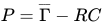
where and .

Characteristic function
[edit]The characteristic function of complex normal distribution is given by[5]

where the argument is an n-dimensional complex vector.

Properties
[edit]- If is a complex normal n-vector, an m×n matrix, and a constant m-vector, then the linear transform will be distributed also complex-normally:



- If is a complex normal n-vector, then
![{\displaystyle 2{\Big [}(\mathbf {Z} -\mu )^{\mathrm {H} }{\overline {P^{-1}}}(\mathbf {Z} -\mu )-\operatorname {Re} {\big (}(\mathbf {Z} -\mu )^{\mathrm {T} }R^{\mathrm {T} }{\overline {P^{-1}}}(\mathbf {Z} -\mu ){\big )}{\Big ]}\ \sim \ \chi ^{2}(2n)}](https://wikimedia.org/api/rest_v1/media/math/render/svg/a4752c39ed434c1a5f987accdda45de63384153f)
- Central limit theorem. If are independent and identically distributed complex random variables, then

- where and .
![{\displaystyle {\sqrt {T}}{\Big (}{\tfrac {1}{T}}\textstyle \sum _{t=1}^{T}Z_{t}-\operatorname {E} [Z_{t}]{\Big )}\ \xrightarrow {d} \ {\mathcal {CN}}(0,\,\Gamma ,\,C),}](https://wikimedia.org/api/rest_v1/media/math/render/svg/7a8e03845ead334b995c22f8fb6a63887477b36d)
![{\displaystyle \Gamma =\operatorname {E} [ZZ^{\mathrm {H} }]}](https://wikimedia.org/api/rest_v1/media/math/render/svg/040fb5df40ce465da42594603d54e851879ccdf9)
![{\displaystyle C=\operatorname {E} [ZZ^{\mathrm {T} }]}](https://wikimedia.org/api/rest_v1/media/math/render/svg/d57ca27eba4a64bb77bac89459414af49a542522)
- The modulus of a complex normal random variable follows a Hoyt distribution.[6]
Circularly-symmetric central case
[edit]Definition
[edit]A complex random vector is called circularly symmetric if for every deterministic the distribution of equals the distribution of .[4]: pp. 500–501


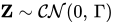
Central normal complex random vectors that are circularly symmetric are of particular interest because they are fully specified by the covariance matrix .
The circularly-symmetric (central) complex normal distribution corresponds to the case of zero mean and zero relation matrix, i.e. and .[3]: p. 507 [7] This is usually denoted
Distribution of real and imaginary parts
[edit]If is circularly-symmetric (central) complex normal, then the vector is multivariate normal with covariance structure


where .
![{\displaystyle \Gamma =\operatorname {E} [\mathbf {Z} \mathbf {Z} ^{\mathrm {H} }]}](https://wikimedia.org/api/rest_v1/media/math/render/svg/5664837bef03da1b45373e4aefa316892ccf80ed)
Probability density function
[edit]For nonsingular covariance matrix , its distribution can also be simplified as[3]: p. 508
- .

Therefore, if the non-zero mean and covariance matrix are unknown, a suitable log likelihood function for a single observation vector would be


The standard complex normal (defined in Eq.1) corresponds to the distribution of a scalar random variable with , and . Thus, the standard complex normal distribution has density

Properties
[edit]The above expression demonstrates why the case , is called “circularly-symmetric”. The density function depends only on the magnitude of but not on its argument. As such, the magnitude of a standard complex normal random variable will have the Rayleigh distribution and the squared magnitude will have the exponential distribution, whereas the argument will be distributed uniformly on .


![{\displaystyle [-\pi ,\pi ]}](https://wikimedia.org/api/rest_v1/media/math/render/svg/cb064fd6c55820cfa660eabeeda0f6e3c4935ae6)
If are independent and identically distributed n-dimensional circular complex normal random vectors with , then the random squared norm
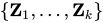
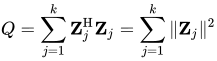
has the generalized chi-squared distribution and the random matrix
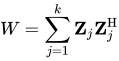
has the complex Wishart distribution with degrees of freedom. This distribution can be described by density function


where , and is a nonnegative-definite matrix.


See also
[edit]- Complex normal ratio distribution
- Directional statistics § Distribution of the mean (polar form)
- Normal distribution
- Multivariate normal distribution (a complex normal distribution is a bivariate normal distribution)
- Generalized chi-squared distribution
- Wishart distribution
- Complex random variable
References
[edit] | This article includes a list of general references, but it lacks sufficient corresponding inline citations. (July 2011) |
- ^ Goodman, N.R. (1963). "Statistical analysis based on a certain multivariate complex Gaussian distribution (an introduction)". The Annals of Mathematical Statistics. 34 (1): 152–177. doi:10.1214/aoms/1177704250. JSTOR 2991290.
- ^ bookchapter, Gallager.R, pg9.
- ^ a b c d e f Lapidoth, A. (2009). A Foundation in Digital Communication. Cambridge University Press. ISBN 9780521193955.
- ^ a b c d Tse, David (2005). Fundamentals of Wireless Communication. Cambridge University Press. ISBN 9781139444668.
- ^ a b c Picinbono, Bernard (1996). "Second-order complex random vectors and normal distributions". IEEE Transactions on Signal Processing. 44 (10): 2637–2640. Bibcode:1996ITSP...44.2637P. doi:10.1109/78.539051.
- ^ Daniel Wollschlaeger. "The Hoyt Distribution (Documentation for R package 'shotGroups' version 0.6.2)".[permanent dead link]
- ^ bookchapter, Gallager.R

