Weighting pattern
A weighting pattern for a linear dynamical system describes the relationship between an input u {\displaystyle u} and output y {\displaystyle y} . Given the time-variant system described by x ˙ ( t ) = A ( t ) x ( t ) + B ( t ) u ( t ) {\displaystyle {\dot {x}}(t)=A(t)x(t)+B(t)u(t)} y ( t ) = C ( t ) x ( t ) {\displaystyle y(t)=C(t)x(t)} , then the output can be written as y ( t ) = y ( t 0 ) + ∫ t 0 t T ( t , σ ) u ( σ ) d σ {\displaystyle y(t)=y(t_{0})+\int _{t_{0}}^{t}T(t,\sigma )u(\sigma )d\sigma } , where T ( ⋅ , ⋅ ) {\displaystyle T(\cdot ,\cdot )} is the weighting pattern for the system. For such a system, the weighting pattern is T ( t , σ ) = C ( t ) ϕ ( t , σ ) B ( σ ) {\displaystyle T(t,\sigma )=C(t)\phi (t,\sigma )B(\sigma )} such that ϕ {\displaystyle \phi } is the state transition matrix. The weighting pattern will determine a system, but if there exists a realization for this weighting pattern then there exist many that do so.
 | This article relies largely or entirely on a single source. (March 2025) |
A weighting pattern for a linear dynamical system describes the relationship between an input and output . Given the time-variant system described by


- ,


then the output can be written as
- ,
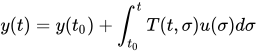
where is the weighting pattern for the system. For such a system, the weighting pattern is such that is the state transition matrix.



The weighting pattern will determine a system, but if there exists a realization for this weighting pattern then there exist many that do so.[1]
Linear time invariant system
[edit]In a LTI system then the weighting pattern is:
- Continuous

where is the matrix exponential.

- Discrete
- .

See also
[edit]References
[edit]- ^ Brockett, Roger W. (1970). Finite Dimensional Linear Systems. John Wiley & Sons. ISBN 978-0-471-10585-5.