Trigamma function

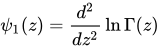
In mathematics, the trigamma function, denoted ψ1(z) or ψ(1)(z), is the second of the polygamma functions, and is defined by ψ 1 ( z ) = d 2 d z 2 ln Γ ( z ) {\displaystyle \psi _{1}(z)={\frac {d^{2}}{dz^{2}}}\ln \Gamma (z)} . It follows from this definition that ψ 1 ( z ) = d d z ψ ( z ) {\displaystyle \psi _{1}(z)={\frac {d}{dz}}\psi (z)} where ψ(z) is the digamma function. It may also be defined as the sum of the series ψ 1 ( z ) = ∑ n = 0 ∞ 1 ( z + n ) 2 , {\displaystyle \psi _{1}(z)=\sum _{n=0}^{\infty }{\frac {1}{(z+n)^{2}}},} making it a special case of the Hurwitz zeta function ψ 1 ( z ) = ζ ( 2 , z ) . {\displaystyle \psi _{1}(z)=\zeta (2,z).} Note that the last two formulas are valid when 1 − z is not a natural number.

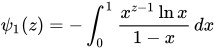
In mathematics, the trigamma function, denoted ψ1(z) or ψ(1)(z), is the second of the polygamma functions, and is defined by
- .
It follows from this definition that
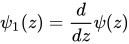
where ψ(z) is the digamma function. It may also be defined as the sum of the series
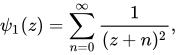
making it a special case of the Hurwitz zeta function

Note that the last two formulas are valid when 1 − z is not a natural number.
Calculation
[edit]A double integral representation, as an alternative to the ones given above, may be derived from the series representation:
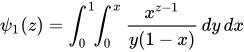
using the formula for the sum of a geometric series. Integration over y yields:
An asymptotic expansion as a Laurent series can be obtained via the derivative of the asymptotic expansion of the digamma function:

where Bn is the nth Bernoulli number and we choose B1 = 1/2.
Recurrence and reflection formulae
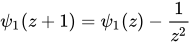
[edit]The trigamma function satisfies the recurrence relation
and the reflection formula
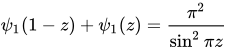
which immediately gives the value for z = 1/2: .

Special values
[edit]At positive integer values we have that

At positive half integer values we have that

The trigamma function has other special values such as:
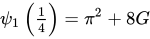
where G represents Catalan's constant.
There are no roots on the real axis of ψ1, but there exist infinitely many pairs of roots zn, zn for Re z < 0. Each such pair of roots approaches Re zn = −n + 1/2 quickly and their imaginary part increases slowly logarithmic with n. For example, z1 = −0.4121345... + 0.5978119...i and z2 = −1.4455692... + 0.6992608...i are the first two roots with Im(z) > 0.
Relation to the Clausen function
[edit]The digamma function at rational arguments can be expressed in terms of trigonometric functions and logarithm by the digamma theorem. A similar result holds for the trigamma function but the circular functions are replaced by Clausen's function. Namely,[1]

Appearance
[edit]The trigamma function appears in this sum formula:[2]

See also
[edit]Notes
[edit]- ^ Lewin, L., ed. (1991). Structural properties of polylogarithms. American Mathematical Society. ISBN 978-0821816349.
- ^ Mező, István (2013). "Some infinite sums arising from the Weierstrass Product Theorem". Applied Mathematics and Computation. 219 (18): 9838–9846. doi:10.1016/j.amc.2013.03.122.
References
[edit]- Milton Abramowitz and Irene A. Stegun, Handbook of Mathematical Functions, (1964) Dover Publications, New York. ISBN 0-486-61272-4. See section §6.4
- Eric W. Weisstein. Trigamma Function -- from MathWorld--A Wolfram Web Resource