Tensor reshaping
In multilinear algebra, a reshaping of tensors is any bijection between the set of indices of an order- M {\displaystyle M} tensor and the set of indices of an order- L {\displaystyle L} tensor, where L < M {\displaystyle L<M} . The use of indices presupposes tensors in coordinate representation with respect to a basis. The coordinate representation of a tensor can be regarded as a multi-dimensional array, and a bijection from one set of indices to another therefore amounts to a rearrangement of the array elements into an array of a different shape. Such a rearrangement constitutes a particular kind of linear map between the vector space of order- M {\displaystyle M} tensors and the vector space of order- L {\displaystyle L} tensors.
 | This article needs additional citations for verification. Please help improve this article by adding citations to reliable sources. Unsourced material may be challenged and removed. Find sources: "Tensor reshaping" – news · newspapers · books · scholar · JSTOR (April 2023) (Learn how and when to remove this message) |
In multilinear algebra, a reshaping of tensors is any bijection between the set of indices of an order-
M
{\displaystyle M}


Definition
[edit]Given a positive integer
M
{\displaystyle M}
![{\displaystyle [M]}](https://wikimedia.org/api/rest_v1/media/math/render/svg/e5ca74e595b2281c0aef1897ecafa282d1f182e2)

For each integer
m
{\displaystyle m}


V
1
⊗
⋯
⊗
V
M
≃
F
I
1
⊗
⋯
⊗
F
I
M
≃
F
I
π
1
⊗
⋯
⊗
F
I
π
M
≃
F
I
π
1
I
π
2
⊗
F
I
π
3
⊗
⋯
⊗
F
I
π
M
≃
F
I
π
1
I
π
3
⊗
F
I
π
2
⊗
F
I
π
4
⊗
⋯
⊗
F
I
π
M
⋮
≃
F
I
1
I
2
…
I
M
,
{\displaystyle {\begin{aligned}V_{1}\otimes \cdots \otimes V_{M}&\simeq F^{I_{1}}\otimes \cdots \otimes F^{I_{M}}\\&\simeq F^{I_{\pi _{1}}}\otimes \cdots \otimes F^{I_{\pi _{M}}}\\&\simeq F^{I_{\pi _{1}}I_{\pi _{2}}}\otimes F^{I_{\pi _{3}}}\otimes \cdots \otimes F^{I_{\pi _{M}}}\\&\simeq F^{I_{\pi _{1}}I_{\pi _{3}}}\otimes F^{I_{\pi _{2}}}\otimes F^{I_{\pi _{4}}}\otimes \cdots \otimes F^{I_{\pi _{M}}}\\&\,\,\,\vdots \\&\simeq F^{I_{1}I_{2}\ldots I_{M}},\end{aligned}}}
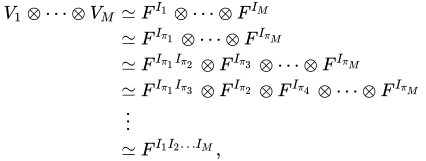
where
π
∈
S
M
{\displaystyle \pi \in {\mathfrak {S}}_{M}}


Coordinate representation
[edit]The first vector space isomorphism on the list above,
V
1
⊗
⋯
⊗
V
M
≃
F
I
1
⊗
⋯
⊗
F
I
M
{\displaystyle V_{1}\otimes \cdots \otimes V_{M}\simeq F^{I_{1}}\otimes \cdots \otimes F^{I_{M}}}








General flattenings
[edit]For any permutation
π
∈
S
M
{\displaystyle \pi \in {\mathfrak {S}}_{M}}


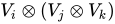
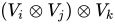



Letting
S
l
=
(
π
(
r
l
−
1
+
1
)
,
π
(
r
l
−
1
+
2
)
,
…
,
π
(
r
l
)
)
{\displaystyle S_{l}=(\pi (r_{l-1}+1),\pi (r_{l-1}+2),\ldots ,\pi (r_{l}))}







![{\displaystyle \mu _{l}:[I_{\pi (r_{l-1}+1)}]\times [I_{\pi (r_{l-1}+2)}]\times \cdots \times [I_{\pi (r_{l})}]\to [I_{S_{l}}]}](https://wikimedia.org/api/rest_v1/media/math/render/svg/4fd5c97ce5a02803b5dae06e96b9ed00b8191acb)



Vectorization
[edit]By means of a bijective map
μ
:
[
I
1
]
×
⋯
×
[
I
M
]
→
[
I
1
⋯
I
M
]
{\displaystyle \mu :[I_{1}]\times \cdots \times [I_{M}]\to [I_{1}\cdots I_{M}]}
![{\displaystyle \mu :[I_{1}]\times \cdots \times [I_{M}]\to [I_{1}\cdots I_{M}]}](https://wikimedia.org/api/rest_v1/media/math/render/svg/005640684f099e6c4b05ec93642cd1736d48fa43)







vec
(
A
)
=
[
a
1
,
1
,
…
,
1
a
2
,
1
,
…
,
1
⋯
a
n
1
,
1
,
…
,
1
a
1
,
2
,
1
,
…
,
1
⋯
a
I
1
,
I
2
,
…
,
I
M
]
T
,
{\displaystyle \operatorname {vec} ({\mathcal {A}})={\begin{bmatrix}a_{1,1,\ldots ,1}&a_{2,1,\ldots ,1}&\cdots &a_{n_{1},1,\ldots ,1}&a_{1,2,1,\ldots ,1}&\cdots &a_{I_{1},I_{2},\ldots ,I_{M}}\end{bmatrix}}^{T},}

which is consistent with the way in which the colon operator in Matlab and GNU Octave reshapes a higher-order tensor into a vector. In general, the vectorization of
A
{\displaystyle {\mathcal {A}}}
![{\displaystyle [a_{\mu ^{-1}(i)}]_{i=1}^{I_{1}\cdots I_{M}}}](https://wikimedia.org/api/rest_v1/media/math/render/svg/d8f1b92342de22f26a044a17b8cc5db8625bd850)
The vectorization of
A
{\displaystyle {\mathcal {A}}}

![{\displaystyle {\mathcal {A}}_{[:]}}](https://wikimedia.org/api/rest_v1/media/math/render/svg/454916891403f1264e6f6208d444c8f60262a56c)
![{\displaystyle [S_{1},S_{2}]}](https://wikimedia.org/api/rest_v1/media/math/render/svg/955122d5f3a15ddbfb277532dc2f113b762aa4bb)


Mode-m Flattening / Mode-m Matrixization
[edit]Let
A
∈
F
I
1
⊗
F
I
2
⊗
⋯
⊗
F
I
M
{\displaystyle {\mathcal {A}}\in F^{I_{1}}\otimes F^{I_{2}}\otimes \cdots \otimes F^{I_{M}}}



A
[
m
]
=
A
[
S
1
,
S
2
]
{\displaystyle {\mathbf {A} }_{[m]}={\mathcal {A}}_{[S_{1},S_{2}]}}
![{\displaystyle {\mathbf {A} }_{[m]}={\mathcal {A}}_{[S_{1},S_{2}]}}](https://wikimedia.org/api/rest_v1/media/math/render/svg/5348d48b787eb9e1e8fca0bacf1359ab5113b9df)
This reshaping is sometimes called matrixizing, matricizing, flattening or unfolding in the literature. A standard choice for the bijections
μ
1
,
μ
2
{\displaystyle \mu _{1},\ \mu _{2}}

A
[
m
]
:=
[
a
1
,
1
,
…
,
1
,
1
,
1
,
…
,
1
a
2
,
1
,
…
,
1
,
1
,
1
,
…
,
1
⋯
a
I
1
,
I
2
,
…
,
I
m
−
1
,
1
,
I
m
+
1
,
…
,
I
M
a
1
,
1
,
…
,
1
,
2
,
1
,
…
,
1
a
2
,
1
,
…
,
1
,
2
,
1
,
…
,
1
⋯
a
I
1
,
I
2
,
…
,
I
m
−
1
,
2
,
I
m
+
1
,
…
,
I
M
⋮
⋮
⋮
a
1
,
1
,
…
,
1
,
I
m
,
1
,
…
,
1
a
2
,
1
,
…
,
1
,
I
m
,
1
,
…
,
1
⋯
a
I
1
,
I
2
,
…
,
I
m
−
1
,
I
m
,
I
m
+
1
,
…
,
I
M
]
{\displaystyle {\mathbf {A} }_{[m]}:={\begin{bmatrix}a_{1,1,\ldots ,1,1,1,\ldots ,1}&a_{2,1,\ldots ,1,1,1,\ldots ,1}&\cdots &a_{I_{1},I_{2},\ldots ,I_{m-1},1,I_{m+1},\ldots ,I_{M}}\\a_{1,1,\ldots ,1,2,1,\ldots ,1}&a_{2,1,\ldots ,1,2,1,\ldots ,1}&\cdots &a_{I_{1},I_{2},\ldots ,I_{m-1},2,I_{m+1},\ldots ,I_{M}}\\\vdots &\vdots &&\vdots \\a_{1,1,\ldots ,1,I_{m},1,\ldots ,1}&a_{2,1,\ldots ,1,I_{m},1,\ldots ,1}&\cdots &a_{I_{1},I_{2},\ldots ,I_{m-1},I_{m},I_{m+1},\ldots ,I_{M}}\end{bmatrix}}}
![{\displaystyle {\mathbf {A} }_{[m]}:={\begin{bmatrix}a_{1,1,\ldots ,1,1,1,\ldots ,1}&a_{2,1,\ldots ,1,1,1,\ldots ,1}&\cdots &a_{I_{1},I_{2},\ldots ,I_{m-1},1,I_{m+1},\ldots ,I_{M}}\\a_{1,1,\ldots ,1,2,1,\ldots ,1}&a_{2,1,\ldots ,1,2,1,\ldots ,1}&\cdots &a_{I_{1},I_{2},\ldots ,I_{m-1},2,I_{m+1},\ldots ,I_{M}}\\\vdots &\vdots &&\vdots \\a_{1,1,\ldots ,1,I_{m},1,\ldots ,1}&a_{2,1,\ldots ,1,I_{m},1,\ldots ,1}&\cdots &a_{I_{1},I_{2},\ldots ,I_{m-1},I_{m},I_{m+1},\ldots ,I_{M}}\end{bmatrix}}}](https://wikimedia.org/api/rest_v1/media/math/render/svg/e1231e2f5eed3aa2b17d8553b7785f9f6a7c863c)
Definition Mode-m Matrixizing:[1]
[
A
[
m
]
]
j
k
=
a
i
1
…
i
m
…
i
M
,
where
j
=
i
m
and
k
=
1
+
∑
n
=
0
n
≠
m
M
(
i
n
−
1
)
∏
l
=
0
l
≠
m
n
−
1
I
l
.
{\displaystyle [{\mathbf {A} }_{[m]}]_{jk}=a_{i_{1}\dots i_{m}\dots i_{M}},\;\;{\text{ where }}j=i_{m}{\text{ and }}k=1+\sum _{n=0 \atop n\neq m}^{M}(i_{n}-1)\prod _{l=0 \atop l\neq m}^{n-1}I_{l}.}
![{\displaystyle [{\mathbf {A} }_{[m]}]_{jk}=a_{i_{1}\dots i_{m}\dots i_{M}},\;\;{\text{ where }}j=i_{m}{\text{ and }}k=1+\sum _{n=0 \atop n\neq m}^{M}(i_{n}-1)\prod _{l=0 \atop l\neq m}^{n-1}I_{l}.}](https://wikimedia.org/api/rest_v1/media/math/render/svg/ed2f6b47cbf1e55ad6b59fc2469c28de1fb09701)
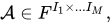
![{\displaystyle {\mathbf {A} }_{[m]}\in F^{I_{m}\times (I_{1}\dots I_{m-1}I_{m+1}\dots I_{M})}}](https://wikimedia.org/api/rest_v1/media/math/render/svg/d78104d10c5567d7da3a1a01e4f65a398f854e46)
References
[edit]- ^ Vasilescu, M. Alex O. (2009), "Multilinear (Tensor) Algebraic Framework for Computer Graphics, Computer Vision and Machine Learning" (PDF), University of Toronto, p. 21