This is the talk page for discussing improvements to the Mathematics article. This is not a forum for general discussion of the subject of the article.
Mathematics was one of the Mathematics good articles, but it has been removed from the list. There are suggestions below for improving the article to meet the good article criteria. Once these issues have been addressed, the article can be renominated. Editors may also seek a reassessment of the decision if they believe there was a mistake.
This article is within the scope of WikiProject Mathematics, a collaborative effort to improve the coverage of mathematics on Wikipedia. If you would like to participate, please visit the project page, where you can join the discussion and see a list of open tasks.MathematicsWikipedia:WikiProject MathematicsTemplate:WikiProject Mathematicsmathematics
This article is within the scope of WikiProject Statistics, a collaborative effort to improve the coverage of statistics on Wikipedia. If you would like to participate, please visit the project page, where you can join the discussion and see a list of open tasks.StatisticsWikipedia:WikiProject StatisticsTemplate:WikiProject StatisticsStatistics
Brief subsection for mathematicians as a subculture / in pop-culture?
Requests and metadata
There is a request, submitted by [[User:Sdkb|Sdkb]] ([[User talk:Sdkb|talk]]), for an audio version of this article to be created. For further information, see WikiProject Spoken Wikipedia.
The rationale behind the request is: Level-1 vital article.
The Definition of Mathematics in the First Sentence Doesn't Define Mathematics
This article used to contain a more accurate and simplified definition of mathematics in the summary (the first sentence). Checking Merriam-Webster, Cambridge, Dictionary.com and Britannica.com will show that these (among other) generally accepted lexicographers all define mathematics as something very similar to "the scientific study of space, structure, quantity and change", or words very similar to those. This is also what Wikipedia used to define it as, but since I last consulted the article, it has changed the definition to "a field of study that discovers and organizes methods, theories and theorems for various sciences . . ." This is too abstract; it doesn't even describe what types of methods or theorems mathematics discovers or organizes.
At the very least, any definition of the term should include the fact that the subject involves quantities and the relationships among them. I'm not saying the definition is completely incorrect, but it isn't specific enough to describe what mathematics is, and rather only describes a part of what abstract or pure mathematicians do. TheLibrivore (talk) 11:33, 17 November 2025 (UTC)[reply]
The problem with attempting to define mathematics is that no one in the history of the world has been successful at this. Why would the first sentence of the article succeed where everyone else has failed? Tito Omburo (talk) 11:36, 17 November 2025 (UTC)[reply]
In my opinion, in this definition:
Mathematics is a field of study that discovers and organizes methods, theories, and theorems that are developed and proved for the needs of empirical sciences and mathematics itself.
"that are developed and proved" can be omitted, which yields:
Mathematics is a field of study that discovers and organizes methods, theories, and theorems for the needs of empirical sciences and mathematics itself.
A lot of mathematics is developing methods and proving (or disproving) conjectures. So, the definition should keep proved or say something about proofs. EulerianTrail (talk) 15:15, 17 November 2025 (UTC)[reply]
How is this one?
Mathematics is a field of study that discovers, develops, organizes and proves methods, theories, and theorems for the needs of empirical sciences and mathematics itself.
A side from that, I think this definition lacks "Concepts". For example, "number" and "shape", "circle", "rectangle" etc. are concepts, neither method, not theory, nor theorem. But they are concepts. So I propose:
Mathematics is a field of study that discovers, develops, organizes and proves concepts, methods, theories, and theorems for the needs of empirical sciences and mathematics itself.
The first sentence of the article is not intended to be a definition. We have a Proposed Definitions section later.
We have argued about the first sentence incessantly for years on this talk page. Writing an opening sentence that is verifiable, correct, concise, and thorough is extremely difficult. For example, I object that the current opening sentence (and the amended version proposed by Hooman Mallahzadeh) also applies to computer science and statistics. Mgnbar (talk) 15:41, 17 November 2025 (UTC)[reply]
I have linked "proved" to mathematical proof. So, the opening sentence applies to computer science and statistics only when mathematical proofs are involved. A work in computer science or statistics that involves mathematical proofs belongs to both mathematics and computer science or mathematics. By the way, I'll link theorem also. D.Lazard (talk) 19:14, 17 November 2025 (UTC)[reply]
Links are not supposed to change or enhance the meaning of the text. You provide the links as a courtesy for people who want to know more, not to clarify what the words mean. You always have to assume that the links will not be followed. --Trovatore (talk) 19:54, 17 November 2025 (UTC)[reply]
Computer science and statistics are both branches of mathematics. (Especially those parts of them involved with defining and proving theorems about abstract objects.) They are split into separate academic departments for practical reasons: they are large, have wide practical application, and their students are not expected to have general expertise in all areas of pure mathematics to the level of "pure mathematics" students. –jacobolus(t)20:27, 17 November 2025 (UTC)[reply]
I think more to the point, the lead sentence and lead paragraph are meant to describe mathematics, not to demarcate it from everything that is not mathematics. We don't have to take a position on whether computer science is or is not mathematics. --Trovatore (talk) 20:39, 17 November 2025 (UTC)[reply]
In my opinion, this definition lacks the adjective "abstract", and I propose this definition:
Mathematics is a field of study that discovers and organizes abstract methods, theories, and theorems that are developed and proved for the needs of empirical sciences and mathematics itself.
@D.Lazard: Hi, and sorry for pinging you. In fact, much of mathematics is about mathematical objects (which is an umbrella term for numbers, expressions, shapes, functions, and sets etc.) and their properties. But we see nothing about that in this definition. I really propose to include that. Thanks, Hooman Mallahzadeh (talk) 14:59, 19 November 2025 (UTC)[reply]
@Jacobolus Yes, it is mentioned there. But we need that in definition. I personally would define mathematics as:
Mathematics is a set of primitive notions and derived objects that have properties that are proved by methods, theories and theorems from primitive ones.
@Hooman Mallahzadeh Before continuing, I would recommend you spend some time reading all of the discussions about the lead section of this article from the past few years. If you want, you can also read discussions going back further than that. –jacobolus(t)19:20, 19 November 2025 (UTC)[reply]
I agree with Jacobulus. The current first sentence is a compromise resulting from many discussions on this talk page, and I guess that nobody is fully satisfied with it. Personally, I would suggest
Such a first sentence has the advantage of getting rid of WP:weasel words ("field of study", "organizes methods"), of not excluding any area of mathematics, and of distinguishing mathematics from other sciences and fields of study.
I have a little hope that this formulation could get a consensus, but, if a discussion on the first sentence is opened again, this suggestion must be taken into account. D.Lazard (talk) 15:55, 20 November 2025 (UTC)[reply]
My view continues to be: The opening sentence is not a definition. We should improve it, to make it clear that it is not even trying to be a definition. Mgnbar (talk) 18:37, 20 November 2025 (UTC)[reply]
As significant as mathematics is, there should be an image in the introduction of the article to represent it. Are there any thoughts as to what it should be? I am thinking a visual proof, or a fractal, or something else that is simple but still is representative of mathematics. EulerianTrail (talk) 22:33, 26 November 2025 (UTC)[reply]
No image exists which meets this criterion. For pure flair, an image could be added, say, of Archimedes pondering his orbs, but I struggle to see the relevance of such an image. 23:53, 26 November 2025 (UTC)— Preceding unsigned comment added by Tito Omburo (talk • contribs) 00:53, 27 November 2025 (UTC)[reply]
As said below, the removed image meets perfectly this criterion. Moreover, this image contains both formulas and geometric figures, which is much better than an image containing only figures or only formulas. D.Lazard (talk) 15:57, 27 November 2025 (UTC)[reply]
You removed an image of a mathematician reasoning about formulas on a blackboard, because you believe that it illustrates "the Galton–Watson process of probability theory". I congratulate you to be able to recognize this, but I think that that this will not be the case for most readers. Persomally, I was only able to guess that it was about probabilities, because of the notation
E
(
⋯
)
{\displaystyle E(\cdots )}
, but I was not sure, because this notation has other uses in mathematics.
Since reasonning on formulas is the core of mathematics, I consider that this image illustrates well the whole mathematics and I strongly suggest to restore the image. D.Lazard (talk) 15:42, 27 November 2025 (UTC)[reply]
Mathematics Barnstar
As you stated in the changelog "the first image must not be specific to an area of mathematics" which the image you are referring to was added recently by @Fgnievinski and is in probability theory. Thus, that image is not representative of the whole of mathematics and it is unfamiliar to most readers including yourself as you mentioned. Which you stated in the changelog as a reason not to include an image in the lead when I added a geometric visualization of Euler's formula to which you stated many readers are not familiar with complex numbers.
A possible image could be a photomontage of various math symbols and objects just like the math barnstar. I would be willing to do this and include a variety of symbols and objects. EulerianTrail (talk) 16:47, 27 November 2025 (UTC)[reply]
I think this is all missing the point. An image is supposed to convey something encyclopedic. It is not decoration. An image is not required, and no image adequately conveys (or sheds any light on) the subject of the article. Tito Omburo (talk) 17:47, 27 November 2025 (UTC)[reply]
The main purpose of the lead image is to "allow readers to quickly assess if they have arrived at the right page" MOS:LEADIMAGE and to be representative of the subject. It may very well be that for this article no image is better since any individual image becomes too specific, but that is why I suggested a photomontage. EulerianTrail (talk) 18:02, 27 November 2025 (UTC)[reply]
I really don't think we need an image for that purpose at the "mathematics" article. I strongly prefer continuing not to have a lead image. --Trovatore (talk) 18:21, 27 November 2025 (UTC)[reply]
@Trovatore We should consider the needs of the audience over the preference of editors, especially if the editors are experts and the audience is mainly non-expert. (Experts in math education excepted.)
The proposed image, of a person writing mathematics on a chalkboard, is representative of the common practice of mathematics. Most readers won't understand the content on the chalkboard, unless we choose a really simple expression, such as "1+2". But that is unnecessary as the content is irrelevant, since the image seeks to illustrate the process of doing math, not its result (which wouldn't fit on a chalkboard anyways). fgnievinski (talk) 13:43, 1 December 2025 (UTC)[reply]
I don't think a lead image is necessary per se, but the chalkboard image does suggest the good point that we should discuss in much more detail about the basic tools and methods used for mathematics, perhaps under § Symbolic notation and terminology or § Training and practice, or in a new section, where it can be mentioned that e.g. mathematics routinely involves graphical manipulation of symbolic notation and/or diagrams (typically with pen and paper or a chalkboard), used to represent abstract objects; that the historical format for presenting mathematical knowledge for over 2 millennia has been lectures with supporting diagrams and notation, including not only school lectures but also lectures targeted to an expert audience (e.g. today at conferences); that work is also shared through research papers, monographs, and textbooks; that mathematical training and practice throughout history has involved posing and solving of contrived problems, ranging from easy problems given as schoolwork to very difficult problems posed as a challenge to the top experts.
Our current discussion of all of these topics is non-existent or limited, with some brief mentions in passing that assume that readers already basically know what mathematics is like, as a practice, and that do a very poor job conveying it to an unfamiliar audience. We only have such examples as "In mathematics, the experimentation may consist of computation on selected examples or of the study of figures or other representations of mathematical objects (often mind representations without physical support)", "Euclid organized mathematical knowledge by way of postulates and first principles, which evolved into the axiomatic method that is used in mathematics today, consisting of definition, axiom, theorem, and proof. His book, Elements, is widely considered the most successful and influential textbook of all time", "many important mathematical results (theorems) are solutions of problems that other mathematicians failed to solve, and the invention of a way for solving them may be a fundamental way of the solving process" but there is no further context or elaboration about any of these. The word "diagram" is not mentioned except without explanation in a couple of captions (and no synonyms like "figure" or "drawing" are used anywhere). The only mention of graphing functions comes in "Analytic geometry allows the study of curves unrelated to circles and lines. Such curves can be defined as the graph of functions, the study of which led to differential geometry. They can also be defined as implicit equations, often polynomial equations (which spawned algebraic geometry). Analytic geometry also makes it possible to consider Euclidean spaces of higher than three dimensions."
It would be appropriate to include quite a few relevant images of mathematicians doing work or of mathematical work itself in such sections, whether or not an image goes in the lead. –jacobolus(t)21:36, 27 November 2025 (UTC)[reply]
The image that was removed seems to meet the requirements of MOS:LEADIMAGE. It gives the reader an indication that they landed in the right place, it's neutral and not shocking. It also humanizes a very abstract subject. Perhaps there are better lead images, but this one is at worst harmless and does not violate any policy or guideline. It should It should not have been removed without discussion. I am restoring it pending a consensus for change.--agr (talk) 22:05, 1 December 2025 (UTC)[reply]
I think the concern whether a reader has "landed in the right place" seems unserious. This is the article on mathematics. Any (hypothetical, possibly non-existent) reader unsure about this is unlikely to be satisfied by an abstract martingale calculation at a blackboard. So this invocation of LEADIMAGE strikes me as unserious.
I think the concern being raised is not literally whether a reader knows they have “landed in the right place,” but whether the lead image meets the requirement in MOS:LEADIMAGE that it be representative of the subject as a whole. That is the actual guideline at issue.
For a topic as broad and abstract as mathematics, a photograph of a single person performing a very specific, concrete activity does not satisfy that requirement. Mathematics comprises logic, proof, abstraction, structure, quantity, geometry, analysis, algebra, and many other domains that have no visual resemblance to a chalkboard computation. Using an image of one practitioner performing one narrow task inevitably privileges that activity as emblematic of the field, which is precisely what LEADIMAGE cautions against.
So the invocation of MOS:LEADIMAGE here is not about hypothetical confused readers; it is about representational scope. On that criterion, the image does not meet the guideline. Tito Omburo (talk) 23:20, 1 December 2025 (UTC)[reply]
I would add, to Arnold's point about not removing the image without discussion, that the image was a recent addition. It's not as though someone modified the article's stable version by removing a longstanding image; it's the reverse. --Trovatore (talk) 21:52, 2 December 2025 (UTC)[reply]
I searched Wikimedia Commons for "Mathematics" and there are a few images that might work. The first one that jumped out to me was the women teaching geometry image. Failing this, maybe a famous figure from a math text.
Likely represents Sophia/logos (red robe with purple high status) Illumination of P Pythagoria Pi and phi - geometrical shapes set within circle bounded in green representing material worldGeogSage (⚔Chat?⚔) 22:50, 3 April 2026 (UTC)[reply]
I am not sure why we are having this edit war. We seem to be divided about fifty fifty. Maybe we need to give more people a chance to weigh in. I note that the articles computer science and statistics both have images at the top of the page, I suspect most articles on major academic subjects do. I favor adding an image at the top of the page, and am at a loss to understand why some people object so strongly. Rick Norwood (talk) 20:38, 3 December 2025 (UTC)[reply]
My view is that there are probably a lot of articles that have lead images "just because", and for which a lead image is not really useful. I don't think we should follow that trend without having a better reason than that.
A couple of other cases of similar breadth: Philosophy has a lead image but it's a statue of a thinker. I don't think that's really particularly relevant to philosophy, and I can imagine it being seen as "problematic" on cultural grounds, not that I personally pay a lot of attention to that stuff but it's not a fight I want to pick. Science has no lead image per se, though there's a stylized picture of an atom in the navbox for the series on science. I would get rid of that one too, as not sufficiently representative of science in general. --Trovatore (talk) 21:56, 3 December 2025 (UTC)[reply]
There were historically two older images that were lead images being The School of Athens painting zoomed in on Euclid and a math formula (formulas are bad images since they can just be type for accessibility). EulerianTrail (talk) 04:24, 4 December 2025 (UTC)[reply]
I was looking at the article and other level-1 vital topics for another discussion below. What puzzled me for a while was an image of a globe reading a newspaper which appeared at top right (pictured). This seems incongruous and I wondered whether it was vandalism or an April Fool. Clicking on it didn't seem to do anything or provide a clue what it was. After some research, my impression is that it's the baby globe mascot created for the 25th anniversary of Wikipedia and that it's some kind of easter egg. I'd like to get rid of it but I'm not sure how.
The absence of a lead image for the Mathematics article makes the matter worse visually as it then appears that the baby globe is the lead image, which looks weird.
Checking the equivalent articles in other languages such as French, German and Spanish, I find that they all have proper lead images. The English language version thus seems perverse and persnickety. Tsk.
The appearance menu (accessed from the spectacles icon or sidebar) allows the baby globe to be turned off. Having dispensed with that, I plan to try some more images. I found some good inspiration at Portal:Mathematics/Featured picture archive and mathematics and art. As a benchmark, let's start by displaying the image that was the lead picture from 2006 to 2021 – Euclid by Raphael. Andrew🐉(talk) 18:09, 3 April 2026 (UTC)[reply]
Comment. This discussion seems a little unfocused, having gone through several waves of debate fairly haphazardly. I would strongly support the image File:Woman_teaching_geometry.jpg suggested above as ideal for the lede. Several reasons that come to mind are:
it shows mathematical shapes and implements that will be recognizable without overwhelming the viewer with specificity;
the activities shown are more recognizably schematic rather than narrowly specific, as the image of the blackboard filled with specialized notation was;
it presents mathematics as a human activity (particularly a social and pedagogical on) rather than a specific object, aligning with the broad scope of the article and topic;
it avoids the strong stylistic framing of Renaissance or allegorical paintings, where mathematics is often secondary to artistic or symbolic concerns;
the allegorical aspect of the illumination is philosophically relevant to the topic (in this case the Platonic interpretation) but restrained, and does not force that ontology onto the viewer;
it shows the role of teaching and transmission in mathematics;
it includes representation (in this case women in mathematics) without making that the focus;
it does not show recognizable historical figures (like Archimedes) that would unduly narrow the scope;
I went ahead and added the image suggested above. While there wasn't anything like consensus for any particular image, there does seem broadly to be consensus for an image, so I thought it useful to boldly cut the gordian knot. Sławomir Biały (talk) 07:09, 4 April 2026 (UTC)[reply]
I don't find that image beautiful but it is a reasonable choice. Additional reasons include:
It comes from an edition of Euclid's Elements which is a famous foundational work of mathematics
It is antiquated and so shows the deep roots and tradition of mathematics as a formal topic
It is a featured picture on Commons and so is technically approved as excellent
Why do we need a lead image in the first place? It's not like someone will visit the page and not know it's about the field of mathematics unless there is a lead image. Again, any lead image, especially in an article about a field as broad as mathematics, will appear to heavily skew the lead to one area of mathematics Mechanikin (talk) 05:04, 8 April 2026 (UTC)[reply]
This image was selected for a variety of reasons, enumerated above. Several of the reasons: it does not unduly bias to one area of mathematics, it is not overtly allegorical (and the allegory it does present subtly is one of the major philosophical views of mathematics), it includes representation in mathematics (women in mathematics), it shows mathematics as a human activity and includes one such activity prototypical of mathematical practice (teaching, but only in a fairly coded way), it is a featured image, it has historical depth. Other proposed lede images, by contrast, are either very allegorical, illustrate recognizable historical figures, or show very specialized activities such as specific calculations in probability theory. While the image is grounded in geometry, that is historically the most accessible and widely recognizable form of mathematics, and it is presented here in a schematic way rather than as a specialized subfield. This makes it less narrowly scoped than images tied to modern technical notation. Per MOS:LEADIMAGE, the lead image should be representative of the topic as a whole and not overly specific. For a subject as broad as mathematics, perfect representativeness is not achievable, so the relevant standard is whether the image is less specific and less misleading than the alternatives, and how much of the overall picture it conveys. This image ticks a lot of boxes. Sławomir Biały (talk) 05:17, 8 April 2026 (UTC)[reply]
It is impossible for one to accurately generalize the intent of one who visits the article, even with specificity as low as the broad region of mathematics that is being looked for, and thus how the lead image, if it exists, will affect one's judgement on what the field of mathematics is about is and should be, in my honest opinion, of relatively low importance (accounting for the fact that any visitor of this page has, within their capacity, at least a rough idea of what mathematics is, and will not judge the field solely based on one image), thus, the excessive effort in deciding, and discussion about whether or not there should be a lead image, what the lead image should be, and the specific image(s) chosen that depict humans engaging in mathematics rather than the concept of mathematics itself (which, from a modern point of view, would be sufficed for by depicting the process of deductive reasoning and the axiomatic foundations of set theory, which all of mathematics is based on), is a signal of the article being treated as a museum specimen or a fine art piece rather than an encyclopedic article with the sole purpose of conveying academic information to those willing to learn. Mechanikin (talk) 07:40, 8 April 2026 (UTC)[reply]
The image does in fact cover several of the aspects being discussed. The history of mathematics is alluded through reference to Euclid's Elements. The teaching of mathematics is depicted. Philosophical interpretations of mathematics are suggested through the allegorical elements (Sophia inscribing mathematics in the world). Foundational and exploratory aspects of mathematics are both represented through Euclidean construction and geometric reasoning. (It also avoids the familiar pattern of representing mathematics only through named male figures that is common in Renaissance art for example.) I would also dispute the characterization of "the concept of mathematics" as essentially deductive reasoning grounded in set theory. That is one important modern perspective, but it is much narrower than the scope of the article, which explicitly includes history, pedagogy, social and cultural aspects, philosophy, and a wide range of mathematical practices (including diagrammatic and geometric reasoning). A lead image should not privilege one such perspective to the exclusion of the others. Mathematics is also a human activity, and the image makes that visible without tying it to any one modern specialty. No single image can represent the whole field, but this one captures multiple dimensions of it in a way that is broader and less specialized than the alternatives discussed above. Sławomir Biały (talk) 08:34, 8 April 2026 (UTC)[reply]
My feeling is that we need an image that clearly describes how mathematicians perform research and this image characterizes it better than any other. But it is not available in Commons, so I think we should keep what you already placed there. Yesterday, all my dreams... (talk) 08:47, 8 April 2026 (UTC)[reply]
Lol. I like the one with "and a miracle happens", with the other mathematician saying "you might want to be more explicit in step 3". Reminds me of an anecdote a Romanian friend told me: two mathematicians are discussing a proof step; one says its trivial; the other goes off and sits in their office alone for a few hours, comes back, and says "yes, it's trivial". Sławomir Biały (talk) 09:03, 8 April 2026 (UTC)[reply]
I believe this image of mathematical symbols is broad enough to function as a lead image. If we wanted to add additional symbols, then I would be willing to do so.MathematicsEulerianTrail (talk) 13:05, 8 April 2026 (UTC)[reply]
Likewise, mathematics is not an Illumination P. The current image is heavily biased towards geometry. Also, if you want a women teaching mathematics and wanted to show diversity then an image a women teacher and children of both genders is better than a group of monks with a personification of a subject as a fictional women. EulerianTrail (talk) 13:27, 8 April 2026 (UTC)[reply]
The point is that the lead image should reflect, as far as possible, the scope and breadth of the subject. For an article as broad as mathematics, that includes not only particular subfields, but also history, pedagogy, philosophy, cultural transmission, visual and diagrammatic practice, exploration, and deductive reasoning. No single image can literally depict all of that, so the relevant question is comparative: which image is less narrow and less misleading as a representation of the topic as a whole? On that standard, a collage of symbols smashed into a pane does not seem adequate. I'm also happy to consider your alternative image proposal. It shows a woman teaching grammar in front of a class of young children. I do not think this is a good image, because it does not illustrate the history, philosophy, cultural transmission, visual practice, or deductive method associated with mathematics. Perhaps you feel it is more suitable than it seems to me, but I think you should clarify the reasons. Sławomir Biały (talk) 13:42, 8 April 2026 (UTC)[reply]
First of all, that is not clear from the image. There is a drawing of a house on the board and what appear to be letters. Secondly, that is responsive to "history, philosophy, cultural transmission, visual practice, or deductive method"... how? Sławomir Biały (talk) 13:48, 8 April 2026 (UTC)[reply]
I would like to be provided an outline of the disadvantages of not having a lead image in this article. It seems that the inclusion of any lead image is the cause of much disagreement Mechanikin (talk) 13:54, 8 April 2026 (UTC)[reply]
If a lead image is needed. I think it is best to give much discussion before plopping an image into the article. The current image is extremely biased to a 14th century view and geometry. The image might be useful for a history of geometry article but not of mathematics. I only shared the teaching image since it seemed to fit better your goals of a lead image than the one you placed in the article.
Would it be nice to have a lead image? Probably, but is it necessary. I think the current consensus is leaning toward image, but we have not completed this discussion.
Assume we reach consensus to have a lead image, what should it be? This discussion needs to take place, where we find an image that is both representative of mathematics and is not confusing to a reader upon landing on the page. The 14th century image is like using the lizard image for the page dinosaur. Hylaeosaurus
I think the page Dinosaur might actually have the solution we need for the mathematics article. Instead of a lead image, they have a collection of images in the infobox showing different dinosaurs. I think we should do something similar and have different mathematical topics be represented as images in the infobox: teaching, history (The School of Athens is a good choice), topology, graph theory, probability, number theory, geometry, algebra. EulerianTrail (talk) 14:22, 8 April 2026 (UTC)[reply]
This is a good idea. It is also what the wikipedia page Physics does for its lead. It's not a single image, but different images showing different areas of physics. I think that without adhering to a purist view of mathematics (that is, it's nothing except deductive reasoning from axioms), deciding what a lead image should be is messy.
Either we have a lead with multiple images showing different areas of mathematics, or we decide not to have a lead image. I am thoroughly unconvinced of the idea that the current lead image (the woman teaching geometry) is in any way better than not having a lead image at all. Again, this article is an encyclopedic text, not a cultural artefact. Mechanikin (talk) 14:38, 8 April 2026 (UTC)[reply]
I think the first two images would be more suited for a 'history of mathematics' and a 'mathematics pedagogy' page than this. The last image you provided is merely a symbol. Similar to the physics page (where the order of the images is from classical mechanics, to thermodynamics, to electricity, then modern physics etc. in the order of better theories), a good lead image of mathematics would start from set theory, to order theory, to abstract algebra, to mathematical analysis, to general topology, to measure theory, to probability theory, and maybe applied mathematics; in that general direction. A historical depiction of geometry loses focus of what mathematics is, and a classroom teaching mathematics focuses a bit too much on pedagogy and less on the logical hierarchy of mathematics Mechanikin (talk) 15:00, 8 April 2026 (UTC)[reply]
There is mathematics education that stands as its own field in mathematics. Likewise, history of mathematics is a common subject covered in many schools, and it would be neglectful to leave out some representation for it. I really like the magma to group diagram, die, and topology mug images as recognizable and representative images. For the others, I am sure there are better images, I just put this together as a starting point. EulerianTrail (talk) 15:26, 8 April 2026 (UTC)[reply]
Yeah, I don't like this idea of showing multiple images. Someone suggested an image, fine. But if there isn't a single image that gets consensus, I don't see how 5 images will: it just creates needless visual bloat. Most readers will expect an image of something. It might as well be an image that shows multiple aspects of the subject: mathematics in art, history, pedagogy, experimentation, philosophy, and reasoning. Jacobolus's image below is interesting, in that it shows mathematics in commerce, science, and the Arab world, all of which are worthy things of an image. But I think the mathematical content is too hard to discern, without very close examination. I think a wider RfC might be useful. Mechanikin's suggestion that perhaps having no image is the best solution, could also be an option there (I realize they may not hold this view, but did put it out as a suggestion). Sławomir Biały (talk) 13:24, 9 April 2026 (UTC)[reply]
Interesting item about math instruments. Thanks for pointing it out. I had forgotten about it altogether. The German article mentions calculators and computers as such. Are they? Supercomputers? I will add a few "further reading" items for now given that excellent sources exist. Yesterday, all my dreams... (talk) 13:07, 9 April 2026 (UTC)[reply]
I would leave out any significant discussion of calculators and computers and focus on "analog" instruments, since by the time of computers I don't think the term had much of any use. Among more recently used tools, could perhaps include nomograms, slide rules, the stereographic Wulff net, etc. But for many centuries there were competing approaches to solving many practical problems: an arithmetical approach involving pen-and-paper calculations with heavy use of table lookups and an "instrumental" approach involving measuring with dividers on various scales, etc. The "instrumental mathematics" has been substantially erased from historical summary of mathematics even though it was probably more practically important at the time and was tremendously influential on more "theoretical" mathematicians. –jacobolus(t)19:52, 9 April 2026 (UTC)[reply]
Given that you obviously know more about the history of those, you should fix that page rather than instructing me how to do it. But I don't agree with the computer issue. Even recently Wolfram was pushing for that and part of the negative response to him was due to the new kind of arrogance in the presentation. And the overlap was closer than you suggest. When l was taking my 2nd year undergrad classes in math (before most of you were born) we were not allowed to use handheld calculators in exams. In fact I had never used a calculator because I could do a lot in my head in those days. But a professor got me an account on the newly installed supercomputer to test his ideas about prime numbers. So we were using supercomputer but not calculators. The computer was an instrument. I continued to use supercomputers for a few more decades and saw them as tools. Yesterday, all my dreams... (talk) 20:48, 9 April 2026 (UTC)[reply]
Sorry, I'm not trying to tell anyone what to do. I do have a medium/long-term goal to improve that page and other related pages. –jacobolus(t)22:40, 9 April 2026 (UTC)[reply]
16th century "mathematicians" and "astronomers" were basically the same group. Earlier as well: you can feel free to call Eudoxus, Eratosthenes, Euclid, Apollonius, Archimedes, Hipparchus, Theodosius, Menelaus, Ptolemy, etc. either "astronomers" or "mathematicians" based on personal preference, both descriptions are accurate. And for that matter this was still true to a substantial degree for a few centuries afterward as well. –jacobolus(t)19:34, 9 April 2026 (UTC)[reply]
"Mathematics is a field of study that discovers and organizes methods, theories, and theorems that are developed and proved for the needs of empirical sciences and mathematics itself."
The word isn't really defined, and to make matters worse, the sentence ends by saying that mathematics serves mathematics. I don't pretend to know better, but I think an opening sentence should put more effort into defining the word itself, and it definitely shouldn't include the word itself in its attempt at a definition.
Perhaps a little more attention needs to be devoted to this first part of the article, which is the most crucial in providing the essential information a reader wants to know. Sure, everybody knows what mathematics is, but its a hard thing to define and anyone looking for a formal definition will be disappointed in this article. Endangeredreader (talk) 19:07, 22 December 2025 (UTC)[reply]
I don't really disagree with you, but you have to understand that massive effort has been put into the opening sentence. You can read about it on this talk page and its archives. Agreeing on a definition of mathematics is difficult, and people have a lot of conflicting goals for the opening sentence, and what you're currently seeing is the result of painful compromise.
I agree that this first sentence is poor. Its reference to empirical science seems to be recentism. The basics of mathematics are grounded in everyday life -- measuring and counting for practical purposes such as administration, business, crafts, trade, navigation and so forth. Let's see how it compares with the versions in other languages:
French: Les mathématiques (ou la mathématique) sont un ensemble de connaissances abstraites résultant de raisonnements logiques appliqués à des objets divers tels que les ensembles mathématiques, les nombres, les formes, les structures, les transformations, etc. ; ainsi qu'aux relations et opérations mathématiques qui existent entre ces objets.
(Mathematics (or mathematical theory) is a body of abstract knowledge resulting from logical reasoning applied to various objects such as mathematical sets, numbers, shapes, structures, transformations, etc.; as well as to the mathematical relations and operations that exist between these objects.)
German: Die Mathematik (bundesdeutsches Hochdeutsch: [matemaˈtiːk], [matemaˈtik]; österreichisches Hochdeutsch: [mateˈmaːtik];[1] von altgriechisch μαθηματικὴ [τέχνη] mathēmatikē [téchnē] „Kunst des Lernens“) ist eine Formalwissenschaft, die aus der Untersuchung von geometrischen Figuren und dem Rechnen mit Zahlen entstand.
(Mathematics (... from Ancient Greek μαθηματικὴ [τέχνη] mathēmatikē [téchnē] “art of learning”) is a formal science that arose from the study of geometric figures and calculation with numbers.)
Both seem better than the current English version. The French version lists major components while the German gives its historical origin.
I don't think the reference to empirical science is "recentist". Historically, mathematics developed in close interaction with astronomy, mechanics, physics, and other sciences, just as it also developed from practical activities such as counting, measurement, administration, and trade. So I would not want the lead to suggest that mathematics arose only from geometry and arithmetic in a narrow sense, as the foreign wikis do. That said, I agree that the present opening sentence is not ideal. I also think "formal science", while defensible, has been contentious here and is probably not the best place to start. Likewise, I do not like defining mathematics as a mere "body of abstract knowledge": mathematics is not only a collection of results, but also an activity of (among other things) reasoning, abstraction, and proof. Sławomir Biały (talk) 11:43, 4 April 2026 (UTC)[reply]
A few years ago, the opening sentence of this article was more like the French one you cite, in that it listed some vague topics: numbers, shapes, etc. Mgnbar (talk) 12:20, 4 April 2026 (UTC)[reply]
Per WP:SDAUTO: "All mainspace articles should have a short description (including those with a short description "none"; see below)." Mathematics◎1 is a vital level 1 B class article, it should have a short description. GeogSage (⚔Chat?⚔) 21:18, 30 March 2026 (UTC)[reply]
It did in fact have the short description "none". In my view this is the correct short description for it to have.
Short descriptions are primarily meant to provide quick context, especially for mobile users. No one, or almost no one, needs context on what an article called "mathematics" is going to be about. I think we should restore the "none" short description. --Trovatore (talk) 21:22, 30 March 2026 (UTC)[reply]
Looking at the 10 level 1 Vital articles, the only one other then mathmatics with a short descrition of "none" is Human history, which is a two word title that is fairly specific. Leve 2 History also has a short description. Earth, The arts, science, human, technology, society, philosophy, and life all have one. Not including one for mathmatics is the odd exception on this list. See table. GeogSage (⚔Chat?⚔) 21:48, 30 March 2026 (UTC)[reply]
I am the editor who recently changed the Short description here to "None". I did that because I felt it fitted perfectly into the wording in WP:SDNONE of "...some article titles are sufficiently self-explanatory to English language speakers worldwide that a descriptive annotation would not be helpful." Any attempt to describe the article will inevitably contain considerably more words than the title itself, making it it not really a short description, and fa less useful than the first sentence of the article. Note that the quote at the beginning of this section makes it clear that "none" IS a perfectly valid short description.HiLo48 (talk) 21:59, 30 March 2026 (UTC)[reply]
High level articles that have a lot of views should be formatted as consistently as possible, and should have every possible effort made to ensure they are meeting everyones needs. The listed reasons to have a short description are:
a short descriptive annotation to the title
together with the title, a very brief indication of the field covered
a disambiguation in searches, especially between similarly titled subjects in different fields
They also create annotations, like the ones I used in the table, for tools like invoke:GetShortDescription. Where used, such as in see also sections, not having a short description can make an article not consistent with others in a list. Changing short description to "None" serves no one, no purpose, and offers no benefit. Having one is consistent with other similar articles, enables some functions used on Wikipedia, and may be useful to someone. For example, someone who does not speak English as their first language might be interested in the short description. There is no cost to having a short description, and I don't think the other articles I gave as examples "all do it wrong." If it isn't useful here, that is more of a case against short descriptions as a tool, then this one application. GeogSage (⚔Chat?⚔) 22:19, 30 March 2026 (UTC)[reply]
Please don't use short descriptions in see also sections. Every single example I have ever seen of this was bad. If you want annotations for a see also section, write them manually in a way that is relevant and appropriate for the context, which the generic short descriptions will inevitably not be. If you see other people adding the {{annotated link}} template to see also sections, feel free to tell them that it sucks and recommend they do something better. (Most of the time, no annotation at all would be better.) –jacobolus(t)22:23, 30 March 2026 (UTC)[reply]
Well I guess there's no accounting for taste. I have literally never found a "see also" section where automated short-description-based annotations were relevant and topical, and I have seen quite a few examples where they were confusing, useless, and inappropriate for the context. When I encounter these, if I feel at all motivated, I try to remove them. In my opinion this kind of automated transcluded slop represents the worst of Wikipedia, a too-clever machine-focused solution in search of a problem. –jacobolus(t)00:23, 31 March 2026 (UTC)[reply]
Consistency in general is greatly overrated in Wikipedia, but for the mathematics article specifically it's particularly unimportant. Mathematics is sui generis; there is really nothing else like it.
I disagree that there is no cost to having a short description. The problem with it, specifically for mathematics, is that it tends to put "what mathematics is" too firmly into Wikivoice. If you look at the history of this article, we try VERY VERY HARD INDEED to avoid doing that. --Trovatore (talk) 22:27, 30 March 2026 (UTC)[reply]
First, I want to say that "Status quo ante bellum" was to have a short description. Two days ago it was changed from "area of knowledge" to "academic discipline," and then it was removed. Second, there is great utility in consistency, especially for people automating processes and scraping data. There are several things like mathematics, including sub-disciplines and things that aren't pure mathematics but apply it heavily (such as statistics, which the argument about if it IS mathematics or just uses it is a huge can of worms unlikely to be resolved on Wikipedia). Here are some examples of such pages with annotations that wouldn't work without their short description:
I don't see any significant value in any of those, with the possible exception of "analytics", which I'm wondering if it's the best name for the article. I note with mild interest that the misspelled "chemestry" came up with an annotation, but that doesn't seem very relevant to the discussion. This is not an argument against short descriptions in general, but I do think they're rarely useful for extremely general topics. Note also that it would be very odd to have a "see also" to any of these topics; you're not supposed to use "see also" if the article is linked from the body, and why anything this general would be tangentially related, but not related enough to link, is a bit hard to reconstruct.
It does look like the page had a nonempty SD recently. My memory is that we had the "none" for some time, but I haven't checked that. --Trovatore (talk) 23:04, 30 March 2026 (UTC)[reply]
To be frank, a lot of these short descriptions are pretty useless, and somewhat miss the point of short descriptions, which is to disambiguate titles in a list (e.g. of search results). To quote the information page, "As explained in more detail below, the aim is not to provide a definition of the article's topic, nor to summarise the lead. Instead, concentrate on the purpose of the short description: to complement the title with additional useful information in such a way that a user who sees the two together can easily tell what the article is about and distinguish it from other similarly-titled ones." Of course, including a relatively useless short description also doesn't really hurt anything, so we shouldn't worry excessively about it either way, and it's not worth trying to go remove them from other pages. –jacobolus(t)22:19, 30 March 2026 (UTC)[reply]
This is more a cases against the concept of short descriptions in general, rather then this specific case. I just noted above, there are some functions that short descriptions enable, and consistency between our articles. Per WP:SDNONE: "The short description "none" should be used sparingly, and only where the entirety of the title will be reasonably clear to English-speaking readers worldwide. Bear in mind that readers outside your own country or culture may never have come across terms that to you are extremely well-known. Rather than using "none", try where you can to construct a short description that imparts useful information." GeogSage (⚔Chat?⚔) 22:23, 30 March 2026 (UTC)[reply]
Count me as a no. The point of a short description is not to define the subject, but to provide clarity in cases where there could be confusion, such as seeing the article in search results or encountering it in a "see also" list. Here, there is nothing to clarify. This is the article about mathematics, not about any of the other topics with the same or similar names. Those could benefit from short descriptions to avoid confusion with this, but this itself is fine without. All of the attempts to invent a short description that I see here are, AFAICT, attempts to fill up a blank space without conveying any information. I see no point in leaving a deliberately uninformative message rather than saying nothing. Stepwise Continuous Dysfunction (talk) 22:08, 4 April 2026 (UTC)[reply]
If the other articles could benefit from a short description to avoid confusion with this, then this can benefit from a short description to ensure it isn't confused for those. A short description of "none" doesn't tell anyone that this mathematics article is the one about mathematics. In a list of 10 articles with the same or very similar names, there isn't an easy way to just know that this is the one about the area of knowledge. GeogSage (⚔Chat?⚔) 03:26, 9 April 2026 (UTC)[reply]
So to find the page for mathematics, rather then giving it a short description to differentiate it from the other pages, a user should read all the other short descriptions, and when none fit they will realize the one without a short description is the correct one? Or we are assuming they will intuitively know that the one without is the mathematics page for the area of knowledge, rather then just assuming (as I would) that it is probably a random stub that no one has taken the time to add a short description to yet? GeogSage (⚔Chat?⚔) 08:48, 9 April 2026 (UTC)[reply]
Also, mathematics is not really an area of knowledge. As there are things that are encompassed by mathematics but that is not knowledge. EulerianTrail (talk) 08:51, 9 April 2026 (UTC)[reply]
The other level 1 vital article pages have short descriptions and disambiguation is one major reason they exist. The arguments against adding a short description seem to just be that it is hard to agree one what one should be, not anything grounded in policy, examples set in other pages, or practical application. GeogSage (⚔Chat?⚔) 15:06, 9 April 2026 (UTC)[reply]
Actually, the strongest arguments against a short description are, in fact, grounded in policy, as opposed to reading things into a guideline which are not, in fact, there. "No one can agree how to describe mathematics, and therefore there should not be a short description" is, in fact, a policy argument. Sławomir Biały (talk) 15:41, 9 April 2026 (UTC)[reply]
Per Wikipedia:Short description: "A short description is not intended as a definition," and before we use none we should "Bear in mind that readers outside your own country or culture may never have come across terms that to you are extremely well-known." I believe we could come to a general consensus on an acceptable short description that isn't a perfect definition. I don't think the inability to satisfy the complete definition of mathematics is a good excuse. The short description just has to work with the title to "indicate the article's scope." As there are other articles with a similar name, this is important. GeogSage (⚔Chat?⚔) 16:11, 9 April 2026 (UTC)[reply]
To be sure, that is a reasonable position. But it is not a policy argument. A more precise policy argument against a description is that there is no widely accepted description of mathematics, so a non-vacuous description cannot satisfy our policies (especially WP:NPOV, and others like WP:V). I happen to believe that those are good policy arguments against giving a description, but ymmv. Sławomir Biały (talk) 16:25, 9 April 2026 (UTC)[reply]
Also, the title mathematics is self-explanatory to a reader thus by WP:SDNONE it should have the short description of none.
Also, just because it most vital 1 articles have a more descriptive article is not a valid argument for this article to have one according to WP:OTHERCONTENT.
There appears to be no benefit to adding a short description. Downsides include: fluff (nothing more the reader would get than to read the title), there will be constant edit wars from a short description not being agreed upon, and decrease accessibility (for people with small screens or screen readers who will have to go through the extra fluff). EulerianTrail (talk) 19:22, 9 April 2026 (UTC)[reply]
It is not self-explanatory if there are multiple pages with very similar titles.
Per WP:OTHERCONTENT: "While consistency with other pages is not a good argument by itself, comparisons between pages are often made in order to illustrate a more substantial argument; as such, comparative statements should not be dismissed out of hand unless they lack any deeper reasoning." The deeper reasoning is that other high level articles that could be called "self-explanatory" have short descriptions. Broadly, we default to including them. Until recently, this page had one. It was removed, and then the new state was declared the "Status quo ante bellum" by @Trovatore before this RfC (something I disagree with per WP:STATUSQUO, and think that they should have have probably self reverted once this was pointed out). The dispute arose when the short description was made none if I'm reading difs correctly.
There are benefits already listed, including facilitating tools like annotated links and facilitating disambiguation between this page and others also named Mathematics. The downsides you list could be applied to short descriptions in general.
Actually I'll summarize for the convenience of the closer: Mathematics does not need a short description because English speakers worldwide know what it is, per WP:SDNONE. It should not have a short description because it tends to force an interpretation of "what mathematics is" into Wikivoice, and we want very badly to avoid that. The arguments for the usefulness of short descriptions for articles in general do not really apply to articles on extremely broad topics like mathematics. --Trovatore (talk) 23:27, 30 March 2026 (UTC)[reply]
Yes Discussion above shows my opinion, but I'll restate briefly. I think that WP:SDNONE "Rather than using "none", try where you can to construct a short description that imparts useful information" applies here. The norm for these high level general articles is to have a short description, and there are benefits to them. Listing it as "none" is inconsistent with other pages, and offers no utility. If having one can offer some benefit to someone, I think that this page should have a short description. Failing that, I question the practice of having them at all. GeogSage (⚔Chat?⚔) 23:24, 30 March 2026 (UTC)[reply]
No: This is a microcosm of the ongoing fight over the first sentence of the article. Mathematics is notoriously difficult to define. I worry that instead of fighting perpetually over the first sentence, we will find ourselves fighting perpetually over the first sentence AND the short description. And what about the counter-arguments? Consistency is a hopeless dream on Wikipedia, and overrated anyway. And the average reader already has a decent idea of what math is, without the short description. Let's take the effort, that we would have spent on this fight, and use it to better Wikipedia elsewhere. Mgnbar (talk) 23:36, 30 March 2026 (UTC)[reply]
Difficulty to define is the exact opposite of the argument made above that "English speakers worldwide know what it is." Before recent changes, "area of knowledge" what what it was. It was changed to "academic discipline." Both of those seem fine. Logic has the short description "Study of correct reasoning," we could use that as a model. Merriam-Webster definition of mathematics is "the science of numbers and their operations, interrelations, combinations, generalizations, and abstractions and of space configurations and their structure, measurement, transformations, and generalizations." Britannica defines it as "the science of structure, order, and relation that has evolved from elemental practices of counting, measuring, and describing the shapes of objects." A short description as simple as "the science of numbers" could work. GeogSage (⚔Chat?⚔) 00:10, 31 March 2026 (UTC)[reply]
I guarantee you that "the science of numbers" will lead to massive fighting, burning countless person-hours that could have been used improving Wikipedia. I don't know you, so I apologize if I'm incorrectly "talking down to you", but: You need to study the archives of this talk page, to understand how contentious all of this is. Mgnbar (talk) 00:17, 31 March 2026 (UTC)[reply]
I don't mind being told to read the page lore. I don't think that page infighting is a good reason to avoid doing something. My main concern is that this is a basic part of Wikipedia page formats, and similar pages have one. The fact it is such a hot topic of debate undermines the idea that it is a topic that is universally understood, which makes it more important to have then other pages. This page had one until recently, the existing one has been removed. I thought it was vandalism or a new editor at first when I saw that, the default is to include one, and I'm not seeing a reason not to. GeogSage (⚔Chat?⚔) 00:27, 31 March 2026 (UTC)[reply]
Obviously not universally understood. In fact some people would say that no one understands it. But short descriptions aren't meant to convey understanding; they're meant to give broad context, so that you have confidence what the topic of the article is in general terms. The risk that anyone won't know that for mathematics is minuscule. --Trovatore (talk) 04:27, 31 March 2026 (UTC)[reply]
Yes, but it should be very vague like "field of study". Nobody who reads this will become better informed about what mathematics is, of course, but that level of description is necessary and sufficient to distinguish this article among other potential search results like True Mathematics and True Mathematics. —David Eppstein (talk) 01:14, 31 March 2026 (UTC)[reply]
No,Being consistent with other pages doesn't make it useful for this page. It should be evaluated on its own - and to me, 'none' fits quite well. --John (User:Jwy/talk) 01:56, 31 March 2026 (UTC)[reply]
Yes, I don't see why an article would need to be made an explicit exception from having a short description. Do we do this with any other article? As for the "everyone knows what a horse is" argument: we still give a short description to the Horse article, and a ton of other things that it's safe to say everyone knows what they are. If editors can't get along and agree on some more precise short description then make it something incredibly simple like "Field of study" and be done with it. ⹃Maltazarianᚾparley
∨
{\displaystyle \lor }
investigateᛅ02:34, 31 March 2026 (UTC)[reply]
It would be better because it works fine and keeps consistency. It's also not just "none", it's "'none' by RfC consensus". That means it's firmly established that it should be none and would pretty much require another RfC to overturn it (unless clear consensus would be found). I don't see a reason we should grant one article an explicit and RfC-backed exemption from general practice if there is a perfectly workable alternative. It's the same reasoning I'd give you if you asked me how having "Anatomical structure found in vertebrates" as the short description on Foot was better than having no description. Is it helping people identify the article? Ehh, doubtful. Is it causing any issues? Certainly not. ⹃Maltazarianᚾparley
∨
{\displaystyle \lor }
investigateᛅ03:08, 31 March 2026 (UTC)[reply]
Also as opposed to other articles that currently have no description but also have no alternative meanings this article's title can in fact refer to other subjects, which is why we have Mathematics (disambiguation). So having a short description tells the reader that yes, this is the page you're looking for. This is especially true for an article that does not have an image showing up in the search bar result for it. ⹃Maltazarianᚾparley
∨
{\displaystyle \lor }
investigateᛅ03:16, 31 March 2026 (UTC)[reply]
Comment: The need for disambiguation pages is probably the single best argument I've seen for a short descriptions on pages. The fact the one for mathematics lists articles for nine songs and three other uses illustrates this is not a cut and dry term that could never be confused with something else. GeogSage (⚔Chat?⚔) 07:53, 31 March 2026 (UTC)[reply]
As to "do we do this with any other article?" I'm fairly sure the answer is yes, lots, though I don't actually know a convenient way to search for them. The fact that horse has an SD is I think frankly silly. Just because other articles do silly things is not a good argument to do a silly thing here for "consistency". --Trovatore (talk) 04:22, 31 March 2026 (UTC)[reply]
To clarify: I meant to ask if we have established a consensus that no short description of any sort should be added to an article. I realize now that it comes across as asking if "none" is used on any other article, to which the answer is firmly yes (WP:SDNONE specifically covers this). As for your argument that other articles doing silly things is not a reason to do it here: I'm willing to accept, but the more important point I made is that more than one thing is referred to as "Mathematics", which means a short description is in order as the title alone is not enough to unambiguously show what the article is about. That might seem silly, but that's one of the purposes of short descriptions (WP:SDESC). I say that Horse should, in fact, have the short description it has ("domesticated equine"). It distinguishes it from the articles on undomesticated horses Wild horse, Przewalski's horse and Tarpan. That is to say, you know you're getting an article on Equus ferus caballus and not Equus ferus or something else. And you also have all the other things over at Horse (disambiguation). ⹃Maltazarianᚾparley
∨
{\displaystyle \lor }
investigateᛅ05:00, 31 March 2026 (UTC)[reply]
Well, it may be that no one has ever gone to the trouble of starting an RfC on the question at another article. I'm not sure how you get back to an SDNONE at this article without such a consensus. I'd be happy with that outcome if it's available. As for the articles called "mathematics (foo)", they are all very obviously secondary topics; no one is likely to be expecting them to be treated at the article just called "mathematics". As for horse, yes, those are also obviously secondary, and I still think it's silly to have an SD at horse. But it isn't harmful, because AFAIK there isn't a controversy about what it means to be a horse that Wikipedia needs to avoid taking sides in. For mathematics, there is, and Wikipedia needs to remain neutral. --Trovatore (talk) 05:19, 31 March 2026 (UTC)[reply]
Admittedly you won't get back to an SDNONE at this article without such a consensus, so this is the right way to go about it. There isn't anything wrong with that. And yes, they are secondary topics, that's why they're placed at a disambiguation, but while primary topics shouldn't be on disambiguation pages it's still warranted to have short descriptions on them, specifically because they don't have the ability to be harmful like disambiguation pages where primary topics should be leading to wasting reader's time and energy. Also, even if it's obvious to us X (Y) won't be treated at X, and obvious to anyone if they thought about it, it is often readers will find themselves not thinking and making silly mistakes.
Anyways if it actually was in some way harmful to include a short description I'd be against it, but I just don't see how putting "field of study" there would fail to be neutral, although I can imagine the kind of arguments that have taken place over trying to describe mathematics in a single sentence for the opening of the article. Might go take a peek at the archives actually. ⹃Maltazarianᚾparley
∨
{\displaystyle \lor }
investigateᛅ06:03, 31 March 2026 (UTC)[reply]
Alright I can certainly say I now understand why you aren't keen on anything that could lead to arguments over what mathematics actually is.Although I can't say I'm not at least a little bit temped to start defending formalism. Still, is field of study not sufficiently generic to avoid spawning any such arguments? ⹃Maltazarianᚾparley
∨
{\displaystyle \lor }
investigateᛅ07:21, 31 March 2026 (UTC)[reply]
I can live with "field of study". It would be hard to argue that it's not a field of study, though there are those who don't think that's the most important thing it is. I just don't really see why we need it. --Trovatore (talk) 23:24, 31 March 2026 (UTC)[reply]
Field of study, I think sounds equally good as academic discipline or intellectual discipline but I think science of number is also good but I do know not, it sounds worse than the others Thirtyeight38 (talk) 23:46, 31 March 2026 (UTC)[reply]
The problem with "academic discipline" is that it appears to exclude mathematics done outside the academic environment. "Intellectual discipline" can also be seen as biased against mathematics done for immediate practical reasons (my background is pure mathematics and that's what I prefer to emphasize, but not to the extent of making the first words mobile readers see exclusive to pure). If we must have an SD, which I am still not convinced of but does seem to be the way the wind is blowing, I can live with either "field of study" or "field of knowledge". --Trovatore (talk) 23:56, 31 March 2026 (UTC) Note that "science of number" is not going to fly; whether math is a science is a subject of controversy, and that it is not limited to numbers is just a fact. --Trovatore (talk) 23:58, 31 March 2026 (UTC)[reply]
Fair, but I would argue that it being an intellectual discipline does not make it biased l, as whenever you do math you exercise your intellect, if not by much. But still requires the exercise of one's mind, in my opinion makes me consider it an intellectual discipline, thoughts? Thirtyeight38 (talk) 00:16, 1 April 2026 (UTC)[reply]
That is, mathematics is a field of musement. Why couldn't there be a field where discourse can aspire to be clear, precise, correct, rigorous, and logical? It's clear to me that mathematics is of this ilk. -- Ancheta Wis (talk | contribs)10:33, 6 April 2026 (UTC)[reply]
The short description "Domesticated equine" for Horse is awful. It explains a common word by reference to an obscure jargon-word synonym which much of the intended audience could find confusing or nonsensical. An empty short description would be better. –jacobolus(t)22:41, 1 April 2026 (UTC)[reply]
I did think about making it the same taxonomic relationship but I didn't bother as the point was that the name of a taxonomic division ranked above species is not jargon for one of the species that is a member of that taxonomic division, but yes, primate would be to human as equine is to a horse. ⹃Maltazarianᚾparley
∨
{\displaystyle \lor }
investigateᛅ11:06, 2 April 2026 (UTC)[reply]
The dictionary definition of equine as a noun is literally "a horse" (in 3 different dictionaries I checked – one said equine could mean a horse or any horse-like animal). As an adjective, equine means something like "relating to horses". It's just an anglicization of the Latin word for horse. –jacobolus(t)16:50, 4 April 2026 (UTC)[reply]
I checked [Collins Dictionary because it summarizes multiple sources and it says "of or relating to a horse" (which I admit I forgot was an alternative meaning of equine) and of or relating to Equidae. Only one alternative says simply "a horse" and I'm thinking that's a descriptive definition of how people in general might use it, not a scientific one.
Yes, basically per Maltazarian's argument above, and it should be specific even if that causes arguments. In fact I'd prefer it specifically use the word "numbers" even though I'm aware there are many branches of math that don't involve numbers. While I understand that "field of study" is easier it is IMO a loophole in the general preference for short descriptions to use one that is basically meaningless. The point of a short description is to describe what a page is about in contexts where we don't have enough space to display the entire article. Loki (talk) 03:17, 31 March 2026 (UTC) (Summoned by bot)[reply]
That is a fair point and I partially withdraw my objection, though I would still like to be as clear as possible which field of study this is. Loki (talk) 05:19, 31 March 2026 (UTC)[reply]
I think this attitude is a plague on Wikipedia mathematics articles. We're an encyclopedia and summary is our job. Loki (talk) 06:02, 31 March 2026 (UTC)[reply]
The short description must adhere to all Wikipedia content policies, including NPOV. Therefore it cannot be a definition of the subject of this article. Many short descriptions are definitions, but that is not their purpose: WP:SHORTDESC explicitly disavows this. Sławomir Biały (talk) 05:01, 1 April 2026 (UTC)[reply]
Yeah, Loki, I think you're painting yourself into a completely indefensible position here. The goal of creating a summary trumps NPOV??? Is that really what you think? --Trovatore (talk) 05:34, 1 April 2026 (UTC)[reply]
No? That's an obvious strawman.
But there are cases where it's simply impossible to describe something without taking some kind of position on the underlying dispute and in those cases we don't get to simply choose not to describe it. Loki (talk) 05:44, 1 April 2026 (UTC)[reply]
(More precisely, we present the sourceable mainstream views, all of them. Obviously we're not going to do that in a short description. But a short description is not required.) --Trovatore (talk) 05:50, 1 April 2026 (UTC)[reply]
I think it is wrong to approach a short description as a definition. A short description's purpose is to help readers click on the correct link. The description should be pretty similar to what you'd find on a WP:DAB page, which in the case of Mathematics (disambiguation) is "field of knowledge". WhatamIdoing (talk) 19:18, 31 March 2026 (UTC)[reply]
Agree with WAID that SDs should not be thought of as definitions. I just think it would be much cleaner not to have one here, so that it doesn't even tempt people to think it's a definition, and am not convinced of the necessity given that it's pretty obvious where a link to a bare topic of "mathematics" is going to lead. However, if we must have one, "field of study" and "field of knowledge" are fairly inoffensive. --Trovatore (talk) 00:01, 1 April 2026 (UTC)[reply]
Yes. These short descriptions are meant for disambiguation, not definition, so the lack of a widely accepted definition doesn't worry me. "Field of study" is fine, but I'd prefer something more specific like "Field of study involving numbers and shapes". Mathematics clearly involves both numbers and shapes to some degree, seeing as number theory and geometry are areas of mathematics. The fact that neither numbers nor shapes are fundamental to mathematics doesn't matter. Note that this suggestion is different from "Study of numbers and shapes", which I would oppose. Streded (talk) 07:59, 31 March 2026 (UTC)[reply]
"Field of study involving numbers and shapes" can be interpreted in two ways: (1) mathematics primarily deals with numbers and shapes and (2) number and shapes are but a few examples of things mathematics deals with.
You could argue that (2) is the most natural way to understand the sentence (to me it's not), but you can't deny that there is an ambiguity. And (1) is wrong, since good portion of mathematics is not about either numbers or shapes. So this definition cannot be good, at least in its current form. Malparti (talk) 09:56, 1 April 2026 (UTC)[reply]
Only problem with that is that plenty of people who would generally not consider themselves mathematicians "do mathematics" in one way or another. –jacobolus(t)16:45, 1 April 2026 (UTC)[reply]
Yes, and the opposite problem that a duck may not quack. But this seems to be only "description of mathematics" that is usually settled upon. Sławomir Biały (talk) 16:50, 1 April 2026 (UTC)[reply]
The intended interpretation is somewhere in between: mathematics is most well known for dealing with numbers and shapes. Moreover, I'd argue that numbers and shapes are the primary inspiration of mathematics. There are exceptions (foundations, theoretical computer science, arguably probability) but most areas of mathematics grew more or less directly from our efforts to deal with numbers and shapes. I'm fine with using a different description, but I hope we can reach a description (not definition!) that would help laypeople be certain that this is the article they're looking for. Streded (talk) 03:50, 2 April 2026 (UTC)[reply]
Since it seems clear that I am in the extreme minority thinking that a short description (other than none) is not appropriate (which I still believe strongly, given the plain text of the guideline), I will throw in my contingent support for field of study, being the least-worst of bad ideas. Sławomir Biały (talk) 04:51, 1 April 2026 (UTC)[reply]
I do not think you are in an extreme minority. This seems to clearly fall under WP:SDNONE as others have mentioned. I think this is the case of a noisy minority who can not agree on what to do; whereas, the other case has been fully argued with no clear objectional reason of wikipedia policy. EulerianTrail (talk) 10:22, 2 April 2026 (UTC)[reply]
Comment: I strongly disagree with this portrayal of the discussion. There are multiple reasons within policy that have been given to include a short description, not the least of which is that WP:SDNONE states "none" should be used sparingly, and "Rather than using "none", try where you can to construct a short description that imparts useful information." GeogSage (⚔Chat?⚔) 02:53, 3 April 2026 (UTC)[reply]
What "useful information" could possibly conveyed by a short description here that is not already in the title? That makes even less sense than a purely disambiguational purpose, honestly. Sławomir Biały (talk) 04:22, 3 April 2026 (UTC)[reply]
Comment: Summarizing arguments for: First, Mathematics (disambiguation) has lists articles for nine songs and three other uses, so a short description is useful in distinguishing between articles. This is one of the three main reasons listed on Wikipedia:Short description for having short descriptions on articles at all. Second, several tools on Wikipedia use short descriptions, and not having one makes it so this article can't use those fully. Third, most high vital level articles have one (see table in above discussion), not having one is the exception. Finally, WP:SDNONE states "Rather than using "none", try where you can to construct a short description that imparts useful information." Summary of summary: We are encouraged to use them, it increases functionality (marginally), is consistent with other pages, and there is no real benefit offered to not include one. GeogSage (⚔Chat?⚔) 14:29, 31 March 2026 (UTC)[reply]
Short descriptions were created for the apps which have functions which list articles such as nearby places or the daily top read. Just listing the titles of the articles would have been inadequate and so short descriptions were needed to summarise the topics. These were stored on WikiData but then the editors here who hate WikiData freaked out and demanded that the descriptions be stored here too. There's now a community of gnomes who love fiddling with these but it's mostly busywork. Andrew🐉(talk) 10:08, 1 April 2026 (UTC)[reply]
Yes. (Came here from the WP:VPP link.) I broadly concur with Maltazarian and David Eppstein on this point. A short description adds some navigational utility (albeit marginal) and it improves formatting consistency in a way that reflects well on the polish of the article and the encyclopedia. Keeping to a vague description like "Field of study" should minimize the risk of arguments, I would imagine, though I'm not familiar enough with this subject area to say so definitively. ModernDayTrilobite (talk • contribs) 17:49, 31 March 2026 (UTC)[reply]
Yes Mathematics is one of the ten level-1 vital articles. Here's a list of them with their short descriptions:
They are all similar broad topics and they mostly have short descriptions. Not having a short description is a lame cop-out. If it is due to a disagreement on the definition of the topic then this requires resolution so that the article can be made coherent and stable.
The "field of study" suggestion seems weak but note that the root of the word is the Greek mathema which means much the same.
The problem here is that for nine of these things, you can actually say what they are: the topic is bounded. But there is no "topic" called "mathematics"; "it" is unbounded, err, uhh, "it" (mathematics) is not even an "it" or "thing", in the way that the other items in the list are ... well, items, or things. There's no ontological status for mathematics. linas (talk) 05:47, 1 April 2026 (UTC)[reply]
There are multiple ontological frameworks you can apply to mathematics. This is true of most, if not all, disciplines. For example, I'm a cartographer and there are different views of what a map actually is, what a cartographer does, and so on. I have spent a good amount of time trying to detangle the ontology of geography on Wikipedia, and there are multiple frameworks. There are debates about what constitutes science. Conflicting positions in literature, history, and cultures on a topic doesn't mean there is no position. GeogSage (⚔Chat?⚔) 02:48, 3 April 2026 (UTC)[reply]
Alright but I mean you literally just added that short description to Human history Andrew. After already posting this comment. There isn't actually anything wrong with that but it's perhaps being a bit misleading don't you think? ⹃Maltazarianᚾparley
∨
{\displaystyle \lor }
investigateᛅ17:20, 1 April 2026 (UTC)[reply]
It seemed to be an obvious lacuna and so I took care of it. The challenge of these short descriptions is avoiding repetition of the words of the article's title per WP:SDDUPLICATE and this is a nice puzzle which I enjoy solving. I doubt that will require an RfC too but we shall see... Andrew🐉(talk) 18:00, 1 April 2026 (UTC)[reply]
Comment: Thanks for doing that, I shortened it a bit per WP:SDFORMAT and WP:SDLENGTH ("avoid starting with an article (A, An, The) except when required for correct grammar and meaning") and but don't think it will require a RfC. Probably can still be refined but is better then none. GeogSage (⚔Chat?⚔) 02:31, 3 April 2026 (UTC)[reply]
This article should have a description, whoever is deleting "Intellectual discipline" or "academic discipline" I feel ought to stop. If those are not acceptable descriptions or if there is a reason for the deletion of descriptions I would like to know. Thirtyeight38 (talk) 22:40, 31 March 2026 (UTC)[reply]
No People thinking that a description might be desirable do not undertand the purpose of Wikipedia:Short description. If someone uses a mobile device to search Wikipedia for a name, they see a list of possible article titles. The short description is to help them work out which article they are looking for. There is no wording that might help someone who doesn't know whether they want to read Mathematics. Johnuniq (talk) 02:29, 1 April 2026 (UTC)[reply]
Certainly there is a wording, and an easily reachable wording too, that will help someone decide whether they want to read Mathematics, Mathematics, Mathematics, or Mathematics. One of those is even disambiguated only by an acronym and is about the field of study.
Remember too that this is not just for people that want to reach the field of study but for people that want to reach some other article with a similar name. If you're looking for an album, you don't see it in the list, and one of the entries has no short description, a reader might click on that one instead of scrolling down. Loki (talk) 04:51, 1 April 2026 (UTC)[reply]
It's fine if our description is non-exhaustive. In fact, coming from a linguistics background, no definition is ever exhaustive.
I honestly think a big part of the problem here is that the article on mathematics is read mostly by mathematicians who are used to be able to define things exactly precisely in mathematical notation and are not used to or comfortable with the much less precise nature of natural language definitions. Loki (talk) 18:06, 2 April 2026 (UTC)[reply]
None of those other "mathematics (foo)" articles is a remotely reasonable expectation for clicking on an article called "mathematics". Almost every English speaker in the world is going to expect the link to go to an article on the primary meaning. It's not even remotely close. (Also, mathematics (UIL) is not in fact about a field of study.) --Trovatore (talk) 05:15, 1 April 2026 (UTC)[reply]
When trying to differentiate between articles of similar names in a search query, list, or database, short descriptions are useful. Think of the inverse, someone wanting to see mathematics can use the short description to avoid clicking on one of the other articles. GeogSage (⚔Chat?⚔) 02:28, 3 April 2026 (UTC)[reply]
No There appear to be two issues in collision: (a) humans have a psychological urge to define and categorize (b) mathematics is undefinable and not categorizable. My personal opinion is chill out, relax, you don't need to find a definition for the undefinable; every attempt is doomed to fail. It's OK. Make peace with it. linas (talk) 06:02, 1 April 2026 (UTC)[reply]
Yes If only to avoid the "This page intentionally has no description" display, which only invites readers to come up with something to replace it. It should be "Field of study" which is bland but accurate and unprovocative. Let's keep it simple and move on.--agr (talk) 17:41, 1 April 2026 (UTC)[reply]
There is a book called "Seventeen unconventional essays on mathematics", and as I recall "field of study" is covered in chapter six. After reading chapters one through five, you'd understand that calling it a "field of study" is wildly provocative, which is why it is held off to chapter six. That chapter is written by a sociologist, who defines math as "that thing that professors pass down to their pupils" which is certainly an interesting sociological take. Is it "accurate"? Well, no -- I mean, it is true that professors teach their students, but that is not what mathematics is, at least, not according to the earlier and later chapters. So if you want to say that it is both "accurate" and "unprovocative", it would get tagged with "reliable citation needed", and certainly "Seventeen essays" wouldn't be that citation. In short -- don't just make stuff up cause it sounds good. This is a topic that ... well, a lot of authorities and experts have debated long and hard about; that debate is not easy to sweep away with the pretension of blandness. linas (talk) 22:45, 1 April 2026 (UTC)[reply]
Why would one understand that calling it a "field of study" is "wildly provocative"? What exactly is the issue with calling it a field of study? ⹃Maltazarianᚾparley
∨
{\displaystyle \lor }
investigateᛅ09:12, 2 April 2026 (UTC)[reply]
Not sure I agree with you on that. Sure, one can take the position that the things that "Mathematics" deals with exist separately and independently of those who study them, but generally when something is said to be a field of study it means that it is the subject of study, not that it is the act of studying. ⹃Maltazarianᚾparley
∨
{\displaystyle \lor }
investigateᛅ14:49, 2 April 2026 (UTC)[reply]
I don't have anything against that wording, I'd be perfectly fine with either of those (I think the former one is significantly more likely to gain acceptance though) but other's might not like it. ⹃Maltazarianᚾparley
∨
{\displaystyle \lor }
investigateᛅ15:19, 2 April 2026 (UTC)[reply]
The idea that ``the things that "Mathematics" deals with exist separately and independently of those who study them`` is called "Platonic reality" (red link. Wow; really?) It is the subject of chapter one of the above book; as such, it is quickly dispensed with in later chapters as a wholly untenable position. (I've heard of exit polls at math conferences, and certainly, platonic reality ranks among the top favorites.) One issue is platonic reality includes "the past" (the past cannot be altered, viewed, measured, affected in any way) but "the past" is not normally considered to be a part of "mathematics" (unless you want to claim "the past" is an outer model of some large cardinal axioms, which sounds like drunken grad students arguing in a bar.) The other problem is that many do not accept that mathematical objects are "things". You might think that I'm making a mess with my comments here, but confronting that mess is part of the problem. "Mathematics has no ontological status" is part of that mess. linas (talk) 17:50, 2 April 2026 (UTC)[reply]
(The fix for the redlink Platonic reality is to link to Plato's allegory of the cave, point out that mathematicians dwell in the cave, and see only the shadows, but surely, according to Plato, "the real world must exist out there somewhere". Same deal with historians: they see only shadows of the past, but does this past continue to "really exist", or is it a figment of our imagination? Kind of like 2+2=4?) linas (talk) 18:04, 2 April 2026 (UTC)[reply]
Comment: I really like area of knowledge. I understand how "field of study" can be controversial, at least one debate is "does mathematics exist without humans to conceptualize it, or is it an emergent model humans use to describe the universe," or something to that effect. I think "area of knowledge" bypasses that a bit better the "field of study," however both would be able to serve to distinguish between this and other pages. GeogSage (⚔Chat?⚔) 02:54, 6 April 2026 (UTC)[reply]
"That thing that professors pass down to their pupils" is quite accurate as it is the original meaning of the word, as coined by the ancient Greeks. And still, thousands of years later, it will be most familiar to the general reader as a subject in school. Andrew🐉(talk) 11:56, 2 April 2026 (UTC)[reply]
Makes no difference, end the debate. I remember a NY Times article about an almost endless and utterly useless Wiki debate about the use of The Beatles vs Beatles. Is this getting close to that? The yes/no conclusion will make no difference to anyone's life. I do not edit general articles like this, but perhaps our learned colleagues here would like to spend their precious time to add a couple of paragraphs about metamathematics which is only mentioned in the title of an article in the refs now. Or perhaps improve that article, which needs help. And perhaps a mention of what the MAA crowd say. Regarding a formal definition, perhaps we should talk someone like Mossakowaski to do a formal, convoluted definition like the one for logic, using institutions so people can just nod their heads without understanding what it is. So please let us stop and focus on content. Thanks Yesterday, all my dreams... (talk) 20:37, 1 April 2026 (UTC)[reply]
Specifically: "An abstract representational system studying numbers, shapes, structures, quantitative change and relationships between them." This seems like a weak and controversial definition. It was put in this form by an anonymous IP editor in 2007 (from the previous "The study of numbers, shapes, structure and change and the relationships between these concepts." and nobody has bothered to fix it. Goes to show that wiktionary gets much less traffic and scrutiny than wikipedia. –jacobolus(t)07:34, 2 April 2026 (UTC)[reply]
No, that there are other Wikipedia articles that need to be disambiguated from Mathematics suggests that all of those other articles should have short descriptions, which would be distinct from the null hypothesis. Consensur2 (talk) 15:55, 4 April 2026 (UTC)[reply]
No: The numerous discussions about what is mathematics, here and outside Wikipedia, show that this cannot be summarized in a few words, and that every SD other than "none" will be considered by many as biased. For eample, for practitioners, such as physicists, mathematics is more a tool than a field of study. So, the suggested SD "field of study" emphasizes too much on the academic aspect and is not convenient for professional practitioners. All SD, and all definitions that have ever been proposed are similarly biased. D.Lazard (talk) 14:04, 6 April 2026 (UTC)[reply]
Comment: This is why I like the wording "area of knowledge" more then "field of study." For both physicists and mathematicians, mathematics is an area of knowledge. GeogSage (⚔Chat?⚔) 17:20, 6 April 2026 (UTC)[reply]
You are right, of course Lazard, yet need to present evidence - not that anyone is going to listen!
1. How many people here are top MAA members?
2. Jenny Quinn asked for a short description from 60 MAA members [1].
Gemini's answer The claim above that this cannot be summarized in a few words was provocative. I'd already checked the OED, which is indeed quite wordy. So, I next reached for Gemini to get its answer to the question "What is the most common short description of mathematics?" AI's are often too prolix but Gemini came up with several good short descriptions ranging in size from two to eight words. Its top answer is just four words and is attributed to Lynn Steen, who is quite a respectable source. Verifying this, I find it probably originated with G. H. Hardy, who seems even more respectable. What is this short description? It's "the science of patterns". Q.E.D.
It's interesting that no-one seemed to have come up with such a well reasoned and supported answer yet. The inability of humans to agree on such a simple question indicates that AIs are going to displace Wikipedia's inefficient process quite quickly.
Gemini's full answer
While mathematics is a vast and ancient field, the most common short description used by educators and mathematicians today is:
"The Science of Patterns."
This definition—popularized largely by mathematician Lynn Arthur Steen in the 1980s and later by Keith Devlin—suggests that mathematicians identify, abstract, and study patterns wherever they appear, whether in numbers, shapes, motion, or logic.
Why this description sticks:
Universal Scope: It moves beyond just "arithmetic" or "calculus" to include everything from the symmetry of a snowflake to the behavior of the stock market.
Focus on Structure: It emphasizes that math is about finding the underlying rules that govern the universe.
Predictive Power: Once a pattern is identified and proven, it can be used to predict future outcomes or understand complex systems.
Other Popular Short Descriptions
If "The Science of Patterns" doesn't quite fit the vibe you’re looking for, here are the runners-up:
Description
Focus
The Universal Language
Emphasizes math as a tool for communication that transcends culture and species.
The Study of Quantity, Structure, Space, and Change
The "classic" encyclopedic definition.
A Tool for Problem Solving
Defines math by its practical application in engineering and physics.
Rigorous Logic
Views math as a pure exercise in deductive reasoning.
Technically, the word "mathematics" comes from the Greek máthēma, which simply means "that which is learned" or "lesson." Not exactly a "cheat sheet" for what the subject entails, but a nice reminder that math is essentially the ultimate learning process.
First, as they say, predictions are hard, specially regarding the future. Then what was the most common response to Jenny Quinn? Patterns. So please read that. Gemini probably got it there. Yesterday, all my dreams... (talk) 18:57, 6 April 2026 (UTC)[reply]
Gemini specifically attributed "the science of patterns" to Lynn Steen and Keith Devlin and I suppose that's because they both published works with this in the title. Jenny Quinn's survey is perhaps in the mix too as she wrote:
PATTERN was the most common tag, occurring in 28% of the responses. Charles Zahn first heard “Mathematics is the study of pattern" from Albert Tucker in 1955. Judith Grabiner credited G.H. Hardy in A Mathematician's Apology (1940) where he wrote “a mathematician, like a painter or poet, is a maker of patterns.” I became familiar with it through Keith Devlin’s book Mathematics: The Science of Patterns (1997). David Smith affirmed his appreciation for this short description of our subject with the caveat that it requires understanding the word ‘science.’
The power of AIs is that they have a good recall of all the many sources in their corpus and so are good at providing a quick synthesis and summary of them. Andrew🐉(talk) 19:56, 6 April 2026 (UTC)[reply]
Who proved that mathematical ability implies the ability to communicate with the public at large? No one. That is your underlying assumption. For that matter I recall that Hardy and Littlewood made a list of the best mathematicians of all time. Einstein was well above both of them, but Ramanujan was far above Einstein. So what would he say? I think he never understood the concept of proof anyway, he just knew. And the idea of Hardy is rejected by 70% of Quinn's people. Not the way to go. Yesterday, all my dreams... (talk) 20:10, 6 April 2026 (UTC)[reply]
The evidence of Wikipedia is that editors with mathematical ability are poor at communicating with the public at large. This discussion is a good example and the general state of maths articles even more so. Quinn is a professional educator and understands that this is a pragmatic matter, not a question of The Truth,
Most problems don’t have one right answer; but decisions need to be made to select solutions based on sound logic and what is good enough.
Andrew, yes, decisions must be made and one choice is "accepting" that Arrow's impossibility theorem applies here. Hence no need for a short description that most people will object to. By the way Hardy said what he said before Lotfi Zadeh came along, and those math approaches are not about patterns. Yesterday, all my dreams... (talk) 23:33, 6 April 2026 (UTC)[reply]
I don't have an exact definition; it's a fuzzy concept. This is the English language Wikipedia and so our articles are written in English whose words do not have exact definitions. Editors who wish to work in a more precise and rigorous way should perhaps consider something like the Abstract Wikipedia... Andrew🐉(talk) 12:00, 7 April 2026 (UTC)[reply]
Abstract Wiki? Lord have mercy! There was a village pump discussion of that you should look at. And any discussion of pattern eventually leads to entropy, and the rabbit hole of that vs algorithmic entropy. That discussion will only get you one thing: gray hair. Yesterday, all my dreams... (talk) 12:43, 7 April 2026 (UTC)[reply]
Comment: I don't think any of those suggested short descriptions are better then "area of knowledge" or "field of study" in the ability to both clearly distinguish the page from others, and avoid taking a stance in the academic debate on what mathematics is. AI is a useful tool, but this does not make me think it is any better then humans. Even if we used the AI outputs, we would still need to hold a discussion about which one to choose. I don't see AI displacing Wikipedia processes, the results of Wikipedia processes train AI.
They are better than nothing, which is the issue in this RfC. They demonstrate that there is no shortage of reasonable possibilities. Andrew🐉(talk) 10:18, 7 April 2026 (UTC)[reply]
Comment: "science of patterns", like many of the other slogany attempts to define or characterize mathematics, is philosophically loaded, while also being too vague to be useful. A better description would be something like "study of quantity, structure, space, and change" since this at least describes the major branches of mathematics, though is a bit long for a short description. Honestly, "none" remains probably the best option still. It reflects a true consensus: that there is no consensus for how to describe mathematics. Sławomir Biały (talk) 13:04, 7 April 2026 (UTC)[reply]
Yes. I see nothing detrimental with adding a short description to this article. A definition will cause disagreement (e.g. can math be described as the study of numbers) but we can avoid that by just saying that it is a field of study in the short description. If I didn't go to the talk page out of curiosity, I would've already added a short description. ChaoticVermillion (converse, contribs) 02:01, 8 April 2026 (UTC)[reply]
No. Short Descriptions exist to help disambiguate. Mathematics doesn't need disambiguation. If there was a systemic change that expanded how short descriptions are used, then I would support adding them here. — Preceding unsigned comment added by Abandeali (talk • contribs) 06:24, 12 April 2026 (UTC)[reply]
No, because any short description would have to make controversial ontological assertions and doesn't solve any serious need for disambiguation. However, if editors are set on having a short description it could be something like "Study of abstract objects" which is a claim that can at least be viewed from different perspectives. ScrubbedFalcon (talk) 08:02, 13 April 2026 (UTC)[reply]
Yes; I think having a very ambiguous description such as "field of study" is better than no description. As others have stated, it helps clarify that this is the general article on Mathematics, and keeps things looking nice in the search menu. My personal opinion regarding WP:SDNONE is that its reach should be rather minimal, where descriptions should only be omitted if they are redundant to the title in a more literal sense than this instance. novovtalkedits08:22, 13 April 2026 (UTC)[reply]
Comment: If it is determined that a short description should be added, but "field of study" is seen as too controversial, how about just "topic"?
What should we say that algebra is the study of in the lead paragraph? It is not formulas, since many formulas are not algebraic. On the algebra page, it describes as algebraic structures (which is uninformative) and as a generalization of arithmetic as it introduces variables and operations. Which @Sławomir Biały pointed out that it could be confused with number theory. I have removed the proposed formula since it is even worse than saying generalized arithmetic. EulerianTrail (talk) 16:24, 5 April 2026 (UTC)[reply]
I agree that the long-time version is not ideal, but I would revert this change to go back to the established consensus revision, unless and until a new and different consensus is achieved through discussion. I would say algebra is the study of operations and the structures they form. But that's a little abstract for the lede. Perhaps just "symbols and operations"? Sławomir Biały (talk) 16:31, 5 April 2026 (UTC)[reply]
Symbols does not sound good. I like your suggestion of "study of operations and the structures they form."
The main problem with this is that algebra is not a generalization of arithmetic. That might be a serviceable classroom slogan for elementary algebra generalizing elementary arithmetic, but it's not a good characterization of algebra as a branch of mathematics. Arithmetic is a substantial and well-developed subject in mathematics in its own right, and contains some of the deepest results and unsolved problems. If anything, algebra is applied to arithmetic (for example, central simple algebras are used to study quadratic forms). Sławomir Biały (talk) 10:33, 7 April 2026 (UTC)[reply]
I'm not particularly interested in litigating other articles, and FA/GA are notoriously not good at improving things like this (other than providing a "reference gloss" that can pass for good quality). One article being wrong about something is not a reason to propagate that to other pages. Sławomir Biały (talk) 11:53, 7 April 2026 (UTC)[reply]
Im a seasoned mathematician. I have absolutely no idea what mathematics is. That paragraph feels like it was written by a math professional and is overly precise ~2026-24027-33 (talk) 23:14, 18 April 2026 (UTC)[reply]
Yep, there has been a lot of argumentation over the first paragraph, and what you're currently seeing is the meta-stable result of compromise. Feel free to propose a better paragraph on this talk page, supporting your text with Wikipedia:Reliable sources. Regards, Mgnbar (talk) 00:00, 19 April 2026 (UTC)[reply]


 level-1 vital article is rated B-class on Wikipedia's content assessment scale.


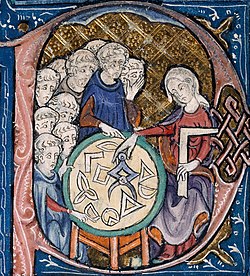


 EulerianTrail (talk) 14:45, 8 April 2026 (UTC)

.jpg)


 Comment: The need for disambiguation pages is probably the single best argument I've seen for a short descriptions on pages. The fact the one for mathematics lists articles for nine songs and three other uses illustrates this is not a cut and dry term that could never be confused with something else. GeogSage (⚔Chat?⚔) 07:53, 31 March 2026 (UTC)


