Talk:0.999...
| This is the talk page for discussing improvements to the 0.999... article itself. This is not a forum for general discussion of the article's subject. Please place discussions on the underlying mathematical issues on the arguments page. For questions about the mathematics involved, try posting to the reference desk instead. |
Article policies
|
Archives (index): 1, 2, 3, 4, 5, 6, 7, 8, 9, 10, 11, 12, 13, 14, 15, 16, 17, 18, 19, 20Auto-archiving period: 31 days  |
| Arguments Archives: Index, 1, 2, 3, 4, 5, 6, 7, 8, 9, 10, 11, 12 |
 | 0.999... is a former featured article. Please see the links under Article milestones below for its original nomination page (for older articles, check the nomination archive) and why it was removed. | |||||||||||||||||||||
 | This article appeared on Wikipedia's Main Page as Today's featured article on October 25, 2006. | |||||||||||||||||||||
| ||||||||||||||||||||||
 | This article is rated B-class on Wikipedia's content assessment scale. It is of interest to multiple WikiProjects. | ||||||||||||||||||||||||||||||
| |||||||||||||||||||||||||||||||


|


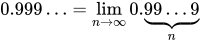



Yet another anon
[edit]Moved to Arguments subpage
Weak or strong inequality
[edit]This is a revival of the discussion Talk:0.999.../Archive 20#Greater than or equal to. Ping to previously interested parties: @Tito Omburo:, @D.Lazard:, @Mr swordfish:, @Trovatore:
The lead says (at the moment):
- Following the standard rules for representing real numbers in decimal notation, its value is the smallest number greater than every number in the increasing sequence 0.9, 0.99, 0.999, and so on.
While it is true in a sense, it may be read as implying (or relying on) the following "standard rule for representing real numbers in decimal notation":
- The value of the decimal 0.abcdefgh... is the smallest number greater than every number in the sequence 0.a, 0.ab, 0.abc, and so on.
which is incorrect. It is (and should be, in my opinion) fixed by writing the following instead:
- Following the standard rules for representing real numbers in decimal notation, its value is the smallest number greater than or equal to every number in the sequence 0.9, 0.99, 0.999, and so on.
I see no serious reason not to do this. "Greater than or equal to" may seem slightly more complicated than "greater than" (though mathematicians may beg to differ on that), but it actually strengthens the argument, and would be less confusing for a reader who happen to speculate "How would that work for a decimal like e.g. 0.25?" Such a reader might conclude the reasoning in the current lead is unconvincing.
One might say the lead does not need to reason at all; it just need to sitpulate facts (borne out by sources and by the article in its entirety). If so, we should leave the reasoning out, saying, e.g.:
- According to the standard rules for representing real numbers in decimal notation, its value is exactly 1.
In my suggested version I left out the word "increasing". I'm not sure it had a function, but I may miss something here.
I've made this change more than once, but been reverted, or it has been edited out - therefore this post.Nø (talk) 11:59, 19 January 2026 (UTC)
- Which part is "incorrect"? 0.999... is provably strictly greater than every number in the sequence 0.9, 0.99, 0.999, .... I don't believe in the existence of your hypothetical reader who has no trouble with the phrase "greater than or equal to" but finds the phrase "greater than" to be so confusing that they can't continue reading beyond it. –jacobolus (t) 16:33, 19 January 2026 (UTC)
- "Greater than or equal to" is only necessary in the special case of a terminating decimal when expressed as an infinite string of zeroes. I don't see the need to add unnecessary verbiage to address that special case, and find it distracting.
- I do think that it's worth keeping the "greater than part" as it explains the "standard rule" being cited. Mr. Swordfish (talk) 17:29, 19 January 2026 (UTC)
- My view continues to be (I think I've said this before but I don't see it in the linked discussion) that we should say "greater than or equal to" because it corresponds to the correct general rule, but we should not say why. Going into why would definitely be distracting. Some readers may wonder why we say "or equal to", and those readers should figure it out for themselves. That exercise may be the greatest value they get from this article. --Trovatore (talk) 20:37, 19 January 2026 (UTC)
- This is not the second part of the sentence that can be confusing, but the first one, which refers to vaguely specified rules. I suggest to change the sentence into:
Following the definition of non-terminating decimals, its value is the smallest number greater than every number in the increasing sequence 0.9, 0.99, 0.999, and so on.
This change would prevent readers to try to applu the sentence to terminating decimals. So "greater than" would be always correct. "Greater than or equal to" would be also correct, but, in the lead, simpler is better. D.Lazard (talk) 22:07, 19 January 2026 (UTC)- No, I don't agree with that. The interpretation of decimal representations doesn't need a special case for "terminating" decimals. Really we should de-emphasize the whole notion of "terminating decimals"; they're really just infinite decimals that happen to have a final segment consisting of zeroes. --Trovatore (talk) 22:20, 19 January 2026 (UTC)
- I think we are closer to consensus on "greater than or equal to" than on "greater than" (which is fewer words but mathematically the less simple concept, and in disagreement with the general meaning of decimal strings even if it holds in this case). I will now change it one more time. Nø (talk) 11:52, 28 January 2026 (UTC)
- PS. I also, again, removed "increasing" in "increasing sequence" - I don't see any need for it. All in all, I've increased the wordcount by 2, while reducing the character count by 1 and the letter count by 2, and sharpening the logic. Nø (talk) 11:56, 28 January 2026 (UTC)
- I think we are closer to consensus on "greater than or equal to" than on "greater than" (which is fewer words but mathematically the less simple concept, and in disagreement with the general meaning of decimal strings even if it holds in this case). I will now change it one more time. Nø (talk) 11:52, 28 January 2026 (UTC)
- No, I don't agree with that. The interpretation of decimal representations doesn't need a special case for "terminating" decimals. Really we should de-emphasize the whole notion of "terminating decimals"; they're really just infinite decimals that happen to have a final segment consisting of zeroes. --Trovatore (talk) 22:20, 19 January 2026 (UTC)
Wiki Education assignment: Proofs and Problem Solving
[edit] This article was the subject of a Wiki Education Foundation-supported course assignment, between 13 January 2026 and 17 April 2026. Further details are available on the course page. Student editor(s): Hasan Paul (article contribs).
— Assignment last updated by Hasan Paul (talk) 17:31, 7 February 2026 (UTC)
Many of these proofs...
[edit]... compare infinite series to real numbers which is an oversight and cannot result in equivalence. Others require us to suspend our knowledge of advances in mathematics in the past 300 years post Euler. In his time this was accurate, however algebra cannot handle infinity properly which was addressed around 100 years after Euler’s passing. Your page doesn’t address either of these assumptions when making claims of proof which continues to give rise to the debate. Either claim your limited universe or replace equivalence with convergence.
Assumptions are not declared ~2026-13994-61 (talk) 12:54, 4 March 2026 (UTC)
List or sequence
[edit]@MartinPoulter and SamuelNelsonGISP: Article currently reads:
- The three dots represent an infinite list of "9" digits.
I agree that this wording is better than the suggested
- The ellipsis represent[s] an infinite continuation of the numeral "9".
because you can't "infinitely continue" a numeral. I prefer the word "ellipsis", but I can see that that would be unfamiliar to some readers. On the other hand, "infinte list" seems inappropriate. Maybe "infinite sequence"? --Macrakis (talk) 20:53, 30 March 2026 (UTC)
- I updated it to Ellipsis instead of three dots because three dots is ambiguous and non-standard terminology; this is not the simple English wiki, just the English wiki, so confusing someone on a niche math article shouldn't be a high concern. Also, even the ellipsis article has a section about this mathematical notation: Ellipsis#In mathematical notation. Also see Repeating decimal#Background for another article that explicitly uses the term ellipsis in another similar explanation.
- I am far less sure about how to word the "infinite continuation of the numeral "9". Digit makes more sense than numeral, thanks for the correction. I'm not sure I like sequence or list though.
- Perhaps it can be rewritten:
- 0.999... is a repeating decimal that is equal to the number 1. The ellipsis represents an infinite succession of the digit "9".
- I still like the word continuation more than list or sequence but this paywalled scholarly article seems to describe a repeating decimal of this nature as an infinite succession. SamuelNelsonGISP (talk) 21:18, 30 March 2026 (UTC)
- I replaced represent in the first sentence of my suggestion with equal (because it is equal) and represents makes it seem as if its just some shorthand or alternative and not a completely valid and distinct way to represent the same value. I guess it is like saying 0.5 represents 1/2 instead of saying 0.5 is 1/2, is meaning equal to. SamuelNelsonGISP (talk) 21:20, 30 March 2026 (UTC)
- I had to click on the three dots link to understand what was meant by "ambiguous". While "three dots" can mean many things, I don't think there is any ambiguity here. It obviously refers to the three dots in the expression being referenced.
- Sequence is the standard mathematical term. We should use that unless there's a good reason not to. Mr. Swordfish (talk) 21:26, 30 March 2026 (UTC)
- Fair enough, me saying its ambiguous is imprecise. But three dots is clearly not the most accurate description of the notation. Sequence is a standard term but it generally means a comma separated list as you can see when the sequence of digits for pi is depicted in that article, not as the normal decimal expansion of pi, but as a parenthetical list of digits. I think if we are talking about the digit "9" repeating, we should not use the term sequence. SamuelNelsonGISP (talk) 21:32, 30 March 2026 (UTC)
- Sequence is a standard term but it generally means a comma separated list...
- The delimiter used to express a sequence is irrelevant to the basic notion of "sequence"; the digits of pi, for example, are a sequence regardless of whether expressed as a comma delimited list, the usual way of writing its decimal expression, or any other way of representing it.
- As explained at sequence:
- In computing and computer science, finite sequences are usually called strings, words or lists, with the specific technical term chosen depending on the type of object the sequence enumerates and the different ways to represent the sequence in computer memory. Infinite sequences are called streams.
- Sequence is the mathematical term. List and string are computer terms. Stream is an infinite sequence in the computer world, but I wouldn't advocate using that here. It's a mathematical article so lets use standard mathematical terms. Mr. Swordfish (talk) 21:59, 30 March 2026 (UTC)
- Well, we're at an impasse over the term sequence. I'm curious about outside opinion. Maybe a more extension analysis of academic or pedagogical literature is in order to help determine which terminology is apt to be used in this case. SamuelNelsonGISP (talk) 22:31, 30 March 2026 (UTC)
- Well, we're at an impasse over the term sequence.
- This thread is barely two hours old. Way too early to declare an impasse. Mr. Swordfish (talk) 01:40, 31 March 2026 (UTC)
- lol are you critiquing my use of impasse. I guess all I meant is both of us made our points and we're not budging, hence I call to hear out others. SamuelNelsonGISP (talk) 02:38, 31 March 2026 (UTC)
- Perhaps we could say "standoff" instead? Hawkeye7 (discuss) 04:29, 31 March 2026 (UTC)
- lol are you critiquing my use of impasse. I guess all I meant is both of us made our points and we're not budging, hence I call to hear out others. SamuelNelsonGISP (talk) 02:38, 31 March 2026 (UTC)
- "List" is used in computing because it is an ordinary plain English word, which in relevant non-technical contexts is much more common than "sequence". (In non-technical contexts "sequence" is more often used in the sense of a "sequence of events" or sequence of temporal steps or stages of some process.) –jacobolus (t) 22:31, 30 March 2026 (UTC)
- While my preference is for "sequence", I have no problem with using an ordinary plain English word such as "list" for a general interest article like this.
- I don't think "infinite continuation" is optimal here. Mr. Swordfish (talk) 01:35, 31 March 2026 (UTC)
- In case it's not clear though, I also think sequence would be more or less fine. I don't think readers will have excessive difficulty with either word. –jacobolus (t) 02:36, 31 March 2026 (UTC)
- Well, we're at an impasse over the term sequence. I'm curious about outside opinion. Maybe a more extension analysis of academic or pedagogical literature is in order to help determine which terminology is apt to be used in this case. SamuelNelsonGISP (talk) 22:31, 30 March 2026 (UTC)
- Fair enough, me saying its ambiguous is imprecise. But three dots is clearly not the most accurate description of the notation. Sequence is a standard term but it generally means a comma separated list as you can see when the sequence of digits for pi is depicted in that article, not as the normal decimal expansion of pi, but as a parenthetical list of digits. I think if we are talking about the digit "9" repeating, we should not use the term sequence. SamuelNelsonGISP (talk) 21:32, 30 March 2026 (UTC)
- "infinite sequence" is the usual mathematical term, so I gravitate towards that over "list". There's an argument to be made to use the less rigorous term to use more familiar words, but I don't think "sequence" it that an obscure a term.
- As for "elipsis" vs "three dots", I can't say that I have a strong opinion either way. Neither is a mathematical term, but "three dots" may be understandable by more readers. Mr. Swordfish (talk) 21:19, 30 March 2026 (UTC)
- I agree that "three dots" is more likely to be understood by the intended audience of this article, who are... the mathematically unsophisticated. And if there is one thing the mathematically unsophisticated do not understand, it is the word "infinity" (or "infinite"). So "infinite sequence" communicates absolutely nothing to them. I suggest it is much better to write "unending sequence", because this is technically certainly not wrong, and makes it easy to reply to objections about what happens at the end of the sequence by pointing out that it does not have an end. Imaginatorium (talk) 05:39, 31 March 2026 (UTC)
- Three dots and unending sequence works for me. Mr. Swordfish (talk) 12:08, 31 March 2026 (UTC)
- You should both look briefly through the history of the page. 6 months ago, it said "The three dots represent an unending list of '9' digits." People keep regularly twiddling the wording one way or another. Before settling on a change it might be worth doing a survey of the past variations of the first few sentences and pinging all of the editors who have made changes to them. –jacobolus (t) 16:15, 31 March 2026 (UTC)
- Well, if people keep twiddling with the wording, we're never going to settle on the language.
- Might it be worth mooting the various recent versions and doing an RFC to see if we can reach consensus on one of them? Mr. Swordfish (talk) 17:04, 31 March 2026 (UTC)
- You should both look briefly through the history of the page. 6 months ago, it said "The three dots represent an unending list of '9' digits." People keep regularly twiddling the wording one way or another. Before settling on a change it might be worth doing a survey of the past variations of the first few sentences and pinging all of the editors who have made changes to them. –jacobolus (t) 16:15, 31 March 2026 (UTC)
- Three dots and unending sequence works for me. Mr. Swordfish (talk) 12:08, 31 March 2026 (UTC)
- I agree that "three dots" is more likely to be understood by the intended audience of this article, who are... the mathematically unsophisticated. And if there is one thing the mathematically unsophisticated do not understand, it is the word "infinity" (or "infinite"). So "infinite sequence" communicates absolutely nothing to them. I suggest it is much better to write "unending sequence", because this is technically certainly not wrong, and makes it easy to reply to objections about what happens at the end of the sequence by pointing out that it does not have an end. Imaginatorium (talk) 05:39, 31 March 2026 (UTC)
- Both "infinite sequence" and "infinite list" seem fine to me. The comp-sci distinction called out above seems not quite right to me. As I understand it a comp-sci "stream" is not so much an infinite sequence as a process from which you can keep getting data without limit. The data you get may not be deterministic (for example, it might come from stdin or from /dev/random) and you never have an infinite amount of data at any particular time. --Trovatore (talk) 01:00, 1 April 2026 (UTC)
- Agree with your critique of the usage of the term "stream" in the sequence article. Of course, this is not the venue for addressing that article's shortcomings.
- Also agree that both "infinite sequence" and "infinite list" seem fine. Mr. Swordfish (talk) 02:37, 2 April 2026 (UTC)
- After reading Imaginatorium's contribution above, I agree that "unending sequence" might be better for the intended readership of this article. --Trovatore (talk) 01:14, 1 April 2026 (UTC)