Radonifying operator
In measure theory, a radonifying operator (ultimately named after Johann Radon) between measurable spaces is one that takes a cylinder set measure (CSM) on the first space to a true measure on the second space. It acquired its name because the pushforward measure on the second space was historically thought of as a Radon measure.
This article relies largely or entirely on a single source. Relevant discussion may be found on the talk page. Please help improve this article by introducing citations to additional sources. Find sources: "Radonifying operator" – news · newspapers · books · scholar · JSTOR (March 2026) |
In measure theory, a radonifying operator (ultimately named after Johann Radon) between measurable spaces is one that takes a cylinder set measure (CSM) on the first space to a true measure on the second space. It acquired its name because the pushforward measure on the second space was historically thought of as a Radon measure.
Definition
[edit]Given two separable Banach spaces
E
{\displaystyle E}
and
G
{\displaystyle G}
, a CSM
{
μ
T
|
T
∈
A
(
E
)
}
{\displaystyle \{\mu _{T}|T\in {\mathcal {A}}(E)\}}
on
E
{\displaystyle E}
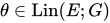
and a continuous linear map
θ
∈
L
i
n
(
E
;
G
)
{\displaystyle \theta \in \mathrm {Lin} (E;G)}
, we say that
θ
{\displaystyle \theta }
is radonifying if the push forward CSM (see below)
{
(
θ
∗
(
μ
⋅
)
)
S
|
S
∈
A
(
G
)
}
{\displaystyle \left\{\left.\left(\theta _{*}(\mu _{\cdot })\right)_{S}\right|S\in {\mathcal {A}}(G)\right\}}
on
G
{\displaystyle G}
"is" a measure, i.e. there is a measure
ν
{\displaystyle \nu }
on
G
{\displaystyle G}
such that
-
(
θ
∗
(
μ
⋅
)
)
S
=
S
∗
(
ν
)
{\displaystyle \left(\theta _{*}(\mu _{\cdot })\right)_{S}=S_{*}(\nu )}
-
(
θ
∗
(
μ
⋅
)
)
S
=
S
∗
(
ν
)
{\displaystyle \left(\theta _{*}(\mu _{\cdot })\right)_{S}=S_{*}(\nu )}
for each
S
∈
A
(
G
)
{\displaystyle S\in {\mathcal {A}}(G)}
, where
S
∗
(
ν
)
{\displaystyle S_{*}(\nu )}
is the usual push forward of the measure
ν
{\displaystyle \nu }
by the linear map
S
:
G
→
F
S
{\displaystyle S:G\to F_{S}}
.[1]
Push forward of a CSM
[edit]Because the definition of a CSM on
G
{\displaystyle G}
requires that the maps in
A
(
G
)
{\displaystyle {\mathcal {A}}(G)}
be surjective, the definition of the push forward for a CSM requires careful attention. The CSM
-
{
(
θ
∗
(
μ
⋅
)
)
S
|
S
∈
A
(
G
)
}
{\displaystyle \left\{\left.\left(\theta _{*}(\mu _{\cdot })\right)_{S}\right|S\in {\mathcal {A}}(G)\right\}}
-
{
(
θ
∗
(
μ
⋅
)
)
S
|
S
∈
A
(
G
)
}
{\displaystyle \left\{\left.\left(\theta _{*}(\mu _{\cdot })\right)_{S}\right|S\in {\mathcal {A}}(G)\right\}}
is defined by
-
(
θ
∗
(
μ
⋅
)
)
S
=
μ
S
∘
θ
{\displaystyle \left(\theta _{*}(\mu _{\cdot })\right)_{S}=\mu _{S\circ \theta }}
-
(
θ
∗
(
μ
⋅
)
)
S
=
μ
S
∘
θ
{\displaystyle \left(\theta _{*}(\mu _{\cdot })\right)_{S}=\mu _{S\circ \theta }}
if the composition
S
∘
θ
:
E
→
F
S
{\displaystyle S\circ \theta :E\to F_{S}}
is surjective. If
S
∘
θ
{\displaystyle S\circ \theta }
is not surjective, let
F
~
{\displaystyle {\tilde {F}}}
be the image of
S
∘
θ
{\displaystyle S\circ \theta }
, let
i
:
F
~
→
F
S
{\displaystyle i:{\tilde {F}}\to F_{S}}
be the inclusion map, and define
-
(
θ
∗
(
μ
⋅
)
)
S
=
i
∗
(
μ
Σ
)
{\displaystyle \left(\theta _{*}(\mu _{\cdot })\right)_{S}=i_{*}\left(\mu _{\Sigma }\right)}
,
-
(
θ
∗
(
μ
⋅
)
)
S
=
i
∗
(
μ
Σ
)
{\displaystyle \left(\theta _{*}(\mu _{\cdot })\right)_{S}=i_{*}\left(\mu _{\Sigma }\right)}
where
Σ
:
E
→
F
~
{\displaystyle \Sigma :E\to {\tilde {F}}}
(so
Σ
∈
A
(
E
)
{\displaystyle \Sigma \in {\mathcal {A}}(E)}
) is such that
i
∘
Σ
=
S
∘
θ
{\displaystyle i\circ \Sigma =S\circ \theta }
.
See also
[edit]- Abstract Wiener space – Mathematical construction relating to infinite-dimensional spaces
- Classical Wiener space – Space of stochastic processes
- Sazonov's theorem
References
[edit]- ^ van Neerven, Jan. "
γ
{\displaystyle \gamma }
-randonifying Operators - A Survey" (PDF). Australian National University. Retrieved 8 Mar 2026.
| Basic concepts | |||||
|---|---|---|---|---|---|
| Sets | |||||
| Types of measures |
| ||||
| Particular measures | |||||
| Maps | |||||
| Main results |
| ||||
| Other results |
| ||||
| Applications & related | |||||
| Basic concepts | |
|---|---|
| Derivatives | |
| Measurability | |
| Integrals | |
| Results | |
| Related | |
| Functional calculus | |
| Applications | |
| Spaces |
| ||||
|---|---|---|---|---|---|
| Theorems | |||||
| Operators | |||||
| Algebras | |||||
| Open problems | |||||
| Applications | |||||
| Advanced topics | |||||