RST model
The Russo–Susskind–Thorlacius model or RST model in short is a modification of the CGHS model to take care of conformal anomalies and render it analytically soluble. In the CGHS model, if we include Faddeev–Popov ghosts to gauge-fix diffeomorphisms in the conformal gauge, they contribute an anomaly of -24. Each matter field contributes an anomaly of 1. So, unless N=24, we will have gravitational anomalies. To the CGHS action S CGHS = 1 2 π ∫ d 2 x − g { e − 2 ϕ [ R + 4 ( ∇ ϕ ) 2 + 4 λ 2 ] − ∑ i = 1 N 1 2 ( ∇ f i ) 2 } {\displaystyle S_{\text{CGHS}}={\frac {1}{2\pi }}\int d^{2}x\,{\sqrt {-g}}\left\{e^{-2\phi }\left[R+4\left(\nabla \phi \right)^{2}+4\lambda ^{2}\right]-\sum _{i=1}^{N}{\frac {1}{2}}\left(\nabla f_{i}\right)^{2}\right\}} , the following term S RST = − κ 8 π ∫ d 2 x − g [ R 1 ∇ 2 R − 2 ϕ R ] {\displaystyle S_{\text{RST}}=-{\frac {\kappa }{8\pi }}\int d^{2}x\,{\sqrt {-g}}\left[R{\frac {1}{\nabla ^{2}}}R-2\phi R\right]} is added, where κ is either ( N − 24 ) / 12 {\displaystyle (N-24)/12} or N / 12 {\displaystyle N/12} depending upon whether ghosts are considered. The nonlocal term leads to nonlocality. In the conformal gauge, S RST = − κ π ∫ d x + d x − [ ∂ + ρ ∂ − ρ + ϕ ∂ + ∂ − ρ ] {\displaystyle S_{\text{RST}}=-{\frac {\kappa }{\pi }}\int dx^{+}\,dx^{-}\left[\partial _{+}\rho \partial _{-}\rho +\phi \partial _{+}\partial _{-}\rho \right]} . It might appear as if the theory is local in the conformal gauge, but this overlooks the fact that the Raychaudhuri equations are still nonlocal.
The Russo–Susskind–Thorlacius model[1] or RST model in short is a modification of the CGHS model to take care of conformal anomalies and render it analytically soluble. In the CGHS model, if we include Faddeev–Popov ghosts to gauge-fix diffeomorphisms in the conformal gauge, they contribute an anomaly of -24. Each matter field contributes an anomaly of 1. So, unless N=24, we will have gravitational anomalies. To the CGHS action
- , the following term
![{\displaystyle S_{\text{CGHS}}={\frac {1}{2\pi }}\int d^{2}x\,{\sqrt {-g}}\left\{e^{-2\phi }\left[R+4\left(\nabla \phi \right)^{2}+4\lambda ^{2}\right]-\sum _{i=1}^{N}{\frac {1}{2}}\left(\nabla f_{i}\right)^{2}\right\}}](https://wikimedia.org/api/rest_v1/media/math/render/svg/af8c5349300a00a59edd271eea445bc9b9e8a50a)
![{\displaystyle S_{\text{RST}}=-{\frac {\kappa }{8\pi }}\int d^{2}x\,{\sqrt {-g}}\left[R{\frac {1}{\nabla ^{2}}}R-2\phi R\right]}](https://wikimedia.org/api/rest_v1/media/math/render/svg/6dcda2dd0ad6bb6770054188c91881f721977a9e)
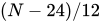
is added, where κ is either or depending upon whether ghosts are considered. The nonlocal term leads to nonlocality. In the conformal gauge,

- .
![{\displaystyle S_{\text{RST}}=-{\frac {\kappa }{\pi }}\int dx^{+}\,dx^{-}\left[\partial _{+}\rho \partial _{-}\rho +\phi \partial _{+}\partial _{-}\rho \right]}](https://wikimedia.org/api/rest_v1/media/math/render/svg/cabb0ef64f311da1c94338e7047fd24e8e17f9e5)
It might appear as if the theory is local in the conformal gauge, but this overlooks the fact that the Raychaudhuri equations are still nonlocal.
References
[edit]- ^ Russo, Jorge; Susskind, Leonard; Thorlacius, Lárus (15 Oct 1992). "The Endpoint of Hawking Evaporation". Physical Review. 46 (8): 3444–3449. arXiv:hep-th/9206070. Bibcode:1992PhRvD..46.3444R. doi:10.1103/PhysRevD.46.3444. PMID 10015289. S2CID 184623.
| Central concepts | |||||||||
|---|---|---|---|---|---|---|---|---|---|
| Toy models | |||||||||
| Quantum field theory in curved spacetime | |||||||||
| Black holes | |||||||||
| Approaches |
| ||||||||
| Applications | |||||||||
See also:  Template:Quantum mechanics topics Template:Quantum mechanics topics | |||||||||
 | This relativity-related article is a stub. You can help Wikipedia by adding missing information. |