Michigan consists of two peninsulas: the heavily forested Upper Peninsula (commonly called "the U.P."), which juts eastward from northern Wisconsin, and the more populated Lower Peninsula, stretching north from Ohio and Indiana. The peninsulas are separated by the Straits of Mackinac, which connects Lake Michigan and Lake Huron, and are linked by the 5-mile-long Mackinac Bridge along Interstate 75. Bordering four of the five Great Lakes and Lake St. Clair, Michigan has the longest freshwater coastline of any U.S. political subdivision, measuring 3,288 miles. The state ranks second behind Alaska in water coverage by square miles and first in percentage, with approximately 42%, and it also contains 64,980 inland lakes and ponds.
The Great Lakes region has largely been inhabited for thousands of years by Indigenous peoples such as the Ojibwe, Odawa, Potawatomi, and Wyandot.
Some people contend that the region's name is derived from the Ojibwe word ᒥᓯᑲᒥ (mishigami), meaning "large water" or "large lake". Others say that it comes from the Mishiiken Tribe of Mackinac Island, also called Michinemackinawgo by Ottawa historian Andrew Blackbird, whose surrounding lands were referred to as Mishiiken-imakinakom, later shortened to Michilimackinac.
In the 17th century, French explorers claimed the area for New France. French settlers and Métis established forts and settlements.
After France's defeat in the French and Indian War in 1762, the area came under British control and later the U.S. following the Treaty of Paris (1783), though control remained disputed with Indigenous tribes until treaties between 1795 and 1842. The area was part of the larger Northwest Territory; the Michigan Territory was organized in 1805. (Full article...)
Entries here consist of Good and Featured articles, which meet a core set of high editorial standards.
Madonnaland: And Other Detours in Fame and Fandom is a non-fiction book written by American essayist and musician Alina Simone. It is a biography of American singer Madonna, as well the author's own analysis of music and pop culture. Upon its release on March 3, 2016 by University of Texas Press, Madonnaland received positive reviews from critics, who praised her writing and bold subject choice. Rolling Stone magazine listed it as one of the 10 Best Music Books released in 2016.
Consisting of six chapters, Madonnaland finds Simone visiting Madonna's birthplace, Bay City, Michigan, where she spoke with the local people about the singer. The book also analyses Madonna's career and fame, with the author delving into her own music career and obscure Bay City bands. Simone had been initially commissioned to write a new biography about the singer. However, due to already available excess content on her, the author felt she would not be able to find anything new. Instead, she ended up writing Madonnaland about her own failure to create a Madonna biography, why Bay City did not have any commemoration for the singer, as well as unknown music bands, pop culture and celebrity life. (Full article...)
The Detroit International Riverfront is an area so designated by the nonprofit city sponsored managing entity, the Detroit Riverfront Conservancy incorporated as a 501(c)(3) organization. The conservancy resulted from a study commissioned by Mayor Kwame Kilpatrick.
Ralph W. Aigler (February 12, 1885 – May 24, 1964) was an American law professor at the University of Michigan from 1910–1954, the University's faculty representative to the Big Ten Conference from 1917 to 1955, and chairman of Michigan's Faculty Board in Control of Athletics from 1917 to 1942. Aigler was a renowned expert on real property law and one of the advisors to the American Law Institute in the drafting of the Restatement of the Law of Property. He is best known, however, for his contributions to the athletics programs at the University of Michigan. Aigler's contributions included leading Michigan back into the Big Ten Conference, leading the effort to construct Michigan Stadium, Yost Fieldhouse and other facilities, negotiating the Big Ten's exclusive contract with the Rose Bowl starting in 1946, hiring Fritz Crisler as football coach and athletic director, and acting as a spokesman for the University and Big Ten for many years on NCAA rules and eligibility issues. He was inducted into the University of Michigan Athletic Hall of Honor in 1982. (Full article...)
Image 5Treaty of Paris, by Benjamin West (1783), an unfinished painting of the American diplomatic negotiators of the Treaty of Paris which brought official conclusion to the Revolutionary War and gave possession of Michigan and other territory to the new United States (from Michigan)
Image 9A map of Michigan by Henry Schenck Tanner, published in 1842, showing such county names as "Negwegon County," "Okkuddo County," and "Unwattin County," prior to an 1843 legislative action renaming sixteen counties in northern Michigan (from History of Michigan)
Image 13Detroit in the mid-twentieth century. At the time, the city was the fourth-largest U.S. metropolis by population, and held about one-third of the state's population. (from Michigan)
Image 24The Detroit-Windsor border crossing is the busiest international border crossing in North America by trade volume, with approximately one-third of all Canada–U.S. trade passing through this link. Pictured in the background is the under-construction Gordie Howe International Bridge, which will complement the existing Ambassador Bridge, shown in the foreground. (from Michigan)
Image 25Map of the original 13 colonies and their territories. Note that Michigan was the object of multiple claims. (from History of Michigan)
Image 31Union members occupying a General Motors body factory during the Flint Sit-Down Strike of 1937 which spurred the organization of militant CIO unions in auto industry (from History of Michigan)
Image 34The Detroit–Windsor area is North America's largest cross-border conurbation, with a combined population of approximately six million people (from Michigan)


.svg)


.jpg)


.jpg)


.png)


.jpg)


.jpg)


.jpg)


.jpg)


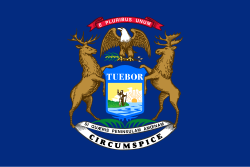 The Flag of Michigan
 The Seal of Michigan
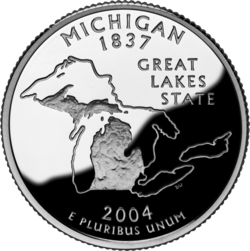 State Quarter – Released in 2004


 Commons
 Wikibooks
 Wikidata
 Wikinews
 Wikiquote
 Wikisource
 Wikiversity
 Wikivoyage
 Wiktionary


