Normal number (computing)
In computing, a normal number is a non-zero number in a floating-point representation which is within the balanced range supported by a given floating-point format: it is a floating point number that can be represented without leading zeros in its significand. The magnitude of the smallest normal number in a format is given by: b E min {\displaystyle b^{E_{\text{min}}}} where b is the base (radix) of the format (like common values 2 or 10, for binary and decimal number systems), and E min {\textstyle E_{\text{min}}} depends on the size and layout of the format. Similarly, the magnitude of the largest normal number in a format is given by b E max ⋅ ( b − b 1 − p ) {\displaystyle b^{E_{\text{max}}}\cdot \left(b-b^{1-p}\right)} where p is the precision of the format in digits and E min {\textstyle E_{\text{min}}} is related to E max {\textstyle E_{\text{max}}} as: E min ≡ Δ 1 − E max = ( − E max ) + 1 {\displaystyle E_{\text{min}}\,{\overset {\Delta }{\equiv }}\,1-E_{\text{max}}=\left(-E_{\text{max}}\right)+1} In the IEEE 754 binary and decimal formats, b, p, E min {\textstyle E_{\text{min}}} , and E max {\textstyle E_{\text{max}}} have the following values: For example, in the smallest decimal format in the table (decimal32), the range of positive normal numbers is 10−95 through 9.999999 × 1096. Non-zero numbers smaller in magnitude than the smallest normal number are called subnormal numbers (or denormal numbers). Zero is considered neither normal nor subnormal.
 | This article needs additional citations for verification. (December 2009) |
| Floating-point formats |
|---|
| IEEE 754 |
|
| Other |
| Alternatives |
| Tapered floating point |
In computing, a normal number is a non-zero number in a floating-point representation which is within the balanced range supported by a given floating-point format: it is a floating point number that can be represented without leading zeros in its significand.
The magnitude of the smallest normal number in a format is given by:

where b is the base (radix) of the format (like common values 2 or 10, for binary and decimal number systems), and depends on the size and layout of the format.

Similarly, the magnitude of the largest normal number in a format is given by
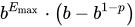
where p is the precision of the format in digits and is related to as:


In the IEEE 754 binary and decimal formats, b, p, , and have the following values:[1]
| Format | Smallest Normal Number | Largest Normal Number | ||||
|---|---|---|---|---|---|---|
| binary16 | 2 | 11 | −14 | 15 | ||
| binary32 | 2 | 24 | −126 | 127 | ||
| binary64 | 2 | 53 | −1022 | 1023 | ||
| binary128 | 2 | 113 | −16382 | 16383 | ||
| decimal32 | 10 | 7 | −95 | 96 | ||
| decimal64 | 10 | 16 | −383 | 384 | ||
| decimal128 | 10 | 34 | −6143 | 6144 |




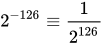
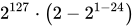
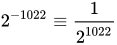

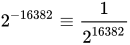

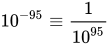

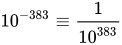

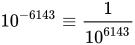

For example, in the smallest decimal format in the table (decimal32), the range of positive normal numbers is 10−95 through 9.999999 × 1096.
Non-zero numbers smaller in magnitude than the smallest normal number are called subnormal numbers (or denormal numbers).
Zero is considered neither normal nor subnormal.
See also
[edit]- Normalized number
- Half-precision floating-point format
- Single-precision floating-point format
- Double-precision floating-point format
References
[edit]- ^ IEEE Standard for Floating-Point Arithmetic, 2008-08-29, doi:10.1109/IEEESTD.2008.4610935, ISBN 978-0-7381-5752-8