In geometry, a nephroid (from Ancient Greek νεφρός (nephrós) 'kidney') is a specific plane curve. It is a type of epicycloid in which the smaller circle's radius differs from the larger one by a factor of one-half.
Plane curve; an epicycloid with radii differing by 1/2
In geometry, a nephroid (from Ancient Greekνεφρός (nephrós)'kidney') is a specific plane curve. It is a type of epicycloid in which the smaller circle's radius differs from the larger one by a factor of one-half.
If the small circle has radius
a
{\displaystyle a}
, the fixed circle has midpoint
(
0
,
0
)
{\displaystyle (0,0)}
and radius
2
a
{\displaystyle 2a}
, the rolling angle of the small circle is
2
φ
{\displaystyle 2\varphi }
and point
(
2
a
,
0
)
{\displaystyle (2a,0)}
the starting point (see diagram) then one gets the parametric representation:
x
(
φ
)
=
3
a
cos
φ
−
a
cos
3
φ
=
6
a
cos
φ
−
4
a
cos
3
φ
,
{\displaystyle x(\varphi )=3a\cos \varphi -a\cos 3\varphi =6a\cos \varphi -4a\cos ^{3}\varphi \ ,}
y
(
φ
)
=
3
a
sin
φ
−
a
sin
3
φ
=
4
a
sin
3
φ
,
0
≤
φ
<
2
π
{\displaystyle y(\varphi )=3a\sin \varphi -a\sin 3\varphi =4a\sin ^{3}\varphi \ ,\qquad 0\leq \varphi <2\pi }
The complex map
z
→
z
3
+
3
z
{\displaystyle z\to z^{3}+3z}
maps the unit circle to a nephroid.[3]
The proof of the parametric representation is easily done by using complex numbers and their representation as complex plane. The movement of the small circle can be split into two rotations. In the complex plane a rotation of a point
z
{\displaystyle z}
around point
0
{\displaystyle 0}
(origin) by an angle
φ
{\displaystyle \varphi }
can be performed by the multiplication of point
z
{\displaystyle z}
(complex number) by
e
i
φ
{\displaystyle e^{i\varphi }}
. Hence the
rotation
Φ
3
{\displaystyle \Phi _{3}}
around point
3
a
{\displaystyle 3a}
by angle
2
φ
{\displaystyle 2\varphi }
is
:
z
↦
3
a
+
(
z
−
3
a
)
e
i
2
φ
{\displaystyle :z\mapsto 3a+(z-3a)e^{i2\varphi }}
,
rotation
Φ
0
{\displaystyle \Phi _{0}}
around point
0
{\displaystyle 0}
by angle
φ
{\displaystyle \varphi }
is
:
z
↦
z
e
i
φ
{\displaystyle :\quad z\mapsto ze^{i\varphi }}
.
A point
p
(
φ
)
{\displaystyle p(\varphi )}
of the nephroid is generated by the rotation of point
2
a
{\displaystyle 2a}
by
Φ
3
{\displaystyle \Phi _{3}}
and the subsequent rotation with
Φ
0
{\displaystyle \Phi _{0}}
:
p
(
φ
)
=
Φ
0
(
Φ
3
(
2
a
)
)
=
Φ
0
(
3
a
−
a
e
i
2
φ
)
=
(
3
a
−
a
e
i
2
φ
)
e
i
φ
=
3
a
e
i
φ
−
a
e
i
3
φ
{\displaystyle p(\varphi )=\Phi _{0}(\Phi _{3}(2a))=\Phi _{0}(3a-ae^{i2\varphi })=(3a-ae^{i2\varphi })e^{i\varphi }=3ae^{i\varphi }-ae^{i3\varphi }}
.
Herefrom one gets
x
(
φ
)
=
3
a
cos
φ
−
a
cos
3
φ
=
6
a
cos
φ
−
4
a
cos
3
φ
,
y
(
φ
)
=
3
a
sin
φ
−
a
sin
3
φ
=
4
a
sin
3
φ
.
{\displaystyle {\begin{array}{cclcccc}x(\varphi )&=&3a\cos \varphi -a\cos 3\varphi &=&6a\cos \varphi -4a\cos ^{3}\varphi \ ,&&\\y(\varphi )&=&3a\sin \varphi -a\sin 3\varphi &=&4a\sin ^{3}\varphi &.&\end{array}}}
(The formulae
e
i
φ
=
cos
φ
+
i
sin
φ
,
cos
2
φ
+
sin
2
φ
=
1
,
cos
3
φ
=
4
cos
3
φ
−
3
cos
φ
,
sin
3
φ
=
3
sin
φ
−
4
sin
3
φ
{\displaystyle e^{i\varphi }=\cos \varphi +i\sin \varphi ,\ \cos ^{2}\varphi +\sin ^{2}\varphi =1,\ \cos 3\varphi =4\cos ^{3}\varphi -3\cos \varphi ,\;\sin 3\varphi =3\sin \varphi -4\sin ^{3}\varphi }
were used. See trigonometric functions.)
x
2
+
y
2
−
4
a
2
=
(
3
a
cos
φ
−
a
cos
3
φ
)
2
+
(
3
a
sin
φ
−
a
sin
3
φ
)
2
−
4
a
2
=
⋯
=
6
a
2
(
1
−
cos
2
φ
)
=
12
a
2
sin
2
φ
{\displaystyle x^{2}+y^{2}-4a^{2}=(3a\cos \varphi -a\cos 3\varphi )^{2}+(3a\sin \varphi -a\sin 3\varphi )^{2}-4a^{2}=\cdots =6a^{2}(1-\cos 2\varphi )=12a^{2}\sin ^{2}\varphi }
one gets
(
x
2
+
y
2
−
4
a
2
)
3
=
(
12
a
2
)
3
sin
6
φ
=
108
a
4
(
4
a
sin
3
φ
)
2
=
108
a
4
y
2
.
{\displaystyle (x^{2}+y^{2}-4a^{2})^{3}=(12a^{2})^{3}\sin ^{6}\varphi =108a^{4}(4a\sin ^{3}\varphi )^{2}=108a^{4}y^{2}\ .}
If the cusps are on the y-axis the parametric representation is
x
=
3
a
cos
φ
+
a
cos
3
φ
,
y
=
3
a
sin
φ
+
a
sin
3
φ
)
.
{\displaystyle x=3a\cos \varphi +a\cos 3\varphi ,\quad y=3a\sin \varphi +a\sin 3\varphi ).}
and the implicit one:
(
x
2
+
y
2
−
4
a
2
)
3
=
108
a
4
x
2
.
{\displaystyle (x^{2}+y^{2}-4a^{2})^{3}=108a^{4}x^{2}.}
It can be generated by rolling a circle with radius
a
{\displaystyle a}
on the outside of a fixed circle with radius
2
a
{\displaystyle 2a}
. Hence, a nephroid is an epicycloid.
Let be
c
0
{\displaystyle c_{0}}
a circle and
D
1
,
D
2
{\displaystyle D_{1},D_{2}}
points of a diameter
d
12
{\displaystyle d_{12}}
, then the envelope of the pencil of circles, which have midpoints on
c
0
{\displaystyle c_{0}}
and are touching
d
12
{\displaystyle d_{12}}
is a nephroid with cusps
D
1
,
D
2
{\displaystyle D_{1},D_{2}}
.
Let
c
0
{\displaystyle c_{0}}
be the circle
(
2
a
cos
φ
,
2
a
sin
φ
)
{\displaystyle (2a\cos \varphi ,2a\sin \varphi )}
with midpoint
(
0
,
0
)
{\displaystyle (0,0)}
and radius
2
a
{\displaystyle 2a}
. The diameter may lie on the x-axis (see diagram). The pencil of circles has equations:
f
(
x
,
y
,
φ
)
=
(
x
−
2
a
cos
φ
)
2
+
(
y
−
2
a
sin
φ
)
2
−
(
2
a
sin
φ
)
2
=
0
.
{\displaystyle f(x,y,\varphi )=(x-2a\cos \varphi )^{2}+(y-2a\sin \varphi )^{2}-(2a\sin \varphi )^{2}=0\ .}
The envelope condition is
f
φ
(
x
,
y
,
φ
)
=
2
a
(
x
sin
φ
−
y
cos
φ
−
2
a
cos
φ
sin
φ
)
=
0
.
{\displaystyle f_{\varphi }(x,y,\varphi )=2a(x\sin \varphi -y\cos \varphi -2a\cos \varphi \sin \varphi )=0\ .}
One can easily check that the point of the nephroid
p
(
φ
)
=
(
6
a
cos
φ
−
4
a
cos
3
φ
,
4
a
sin
3
φ
)
{\displaystyle p(\varphi )=(6a\cos \varphi -4a\cos ^{3}\varphi \;,\;4a\sin ^{3}\varphi )}
is a solution of the system
f
(
x
,
y
,
φ
)
=
0
,
f
φ
(
x
,
y
,
φ
)
=
0
{\displaystyle f(x,y,\varphi )=0,\;f_{\varphi }(x,y,\varphi )=0}
and hence a point of the envelope of the pencil of circles.
The following consideration uses trigonometric formulae for
cos
α
+
cos
β
,
sin
α
+
sin
β
,
cos
(
α
+
β
)
,
cos
2
α
{\displaystyle \cos \alpha +\cos \beta ,\ \sin \alpha +\sin \beta ,\ \cos(\alpha +\beta ),\ \cos 2\alpha }
. In order to keep the calculations simple, the proof is given for the nephroid with cusps on the y-axis.
Equation of the tangent: for the nephroid with parametric representation
x
=
3
cos
φ
+
cos
3
φ
,
y
=
3
sin
φ
+
sin
3
φ
{\displaystyle x=3\cos \varphi +\cos 3\varphi ,\;y=3\sin \varphi +\sin 3\varphi }
:
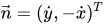
Herefrom one determines the normal vector
n
→
=
(
y
˙
,
−
x
˙
)
T
{\displaystyle {\vec {n}}=({\dot {y}},-{\dot {x}})^{T}}
, at first.
The equation of the tangent
y
˙
(
φ
)
⋅
(
x
−
x
(
φ
)
)
−
x
˙
(
φ
)
⋅
(
y
−
y
(
φ
)
)
=
0
{\displaystyle {\dot {y}}(\varphi )\cdot (x-x(\varphi ))-{\dot {x}}(\varphi )\cdot (y-y(\varphi ))=0}
is:
(
cos
2
φ
⋅
x
+
sin
2
φ
⋅
y
)
cos
φ
=
4
cos
2
φ
.
{\displaystyle (\cos 2\varphi \cdot x\ +\ \sin 2\varphi \cdot y)\cos \varphi =4\cos ^{2}\varphi \ .}
For
φ
=
π
2
,
3
π
2
{\displaystyle \varphi ={\tfrac {\pi }{2}},{\tfrac {3\pi }{2}}}
one gets the cusps of the nephroid, where there is no tangent. For
φ
≠
π
2
,
3
π
2
{\displaystyle \varphi \neq {\tfrac {\pi }{2}},{\tfrac {3\pi }{2}}}
one can divide by
cos
φ
{\displaystyle \cos \varphi }
to obtain
cos
2
φ
⋅
x
+
sin
2
φ
⋅
y
=
4
cos
φ
.
{\displaystyle \cos 2\varphi \cdot x+\sin 2\varphi \cdot y=4\cos \varphi \ .}
Equation of the chord: to the circle with midpoint
(
0
,
0
)
{\displaystyle (0,0)}
and radius
4
{\displaystyle 4}
: The equation of the chord containing the two points
(
4
cos
θ
,
4
sin
θ
)
,
(
4
cos
3
θ
,
4
sin
3
θ
)
)
{\displaystyle (4\cos \theta ,4\sin \theta ),\ (4\cos {\color {red}3}\theta ,4\sin {\color {red}3}\theta ))}
is:
(
cos
2
θ
⋅
x
+
sin
2
θ
⋅
y
)
sin
θ
=
4
cos
θ
sin
θ
.
{\displaystyle (\cos 2\theta \cdot x+\sin 2\theta \cdot y)\sin \theta =4\cos \theta \sin \theta \ .}
For
θ
=
0
,
π
{\displaystyle \theta =0,\pi }
the chord degenerates to a point. For
θ
≠
0
,
π
{\displaystyle \theta \neq 0,\pi }
one can divide by
sin
θ
{\displaystyle \sin \theta }
and gets the equation of the chord:
cos
2
θ
⋅
x
+
sin
2
θ
⋅
y
=
4
cos
θ
.
{\displaystyle \cos 2\theta \cdot x+\sin 2\theta \cdot y=4\cos \theta \ .}
The two angles
φ
,
θ
{\displaystyle \varphi ,\theta }
are defined differently (
φ
{\displaystyle \varphi }
is one half of the rolling angle,
θ
{\displaystyle \theta }
is the parameter of the circle, whose chords are determined), for
φ
=
θ
{\displaystyle \varphi =\theta }
one gets the same line. Hence any chord from the circle above is tangent to the nephroid and
the nephroid is the envelope of the chords of the circle.
The circle may have the origin as midpoint (as in the previous section) and its
radius is
4
{\displaystyle 4}
. The circle has the parametric representation
k
(
φ
)
=
4
(
cos
φ
,
sin
φ
)
.
{\displaystyle k(\varphi )=4(\cos \varphi ,\sin \varphi )\ .}
The tangent at the circle point
K
:
k
(
φ
)
{\displaystyle K:\ k(\varphi )}
has normal vector
n
→
t
=
(
cos
φ
,
sin
φ
)
T
{\displaystyle {\vec {n}}_{t}=(\cos \varphi ,\sin \varphi )^{T}}
. The reflected ray has the normal vector (see diagram)
n
→
r
=
(
cos
2
φ
,
sin
2
φ
)
T
{\displaystyle {\vec {n}}_{r}=(\cos {\color {red}2}\varphi ,\sin {\color {red}2}\varphi )^{T}}
and containing circle point
K
:
4
(
cos
φ
,
sin
φ
)
{\displaystyle K:\ 4(\cos \varphi ,\sin \varphi )}
. Hence the reflected ray is part of the line with equation
cos
2
φ
⋅
x
+
sin
2
φ
⋅
y
=
4
cos
φ
,
{\displaystyle \cos {\color {red}2}\varphi \cdot x\ +\ \sin {\color {red}2}\varphi \cdot y=4\cos \varphi \ ,}
which is tangent to the nephroid of the previous section at point
P
:
(
3
cos
φ
+
cos
3
φ
,
3
sin
φ
+
sin
3
φ
)
{\displaystyle P:\ (3\cos \varphi +\cos 3\varphi ,3\sin \varphi +\sin 3\varphi )}
(see above).
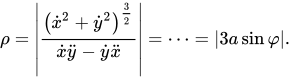
The evolute of a curve is the locus of centers of curvature. In detail: For a curve
x
→
=
c
→
(
s
)
{\displaystyle {\vec {x}}={\vec {c}}(s)}
with radius of curvature
ρ
(
s
)
{\displaystyle \rho (s)}
the evolute has the representation
x
→
=
c
→
(
s
)
+
ρ
(
s
)
n
→
(
s
)
.
{\displaystyle {\vec {x}}={\vec {c}}(s)+\rho (s){\vec {n}}(s).}
with
n
→
(
s
)
{\displaystyle {\vec {n}}(s)}
the suitably oriented unit normal.
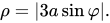
For a nephroid one gets:
The evolute of a nephroid is another nephroid half as large and rotated 90 degrees (see diagram).
Because the evolute of a nephroid is another nephroid, the involute of the nephroid is also another nephroid. The original nephroid in the image is the involute of the smaller nephroid.
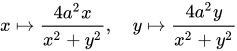
inversion (green) of a nephroid (red) across the blue circle


























![{\displaystyle A=2\cdot {\tfrac {1}{2}}|\int _{0}^{\pi }[x{\dot {y}}-y{\dot {x}}]\;d\varphi |=\cdots =24a^{2}\int _{0}^{\pi }\sin ^{2}\varphi \;d\varphi =12\pi a^{2}}](https://wikimedia.org/api/rest_v1/media/math/render/svg/de13ba263785d0122ca3e5cefc4e65addd140efa)