Matrix addition

In mathematics, matrix addition is the operation of adding two matrices by adding the corresponding entries together. For a vector, v → {\displaystyle {\vec {v}}\!} , adding two matrices would have the geometric effect of applying each matrix transformation separately onto v → {\displaystyle {\vec {v}}\!} , then adding the transformed vectors. A v → + B v → = ( A + B ) v → {\displaystyle \mathbf {A} {\vec {v}}+\mathbf {B} {\vec {v}}=(\mathbf {A} +\mathbf {B} ){\vec {v}}\!}

In mathematics, matrix addition is the operation of adding two matrices by adding the corresponding entries together.
For a vector,
v
→
{\displaystyle {\vec {v}}\!}

-
A
v
→
+
B
v
→
=
(
A
+
B
)
v
→
{\displaystyle \mathbf {A} {\vec {v}}+\mathbf {B} {\vec {v}}=(\mathbf {A} +\mathbf {B} ){\vec {v}}\!}

Definition
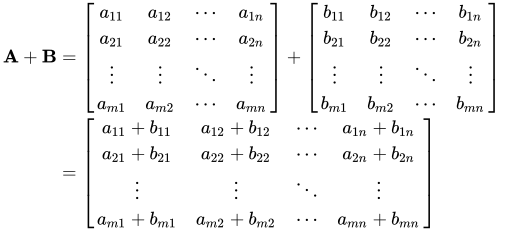
[edit]Two matrices must have an equal number of rows and columns to be added.[1] In which case, the sum of two matrices A and B will be a matrix which has the same number of rows and columns as A and B. The sum of A and B, denoted A + B, is computed by adding corresponding elements of A and B:[2][3]
-
A
+
B
=
[
a
11
a
12
⋯
a
1
n
a
21
a
22
⋯
a
2
n
⋮
⋮
⋱
⋮
a
m
1
a
m
2
⋯
a
m
n
]
+
[
b
11
b
12
⋯
b
1
n
b
21
b
22
⋯
b
2
n
⋮
⋮
⋱
⋮
b
m
1
b
m
2
⋯
b
m
n
]
=
[
a
11
+
b
11
a
12
+
b
12
⋯
a
1
n
+
b
1
n
a
21
+
b
21
a
22
+
b
22
⋯
a
2
n
+
b
2
n
⋮
⋮
⋱
⋮
a
m
1
+
b
m
1
a
m
2
+
b
m
2
⋯
a
m
n
+
b
m
n
]
{\displaystyle {\begin{aligned}\mathbf {A} +\mathbf {B} &={\begin{bmatrix}a_{11}&a_{12}&\cdots &a_{1n}\\a_{21}&a_{22}&\cdots &a_{2n}\\\vdots &\vdots &\ddots &\vdots \\a_{m1}&a_{m2}&\cdots &a_{mn}\\\end{bmatrix}}+{\begin{bmatrix}b_{11}&b_{12}&\cdots &b_{1n}\\b_{21}&b_{22}&\cdots &b_{2n}\\\vdots &\vdots &\ddots &\vdots \\b_{m1}&b_{m2}&\cdots &b_{mn}\\\end{bmatrix}}\\&={\begin{bmatrix}a_{11}+b_{11}&a_{12}+b_{12}&\cdots &a_{1n}+b_{1n}\\a_{21}+b_{21}&a_{22}+b_{22}&\cdots &a_{2n}+b_{2n}\\\vdots &\vdots &\ddots &\vdots \\a_{m1}+b_{m1}&a_{m2}+b_{m2}&\cdots &a_{mn}+b_{mn}\\\end{bmatrix}}\\\end{aligned}}\,\!}
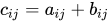
Or more concisely (assuming that A + B = C):[4]
-
c
i
j
=
a
i
j
+
b
i
j
{\displaystyle c_{ij}=a_{ij}+b_{ij}}
For example:
-
[
1
3
1
0
1
2
]
+
[
0
0
7
5
2
1
]
=
[
1
+
0
3
+
0
1
+
7
0
+
5
1
+
2
2
+
1
]
=
[
1
3
8
5
3
3
]
{\displaystyle {\begin{bmatrix}1&3\\1&0\\1&2\end{bmatrix}}+{\begin{bmatrix}0&0\\7&5\\2&1\end{bmatrix}}={\begin{bmatrix}1+0&3+0\\1+7&0+5\\1+2&2+1\end{bmatrix}}={\begin{bmatrix}1&3\\8&5\\3&3\end{bmatrix}}}

Similarly, it is also possible to subtract one matrix from another, as long as they have the same dimensions. The difference of A and B, denoted A − B, is computed by subtracting elements of B from corresponding elements of A, and has the same dimensions as A and B. For example:
-
[
1
3
1
0
1
2
]
−
[
0
0
7
5
2
1
]
=
[
1
−
0
3
−
0
1
−
7
0
−
5
1
−
2
2
−
1
]
=
[
1
3
−
6
−
5
−
1
1
]
{\displaystyle {\begin{bmatrix}1&3\\1&0\\1&2\end{bmatrix}}-{\begin{bmatrix}0&0\\7&5\\2&1\end{bmatrix}}={\begin{bmatrix}1-0&3-0\\1-7&0-5\\1-2&2-1\end{bmatrix}}={\begin{bmatrix}1&3\\-6&-5\\-1&1\end{bmatrix}}}

See also
[edit]Notes
[edit]- ^ Elementary Linear Algebra by Rorres Anton 10e p53
- ^ Lipschutz & Lipson 2017.
- ^ Riley, Hobson & Bence 2006.
- ^ Weisstein, Eric W. "Matrix Addition". mathworld.wolfram.com. Retrieved 2020-09-07.
References
[edit]- Lipschutz, Seymour; Lipson, Marc (2017). Schaum's Outline of Linear Algebra (6 ed.). McGraw-Hill Education. ISBN 9781260011449.
- Riley, K.F.; Hobson, M.P.; Bence, S.J. (2006). Mathematical methods for physics and engineering (3 ed.). Cambridge University Press. doi:10.1017/CBO9780511810763. ISBN 978-0-521-86153-3.