LSH is a cryptographic hash function designed in 2014 by South Korea to provide integrity in general-purpose software environments such as PCs and smart devices. LSH is one of the cryptographic algorithms approved by the Korean Cryptographic Module Validation Program (KCMVP).
And it is the national standard of South Korea (KS X 3262).
LSH is a cryptographic hash function designed in 2014 by South Korea to provide integrity in general-purpose software environments such as PCs and smart devices.[1] LSH is one of the cryptographic algorithms approved by the Korean Cryptographic Module Validation Program (KCMVP).
And it is the national standard of South Korea (KS X 3262).
The overall structure of the hash function LSH is shown in the following figure.
Overall structure of LSH
The hash function LSH has the wide-pipe Merkle-Damgård structure with one-zeros padding.
The message hashing process of LSH consists of the following three stages.
Initialization:
One-zeros padding of a given bit string message.
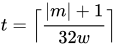
Conversion to 32-word array message blocks from the padded bit string message.
Initialization of a chaining variable with the initialization vector.
Compression:
Updating of chaining variables by iteration of a compression function with message blocks.
Finalization:
Generation of an
n
{\displaystyle n}
-bit hash value from the final chaining variable.
function Hash function LSH
input: Bit string message
m
{\displaystyle m}
output: Hash value
h
∈
{
0
,
1
}
n
{\displaystyle h\in \{0,1\}^{n}}
procedure
{\displaystyle \qquad }
One-zeros padding of
m
{\displaystyle m}
{\displaystyle \qquad }
Generation of
t
{\displaystyle t}
message blocks
{
M
(
i
)
}
i
=
0
t
−
1
{\displaystyle \{{\textsf {M}}^{(i)}\}_{i=0}^{t-1}}
, where
t
=
⌈
|
m
|
+
1
32
w
⌉
{\displaystyle t={\Big \lceil }{\frac {|m|+1}{32w}}{\Big \rceil }}
from the padded bit string
Let
m
{\displaystyle m}
be a given bit string message.
The given
m
{\displaystyle m}
is padded by one-zeros, i.e., the bit ‘1’ is appended to the end of
m
{\displaystyle m}
, and the bit ‘0’s are appended until a bit length of a padded message is
32
w
t
{\displaystyle 32wt}
, where
t
=
⌈
(
|
m
|
+
1
)
/
32
w
⌉
{\displaystyle t=\lceil (|m|+1)/32w\rceil }
and
⌈
x
⌉
{\displaystyle \lceil x\rceil }
is the smallest integer not less than
x
{\displaystyle x}
.
Let
m
p
=
m
0
‖
m
1
‖
…
‖
m
(
32
w
t
−
1
)
{\displaystyle m_{p}=m_{0}\|m_{1}\|\ldots \|m_{(32wt-1)}}
be the one-zeros-padded
32
w
t
{\displaystyle 32wt}
-bit string of
m
{\displaystyle m}
.
Then
m
p
{\displaystyle m_{p}}
is considered as a
4
w
t
{\displaystyle 4wt}
-byte array
m
a
=
(
m
[
0
]
,
…
,
m
[
4
w
t
−
1
]
)
{\displaystyle m_{a}=(m[0],\ldots ,m[4wt-1])}
, where
m
[
k
]
=
m
8
k
‖
m
(
8
k
+
1
)
‖
…
‖
m
(
8
k
+
7
)
{\displaystyle m[k]=m_{8k}\|m_{(8k+1)}\|\ldots \|m_{(8k+7)}}
for all
0
≤
k
≤
(
4
w
t
−
1
)
{\displaystyle 0\leq k\leq (4wt-1)}
.
The
4
w
t
{\displaystyle 4wt}
-byte array
m
a
{\displaystyle m_{a}}
converts into a
32
t
{\displaystyle 32t}
-word array
M
=
(
M
[
0
]
,
…
,
M
[
32
t
−
1
]
)
{\displaystyle {\textsf {M}}=(M[0],\ldots ,M[32t-1])}
as follows.
M
[
s
]
←
m
[
w
s
/
8
+
(
w
/
8
−
1
)
]
‖
…
‖
m
[
w
s
/
8
+
1
]
‖
m
[
w
s
/
8
]
{\displaystyle M[s]\leftarrow m[ws/8+(w/8-1)]\|\ldots \|m[ws/8+1]\|m[ws/8]}
(
0
≤
s
≤
(
32
t
−
1
)
)
{\displaystyle (0\leq s\leq (32t-1))}
From the word array
M
{\displaystyle {\textsf {M}}}
, we define the
t
{\displaystyle t}
32-word array message blocks
{
M
(
i
)
}
i
=
0
t
−
1
{\displaystyle \{{\textsf {M}}^{(i)}\}_{i=0}^{t-1}}
as follows.
M
(
i
)
←
(
M
[
32
i
]
,
M
[
32
i
+
1
]
,
…
,
M
[
32
i
+
31
]
)
{\displaystyle {\textsf {M}}^{(i)}\leftarrow (M[32i],M[32i+1],\ldots ,M[32i+31])}
(
0
≤
i
≤
(
t
−
1
)
)
{\displaystyle (0\leq i\leq (t-1))}
The 16-word array chaining variable
CV
(
0
)
{\displaystyle {\textsf {CV}}^{(0)}}
is initialized to the initialization vector
IV
{\displaystyle {\textsf {IV}}}
.
CV
(
0
)
[
l
]
←
IV
[
l
]
{\displaystyle {\textsf {CV}}^{(0)}[l]\leftarrow {\textsf {IV}}[l]}
(
0
≤
l
≤
15
)
{\displaystyle (0\leq l\leq 15)}
The initialization vector
IV
{\displaystyle {\textsf {IV}}}
is as follows.
In the following tables, all values are expressed in hexadecimal form.
In this stage, the
t
{\displaystyle t}
32-word array message blocks
{
M
(
i
)
}
i
=
0
t
−
1
{\displaystyle \{{\textsf {M}}^{(i)}\}_{i=0}^{t-1}}
, which are generated from a message
m
{\displaystyle m}
in the initialization stage, are compressed by iteration of compression functions.
The compression function
CF
:
W
16
×
W
32
→
W
16
{\displaystyle {\textrm {CF}}:{\mathcal {W}}^{16}\times {\mathcal {W}}^{32}\rightarrow {\mathcal {W}}^{16}}
has two inputs; the
i
{\displaystyle i}
-th 16-word chaining variable
CV
(
i
)
{\displaystyle {\textsf {CV}}^{(i)}}
and the
i
{\displaystyle i}
-th 32-word message block
M
(
i
)
{\displaystyle {\textsf {M}}^{(i)}}
.
And it returns the
(
i
+
1
)
{\displaystyle (i+1)}
-th 16-word chaining variable
CV
(
i
+
1
)
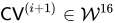
{\displaystyle {\textsf {CV}}^{(i+1)}}
.
Here and subsequently,
W
t
{\displaystyle {\mathcal {W}}^{t}}
denotes the set of all
t
{\displaystyle t}
-word arrays for
t
≥
1
{\displaystyle t\geq 1}
.
The following four functions are used in a compression function:
Message expansion function
MsgExp
:
W
32
→
W
16
(
N
s
+
1
)
{\displaystyle {\textrm {MsgExp}}:{\mathcal {W}}^{32}\rightarrow {\mathcal {W}}^{16(Ns+1)}}
Message addition function
MsgAdd
:
W
16
×
W
16
→
W
16
{\displaystyle {\textrm {MsgAdd}}:{\mathcal {W}}^{16}\times {\mathcal {W}}^{16}\rightarrow {\mathcal {W}}^{16}}
Mix function
Mix
j
:
W
16
→
W
16
{\displaystyle {\textrm {Mix}}_{j}:{\mathcal {W}}^{16}\rightarrow {\mathcal {W}}^{16}}
Word-permutation function
WordPerm
:
W
16
→
W
16
{\displaystyle {\textrm {WordPerm}}:{\mathcal {W}}^{16}\rightarrow {\mathcal {W}}^{16}}
The overall structure of the compression function is shown in the following figure.
Compression function of LSH
In a compression function, the message expansion function
MsgExp
{\displaystyle {\textrm {MsgExp}}}
generates
(
N
s
+
1
)
{\displaystyle (N_{s}+1)}
16-word array sub-messages
{
M
j
(
i
)
}
j
=
0
N
s
{\displaystyle \{{\textsf {M}}_{j}^{(i)}\}_{j=0}^{N_{s}}}
from given
M
(
i
)
{\displaystyle {\textsf {M}}^{(i)}}
.
Let
T
=
(
T
[
0
]
,
…
,
T
[
15
]
)
{\displaystyle {\textsf {T}}=(T[0],\ldots ,T[15])}
be a temporary 16-word array set to the
i
{\displaystyle i}
-th chaining variable
CV
(
i
)
{\displaystyle {\textsf {CV}}^{(i)}}
.
The
j
{\displaystyle j}
-th step function
Step
j
{\displaystyle {\textrm {Step}}_{j}}
having two inputs
T
{\displaystyle {\textsf {T}}}
and
M
j
(
i
)
{\displaystyle {\textsf {M}}_{j}^{(i)}}
updates
T
{\displaystyle {\textsf {T}}}
, i.e.,
T
←
Step
j
(
T
,
M
j
(
i
)
)
{\displaystyle {\textsf {T}}\leftarrow {\textrm {Step}}_{j}\left({\textsf {T}},{\textsf {M}}_{j}^{(i)}\right)}
.
All step functions are proceeded in order
j
=
0
,
…
,
N
s
−
1
{\displaystyle j=0,\ldots ,N_{s}-1}
.
Then one more
MsgAdd
{\displaystyle {\textrm {MsgAdd}}}
operation by
M
N
s
(
i
)
{\displaystyle {\textsf {M}}_{N_{s}}^{(i)}}
is proceeded, and the
(
i
+
1
)
{\displaystyle (i+1)}
-th chaining variable
CV
(
i
+
1
)
{\displaystyle {\textsf {CV}}^{(i+1)}}
is set to
T
{\displaystyle {\textsf {T}}}
.
The process of a compression function in detail is as follows.
function Compression function
CF
{\displaystyle {\textrm {CF}}}
input: The
i
{\displaystyle i}
-th chaining variable
CV
(
i
)
∈
W
16
{\displaystyle {\textsf {CV}}^{(i)}\in {\mathcal {W}}^{16}}
and the
i
{\displaystyle i}
-th message block
M
(
i
)
∈
W
32
{\displaystyle {\textsf {M}}^{(i)}\in {\mathcal {W}}^{32}}
output: The
(
i
+
1
)
{\displaystyle (i+1)}
-th chaining variable
CV
(
i
+
1
)
∈
W
16
{\displaystyle {\textsf {CV}}^{(i+1)}\in {\mathcal {W}}^{16}}
procedure
{\displaystyle \qquad }
{
M
j
(
i
)
}
j
=
0
N
s
←
MsgExp
(
M
(
i
)
)
{\displaystyle \{{\textsf {M}}_{j}^{(i)}\}_{j=0}^{N_{s}}\leftarrow {\textrm {MsgExp}}\left({\textsf {M}}^{(i)}\right)}
{\displaystyle \qquad }
T
←
CV
(
i
)
{\displaystyle {\textsf {T}}\leftarrow {\textsf {CV}}^{(i)}}
{\displaystyle \qquad }
for
j
=
0
{\displaystyle j=0}
to
(
N
s
−
1
)
{\displaystyle (N_{s}-1)}
do
{\displaystyle \qquad }
{\displaystyle \qquad }
T
←
Step
j
(
T
,
M
j
(
i
)
)
{\displaystyle {\textsf {T}}\leftarrow {\textrm {Step}}_{j}\left({\textsf {T}},{\textsf {M}}_{j}^{(i)}\right)}
{\displaystyle \qquad }
end for
{\displaystyle \qquad }
CV
(
i
+
1
)
←
MsgAdd
(
T
,
M
N
s
(
i
)
)
{\displaystyle {\textsf {CV}}^{(i+1)}\leftarrow {\textrm {MsgAdd}}\left({\textsf {T}},{\textsf {M}}_{N_{s}}^{(i)}\right)}
Here the
j
{\displaystyle j}
-th step function
Step
j
:
W
16
×
W
16
→
W
16
{\displaystyle {\textrm {Step}}_{j}:{\mathcal {W}}^{16}\times {\mathcal {W}}^{16}\rightarrow {\mathcal {W}}^{16}}
is as follows.
Let
M
(
i
)
=
(
M
(
i
)
[
0
]
,
…
,
M
(
i
)
[
31
]
)
{\displaystyle {\textsf {M}}^{(i)}=(M^{(i)}[0],\ldots ,M^{(i)}[31])}
be the
i
{\displaystyle i}
-th 32-word array message block.
The message expansion function
MsgExp
{\displaystyle {\textrm {MsgExp}}}
generates
(
N
s
+
1
)
{\displaystyle (N_{s}+1)}
16-word array sub-messages
{
M
j
(
i
)
}
j
=
0
N
s
{\displaystyle \{{\textsf {M}}_{j}^{(i)}\}_{j=0}^{N_{s}}}
from a message block
M
(
i
)
{\displaystyle {\textsf {M}}^{(i)}}
.
The first two sub-messages
M
0
(
i
)
=
(
M
0
(
i
)
[
0
]
,
…
,
M
0
(
i
)
[
15
]
)
{\displaystyle {\textsf {M}}_{0}^{(i)}=(M_{0}^{(i)}[0],\ldots ,M_{0}^{(i)}[15])}
and
M
1
(
i
)
=
(
M
1
(
i
)
[
0
]
,
…
,
M
1
(
i
)
[
15
]
)
{\displaystyle {\textsf {M}}_{1}^{(i)}=(M_{1}^{(i)}[0],\ldots ,M_{1}^{(i)}[15])}
are defined as follows.
M
0
(
i
)
←
(
M
(
i
)
[
0
]
,
M
(
i
)
[
1
]
,
…
,
M
(
i
)
[
15
]
)
{\displaystyle {\textsf {M}}_{0}^{(i)}\leftarrow (M^{(i)}[0],M^{(i)}[1],\ldots ,M^{(i)}[15])}
M
1
(
i
)
←
(
M
(
i
)
[
16
]
,
M
(
i
)
[
17
]
,
…
,
M
(
i
)
[
31
]
)
{\displaystyle {\textsf {M}}_{1}^{(i)}\leftarrow (M^{(i)}[16],M^{(i)}[17],\ldots ,M^{(i)}[31])}
The next sub-messages
{
M
j
(
i
)
=
(
M
j
(
i
)
[
0
]
,
…
,
M
j
(
i
)
[
15
]
)
}
j
=
2
N
s
{\displaystyle \{{\textsf {M}}_{j}^{(i)}=(M_{j}^{(i)}[0],\ldots ,M_{j}^{(i)}[15])\}_{j=2}^{N_{s}}}
are generated as follows.
M
j
(
i
)
[
l
]
←
M
j
−
1
(
i
)
[
l
]
⊞
M
j
−
2
(
i
)
[
τ
(
l
)
]
{\displaystyle {\textsf {M}}_{j}^{(i)}[l]\leftarrow {\textsf {M}}_{j-1}^{(i)}[l]\boxplus {\textsf {M}}_{j-2}^{(i)}[\tau (l)]}
(
0
≤
l
≤
15
,
2
≤
j
≤
N
s
)
{\displaystyle (0\leq l\leq 15,\ 2\leq j\leq N_{s})}
Here
τ
{\displaystyle \tau }
is the permutation over
Z
16
{\displaystyle \mathbb {Z} _{16}}
defined as follows.
The permutation
τ
:
Z
16
→
Z
16
{\displaystyle \tau :\mathbb {Z} _{16}\rightarrow \mathbb {Z} _{16}}
For two 16-word arrays
X
=
(
X
[
0
]
,
…
,
X
[
15
]
)
{\displaystyle {\textsf {X}}=(X[0],\ldots ,X[15])}
and
Y
=
(
Y
[
0
]
,
…
,
Y
[
15
]
)
{\displaystyle {\textsf {Y}}=(Y[0],\ldots ,Y[15])}
, the message addition function
MsgAdd
:
W
16
×
W
16
→
W
16
{\displaystyle {\textrm {MsgAdd}}:{\mathcal {W}}^{16}\times {\mathcal {W}}^{16}\rightarrow {\mathcal {W}}^{16}}
is defined as follows.
MsgAdd
(
X
,
Y
)
:=
(
X
[
0
]
⊕
Y
[
0
]
,
…
,
X
[
15
]
⊕
Y
[
15
]
)
{\displaystyle {\textrm {MsgAdd}}({\textsf {X}},{\textsf {Y}}):=(X[0]\oplus Y[0],\ldots ,X[15]\oplus Y[15])}
The
j
{\displaystyle j}
-th mix function
Mix
j
:
W
16
→
W
16
{\displaystyle {\textrm {Mix}}_{j}:{\mathcal {W}}^{16}\rightarrow {\mathcal {W}}^{16}}
updates the 16-word array
T
=
(
T
[
0
]
,
…
,
T
[
15
]
)
{\displaystyle {\textsf {T}}=(T[0],\ldots ,T[15])}
by mixing every two-word pair;
T
[
l
]
{\displaystyle T[l]}
and
T
[
l
+
8
]
{\displaystyle T[l+8]}
for
(
0
≤
l
<
8
)
{\displaystyle (0\leq l<8)}
.
For
0
≤
j
<
N
s
{\displaystyle 0\leq j<N_{s}}
, the mix function
Mix
j
{\displaystyle {\textrm {Mix}}_{j}}
proceeds as follows.
(
T
[
l
]
,
T
[
l
+
8
]
)
←
Mix
j
,
l
(
T
[
l
]
,
T
[
l
+
8
]
)
{\displaystyle (T[l],T[l+8])\leftarrow {\textrm {Mix}}_{j,l}(T[l],T[l+8])}
(
0
≤
l
<
8
)
{\displaystyle (0\leq l<8)}
Here
Mix
j
,
l
{\displaystyle {\textrm {Mix}}_{j,l}}
is a two-word mix function.
Let
X
{\displaystyle X}
and
Y
{\displaystyle Y}
be words.
The two-word mix function
Mix
j
,
l
:
W
2
→
W
2
{\displaystyle {\textrm {Mix}}_{j,l}:{\mathcal {W}}^{2}\rightarrow {\mathcal {W}}^{2}}
is defined as follows.
function Two-word mix function
Mix
j
,
l
{\displaystyle {\textrm {Mix}}_{j,l}}
input: Words
X
{\displaystyle X}
and
Y
{\displaystyle Y}
output: Words
X
{\displaystyle X}
and
Y
{\displaystyle Y}
procedure
{\displaystyle \qquad }
X
←
X
⊞
Y
{\displaystyle X\leftarrow X\boxplus Y}
;
X
←
X
⋘
α
j
{\displaystyle \qquad X\leftarrow X^{\lll \alpha _{j}}}
;
{\displaystyle \qquad }
X
←
X
⊕
S
C
j
[
l
]
{\displaystyle X\leftarrow X\oplus SC_{j}[l]}
;
{\displaystyle \qquad }
Y
←
X
⊞
Y
{\displaystyle Y\leftarrow X\boxplus Y}
;
Y
←
Y
⋘
β
j
{\displaystyle \qquad Y\leftarrow Y^{\lll \beta _{j}}}
;
{\displaystyle \qquad }
X
←
X
⊞
Y
{\displaystyle X\leftarrow X\boxplus Y}
;
Y
←
Y
⋘
γ
l
{\displaystyle \qquad Y\leftarrow Y^{\lll \gamma _{l}}}
;
{\displaystyle \qquad }
return
X
{\displaystyle X}
,
Y
{\displaystyle Y}
;
The two-word mix function
Mix
j
,
l
{\displaystyle {\textrm {Mix}}_{j,l}}
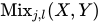
is shown in the following figure.
Two-word mix function
Mix
j
,
l
(
X
,
Y
)
{\displaystyle {\textrm {Mix}}_{j,l}(X,Y)}
The bit rotation amounts
α
j
{\displaystyle \alpha _{j}}
,
β
j
{\displaystyle \beta _{j}}
,
γ
l
{\displaystyle \gamma _{l}}
used in
Mix
j
,
l
{\displaystyle {\textrm {Mix}}_{j,l}}
are shown in the following table.
Bit rotation amounts
α
j
{\displaystyle \alpha _{j}}
,
β
j
{\displaystyle \beta _{j}}
, and
γ
l
{\displaystyle \gamma _{l}}
w
{\displaystyle w}
j
{\displaystyle j}
α
j
{\displaystyle \alpha _{j}}
β
j
{\displaystyle \beta _{j}}
γ
0
{\displaystyle \gamma _{0}}
γ
1
{\displaystyle \gamma _{1}}
γ
2
{\displaystyle \gamma _{2}}
γ
3
{\displaystyle \gamma _{3}}
γ
4
{\displaystyle \gamma _{4}}
γ
5
{\displaystyle \gamma _{5}}
γ
6
{\displaystyle \gamma _{6}}
γ
7
{\displaystyle \gamma _{7}}
32
even
29
1
0
8
16
24
24
16
8
0
odd
5
17
64
even
23
59
0
16
32
48
8
24
40
56
odd
7
3
The
j
{\displaystyle j}
-th 8-word array constant
SC
j
=
(
S
C
j
[
0
]
,
…
,
S
C
j
[
7
]
)
{\displaystyle {\textsf {SC}}_{j}=(SC_{j}[0],\ldots ,SC_{j}[7])}
used in
Mix
j
,
l
{\displaystyle {\textrm {Mix}}_{j,l}}
for
0
≤
l
<
8
{\displaystyle 0\leq l<8}
is defined as follows.
The initial 8-word array constant
SC
0
=
(
S
C
0
[
0
]
,
…
,
S
C
0
[
7
]
)
{\displaystyle {\textsf {SC}}_{0}=(SC_{0}[0],\ldots ,SC_{0}[7])}
is defined in the following table.
For
1
≤
j
<
N
s
{\displaystyle 1\leq j<N_{s}}
, the
j
{\displaystyle j}
-th constant
SC
j
=
(
S
C
j
[
0
]
,
…
,
S
C
j
[
7
]
)
{\displaystyle {\textsf {SC}}_{j}=(SC_{j}[0],\ldots ,SC_{j}[7])}
is generated by
S
C
j
[
l
]
←
S
C
j
−
1
[
l
]
⊞
S
C
j
−
1
[
l
]
⋘
8
{\displaystyle SC_{j}[l]\leftarrow SC_{j-1}[l]\boxplus SC_{j-1}[l]^{\lll 8}}
for
0
≤
l
<
8
{\displaystyle 0\leq l<8}
.
Let
X
=
(
X
[
0
]
,
…
,
X
[
15
]
)
{\displaystyle {\textsf {X}}=(X[0],\ldots ,X[15])}
be a 16-word array.
The word-permutation function
WordPerm
:
W
16
→
W
16
{\displaystyle {\textrm {WordPerm}}:{\mathcal {W}}^{16}\rightarrow {\mathcal {W}}^{16}}
is defined as follows.
The finalization function
FIN
n
:
W
16
→
{
0
,
1
}
n
{\displaystyle {\textrm {FIN}}_{n}:{\mathcal {W}}^{16}\rightarrow \{0,1\}^{n}}
returns
n
{\displaystyle n}
-bit hash value
h
{\displaystyle h}
from the final chaining variable
CV
(
t
)
=
(
C
V
(
t
)
[
0
]
,
…
,
C
V
(
t
)
[
15
]
)
{\displaystyle {\textsf {CV}}^{(t)}=(CV^{(t)}[0],\ldots ,CV^{(t)}[15])}
.
When
H
=
(
H
[
0
]
,
…
,
H
[
7
]
)
{\displaystyle {\textsf {H}}=(H[0],\ldots ,H[7])}
is an 8-word variable and
h
b
=
(
h
b
[
0
]
,
…
,
h
b
[
w
−
1
]
)
{\displaystyle {\textsf {h}}_{\textsf {b}}=(h_{b}[0],\ldots ,h_{b}[w-1])}
is a
w
{\displaystyle w}
-byte variable, the finalization function
FIN
n
{\displaystyle {\textrm {FIN}}_{n}}
performs the following procedure.
H
[
l
]
←
C
V
(
t
)
[
l
]
⊕
C
V
(
t
)
[
l
+
8
]
{\displaystyle H[l]\leftarrow CV^{(t)}[l]\oplus CV^{(t)}[l+8]}
(
0
≤
l
≤
7
)
{\displaystyle (0\leq l\leq 7)}
h
b
[
s
]
←
H
[
⌊
8
s
/
w
⌋
]
[
7
:
0
]
⋙
(
8
s
mod
w
)
{\displaystyle h_{b}[s]\leftarrow H[\lfloor 8s/w\rfloor ]_{[7:0]}^{\ggg (8s\mod w)}}
(
0
≤
s
≤
(
w
−
1
)
)
{\displaystyle (0\leq s\leq (w-1))}
h
←
(
h
b
[
0
]
‖
…
‖
h
b
[
w
−
1
]
)
[
0
:
n
−
1
]
{\displaystyle h\leftarrow (h_{b}[0]\|\ldots \|h_{b}[w-1])_{[0:n-1]}}
Here,
X
[
i
:
j
]
{\displaystyle X_{[i:j]}}
denotes
x
i
‖
x
i
−
1
‖
…
‖
x
j
{\displaystyle x_{i}\|x_{i-1}\|\ldots \|x_{j}}
, the sub-bit string of a word
X
{\displaystyle X}
for
i
≥
j
{\displaystyle i\geq j}
.
And
x
[
i
:
j
]
{\displaystyle x_{[i:j]}}
denotes
x
i
‖
x
i
+
1
‖
…
‖
x
j
{\displaystyle x_{i}\|x_{i+1}\|\ldots \|x_{j}}
, the sub-bit string of a
l
{\displaystyle l}
-bit string
x
=
x
0
‖
x
1
‖
…
‖
x
l
−
1
{\displaystyle x=x_{0}\|x_{1}\|\ldots \|x_{l-1}}
for
i
≤
j
{\displaystyle i\leq j}
.
LSH is secure against known attacks on hash functions up to now.
LSH is collision-resistant for
q
<
2
n
/
2
{\displaystyle q<2^{n/2}}
and preimage-resistant and second-preimage-resistant for
q
<
2
n
{\displaystyle q<2^{n}}
in the ideal cipher model, where
q
{\displaystyle q}
is a number of queries for LSH structure.[1]
LSH-256 is secure against all the existing hash function attacks when the number of steps is 13 or more, while LSH-512 is secure if the number of steps is 14 or more.
Note that the steps which work as security margin are 50% of the compression function.[1]
LSH outperforms SHA-2/3 on various software platforms.
The following table shows the speed performance of 1MB message hashing of LSH on several platforms.
The following table is the comparison at the platform based on Haswell, LSH is measured on Intel Core i7-4770k @ 3.5 GHz quad core platform, and others are measured on Intel Core i5-4570S @ 2.9 GHz quad core platform.
Speed benchmark of LSH, SHA-2 and the SHA-3 finalists at the platform based on Haswell CPU (cycles/byte)[1]
Algorithm
Message size in bytes
long
4,096
1,536
576
64
8
LSH-256-256
3.60
3.71
3.90
4.08
8.19
65.37
Skein-512-256
5.01
5.58
5.86
6.49
13.12
104.50
Blake-256
6.61
7.63
7.87
9.05
16.58
72.50
Grøstl-256
9.48
10.68
12.18
13.71
37.94
227.50
Keccak-256
10.56
10.52
9.90
11.99
23.38
187.50
SHA-256
10.82
11.91
12.26
13.51
24.88
106.62
JH-256
14.70
15.50
15.94
17.06
31.94
257.00
LSH-512-512
2.39
2.54
2.79
3.31
10.81
85.62
Skein-512-512
4.67
5.51
5.80
6.44
13.59
108.25
Blake-512
4.96
6.17
6.82
7.38
14.81
116.50
SHA-512
7.65
8.24
8.69
9.03
17.22
138.25
Grøstl-512
12.78
15.44
17.30
17.99
51.72
417.38
JH-512
14.25
15.66
16.14
17.34
32.69
261.00
Keccak-512
16.36
17.86
18.46
20.35
21.56
171.88
The following table is measured on Samsung Exynos 5250 ARM Cortex-A15 @ 1.7 GHz dual core platform.
Speed benchmark of LSH, SHA-2 and the SHA-3 finalists at the platform based on Exynos 5250 ARM Cortex-A15 CPU (cycles/byte)[1]
LSH-512-224("abc") = D1 68 32 34 51 3E C5 69 83 94 57 1E AD 12 8A 8C D5 37 3E 97 66 1B A2 0D CF 89 E4 89
LSH-512-256("abc") = CD 89 23 10 53 26 02 33 2B 61 3F 1E C1 1A 69 62 FC A6 1E A0 9E CF FC D4 BC F7 58 58 D8 02 ED EC
LSH-512-384("abc") = 5F 34 4E FA A0 E4 3C CD 2E 5E 19 4D 60 39 79 4B 4F B4 31 F1 0F B4 B6 5F D4 5E 9D A4 EC DE 0F 27 B6 6E 8D BD FA 47 25 2E 0D 0B 74 1B FD 91 F9 FE
LSH is free for any use public or private, commercial or non-commercial.
The source code for distribution of LSH implemented in C, Java, and Python can be downloaded from KISA's cryptography use activation webpage.[2]














![{\displaystyle m_{a}=(m[0],\ldots ,m[4wt-1])}](https://wikimedia.org/api/rest_v1/media/math/render/svg/cbc48d8752f23db915bd9326469042c7c23626d2)
![{\displaystyle m[k]=m_{8k}\|m_{(8k+1)}\|\ldots \|m_{(8k+7)}}](https://wikimedia.org/api/rest_v1/media/math/render/svg/00194b743f9909d356a205887738da5349b7249d)



![{\displaystyle {\textsf {M}}=(M[0],\ldots ,M[32t-1])}](https://wikimedia.org/api/rest_v1/media/math/render/svg/bdbfb053f15842258c6a818f02fee38e61136130)
![{\displaystyle M[s]\leftarrow m[ws/8+(w/8-1)]\|\ldots \|m[ws/8+1]\|m[ws/8]}](https://wikimedia.org/api/rest_v1/media/math/render/svg/ff942009f93b5f2bf938904afa8d1c87c1df093e)


![{\displaystyle {\textsf {M}}^{(i)}\leftarrow (M[32i],M[32i+1],\ldots ,M[32i+31])}](https://wikimedia.org/api/rest_v1/media/math/render/svg/9c89cafb0da4dc3e59e17a999d72b66aa8fb15b9)



![{\displaystyle {\textsf {CV}}^{(0)}[l]\leftarrow {\textsf {IV}}[l]}](https://wikimedia.org/api/rest_v1/media/math/render/svg/d00f73c945226f234883521f4244aec7d19585b3)

![{\displaystyle {\textsf {IV}}[0]}](https://wikimedia.org/api/rest_v1/media/math/render/svg/e999e9f3741fbdf52af9cc4a4d9be0b6ccf6945f)
![{\displaystyle {\textsf {IV}}[1]}](https://wikimedia.org/api/rest_v1/media/math/render/svg/19ef984c6c0763a1541d89acf2fa95341b570fa7)
![{\displaystyle {\textsf {IV}}[2]}](https://wikimedia.org/api/rest_v1/media/math/render/svg/03c25b70ee80852f78587b5154f3ddad3a9e007a)
![{\displaystyle {\textsf {IV}}[3]}](https://wikimedia.org/api/rest_v1/media/math/render/svg/5d723c75229cca886dc8219503ca59f941b57e34)
![{\displaystyle {\textsf {IV}}[4]}](https://wikimedia.org/api/rest_v1/media/math/render/svg/c027deaf01f0c4b67a9749d6ff1def884912c858)
![{\displaystyle {\textsf {IV}}[5]}](https://wikimedia.org/api/rest_v1/media/math/render/svg/0cd23ddaf854ce9b457cd9c5d0da3efa6aae8274)
![{\displaystyle {\textsf {IV}}[6]}](https://wikimedia.org/api/rest_v1/media/math/render/svg/4ed177acf98ade6005bbc3598aa9ad09a21f3be6)
![{\displaystyle {\textsf {IV}}[7]}](https://wikimedia.org/api/rest_v1/media/math/render/svg/6bd8b8e7594b13b83421f693bc44bc9a4ef862bf)
![{\displaystyle {\textsf {IV}}[8]}](https://wikimedia.org/api/rest_v1/media/math/render/svg/f291543f56da1d3c98a207c145214248d5417d0c)
![{\displaystyle {\textsf {IV}}[9]}](https://wikimedia.org/api/rest_v1/media/math/render/svg/ddebb4dacc2f97b7603f883187c8d2bcbc43c860)
![{\displaystyle {\textsf {IV}}[10]}](https://wikimedia.org/api/rest_v1/media/math/render/svg/bb7dbd6006744b44ffd77084d528da5588bdda63)
![{\displaystyle {\textsf {IV}}[11]}](https://wikimedia.org/api/rest_v1/media/math/render/svg/ae7f16181346c9d69ee705ea0858c9102ab54e2d)
![{\displaystyle {\textsf {IV}}[12]}](https://wikimedia.org/api/rest_v1/media/math/render/svg/2a2bd2ddfbeace72719eed88c2eea81ff3904c80)
![{\displaystyle {\textsf {IV}}[13]}](https://wikimedia.org/api/rest_v1/media/math/render/svg/2361328bc13a1f6fe820a015a2ee0b2220d28d57)
![{\displaystyle {\textsf {IV}}[14]}](https://wikimedia.org/api/rest_v1/media/math/render/svg/4897271813f7c994d55ddd614305fc32cac0cbee)
![{\displaystyle {\textsf {IV}}[15]}](https://wikimedia.org/api/rest_v1/media/math/render/svg/99235ba6fce415b369c060c2381097b6978b52a5)









![{\displaystyle {\textsf {T}}=(T[0],\ldots ,T[15])}](https://wikimedia.org/api/rest_v1/media/math/render/svg/e4e09d90a1fc91872834fcd3db926cdf0232846f)












![{\displaystyle {\textsf {M}}^{(i)}=(M^{(i)}[0],\ldots ,M^{(i)}[31])}](https://wikimedia.org/api/rest_v1/media/math/render/svg/35b851ae62b4ce876b5a95aae53bf7832d9ceba5)
![{\displaystyle {\textsf {M}}_{0}^{(i)}=(M_{0}^{(i)}[0],\ldots ,M_{0}^{(i)}[15])}](https://wikimedia.org/api/rest_v1/media/math/render/svg/a2939431adf746a70d49069a72f4df41ec59152c)
![{\displaystyle {\textsf {M}}_{1}^{(i)}=(M_{1}^{(i)}[0],\ldots ,M_{1}^{(i)}[15])}](https://wikimedia.org/api/rest_v1/media/math/render/svg/dda4cbacdb5659a94106aabaa03539a5ae9479c2)
![{\displaystyle {\textsf {M}}_{0}^{(i)}\leftarrow (M^{(i)}[0],M^{(i)}[1],\ldots ,M^{(i)}[15])}](https://wikimedia.org/api/rest_v1/media/math/render/svg/8bc56dd40f2cf9561c310e1cb9266c02c0d6a5ab)
![{\displaystyle {\textsf {M}}_{1}^{(i)}\leftarrow (M^{(i)}[16],M^{(i)}[17],\ldots ,M^{(i)}[31])}](https://wikimedia.org/api/rest_v1/media/math/render/svg/79c190f11728ea49c9f324944be1d4c878c53227)
![{\displaystyle \{{\textsf {M}}_{j}^{(i)}=(M_{j}^{(i)}[0],\ldots ,M_{j}^{(i)}[15])\}_{j=2}^{N_{s}}}](https://wikimedia.org/api/rest_v1/media/math/render/svg/28baad504de33b33cec8eb93d02d2dc4d90c51d1)
![{\displaystyle {\textsf {M}}_{j}^{(i)}[l]\leftarrow {\textsf {M}}_{j-1}^{(i)}[l]\boxplus {\textsf {M}}_{j-2}^{(i)}[\tau (l)]}](https://wikimedia.org/api/rest_v1/media/math/render/svg/f9b4426630f63a02dd6235065ece3cc5a0833663)






![{\displaystyle {\textsf {X}}=(X[0],\ldots ,X[15])}](https://wikimedia.org/api/rest_v1/media/math/render/svg/9013d421817a8cf5117819d4484066cc9adef1b5)
![{\displaystyle {\textsf {Y}}=(Y[0],\ldots ,Y[15])}](https://wikimedia.org/api/rest_v1/media/math/render/svg/2525d8d1074a2047bd22fc53aad1f74c93e3700e)
![{\displaystyle {\textrm {MsgAdd}}({\textsf {X}},{\textsf {Y}}):=(X[0]\oplus Y[0],\ldots ,X[15]\oplus Y[15])}](https://wikimedia.org/api/rest_v1/media/math/render/svg/116a4f232b0e499dec64cad7c873fd5feb163043)
![{\displaystyle T[l]}](https://wikimedia.org/api/rest_v1/media/math/render/svg/b1aa20a1c0598137a811b490168efae37eb82058)
![{\displaystyle T[l+8]}](https://wikimedia.org/api/rest_v1/media/math/render/svg/a217b6395baa6d31045da231e60e09deb3ac56aa)


![{\displaystyle (T[l],T[l+8])\leftarrow {\textrm {Mix}}_{j,l}(T[l],T[l+8])}](https://wikimedia.org/api/rest_v1/media/math/render/svg/bcbfbb4b4c4dae0c9b3562bd5a5632c078e536c3)



![{\displaystyle X\leftarrow X\oplus SC_{j}[l]}](https://wikimedia.org/api/rest_v1/media/math/render/svg/81303461fe349f41536a9de3b97568351a29bdee)






![{\displaystyle {\textsf {SC}}_{j}=(SC_{j}[0],\ldots ,SC_{j}[7])}](https://wikimedia.org/api/rest_v1/media/math/render/svg/efecbf19a2f53ca2817f56703e737cfd9886f68b)

![{\displaystyle {\textsf {SC}}_{0}=(SC_{0}[0],\ldots ,SC_{0}[7])}](https://wikimedia.org/api/rest_v1/media/math/render/svg/60ae359b2a28f6fbf8babfc37b5104098ebceca7)

![{\displaystyle SC_{j}[l]\leftarrow SC_{j-1}[l]\boxplus SC_{j-1}[l]^{\lll 8}}](https://wikimedia.org/api/rest_v1/media/math/render/svg/26a0a4dc7a14e437f7ab4c709adc9a98fbc4b63e)


![{\displaystyle SC_{0}[0]}](https://wikimedia.org/api/rest_v1/media/math/render/svg/68d1bf7cd02ea4ce227fad05bee1ef10edf21c0d)
![{\displaystyle SC_{0}[1]}](https://wikimedia.org/api/rest_v1/media/math/render/svg/53155ed01cf05325fc1859cf17d1cedf334cf95c)
![{\displaystyle SC_{0}[2]}](https://wikimedia.org/api/rest_v1/media/math/render/svg/5bab5db617e31e28457e43edfcbb76dbcf623df3)
![{\displaystyle SC_{0}[3]}](https://wikimedia.org/api/rest_v1/media/math/render/svg/73cd303774e917e32fb6b20b1282a69c69ad47da)
![{\displaystyle SC_{0}[4]}](https://wikimedia.org/api/rest_v1/media/math/render/svg/6518b1bf1a8a2d3539ad10dcde5ad1762d1c8d30)
![{\displaystyle SC_{0}[5]}](https://wikimedia.org/api/rest_v1/media/math/render/svg/3f29498127cd8b547101780ac7d6faebc5e40a86)
![{\displaystyle SC_{0}[6]}](https://wikimedia.org/api/rest_v1/media/math/render/svg/63b1c7d4c29c8ce552a4c9c8c051ff647c86f425)
![{\displaystyle SC_{0}[7]}](https://wikimedia.org/api/rest_v1/media/math/render/svg/d8390e42cb325cfd246dc5fbbad160fcd6503e1d)
![{\displaystyle {\textrm {WordPerm}}({\textsf {X}})=(X[\sigma (0)],\ldots ,X[\sigma (15)])}](https://wikimedia.org/api/rest_v1/media/math/render/svg/b48fa7bcc62ec4f57cf7201e133f581631471af4)




![{\displaystyle {\textsf {CV}}^{(t)}=(CV^{(t)}[0],\ldots ,CV^{(t)}[15])}](https://wikimedia.org/api/rest_v1/media/math/render/svg/8bf75c3ec18bf9366032be2c289a4e1b7ba01b35)
![{\displaystyle {\textsf {H}}=(H[0],\ldots ,H[7])}](https://wikimedia.org/api/rest_v1/media/math/render/svg/d9ff06158214fe226ae3568f0177c850ac93485c)
![{\displaystyle {\textsf {h}}_{\textsf {b}}=(h_{b}[0],\ldots ,h_{b}[w-1])}](https://wikimedia.org/api/rest_v1/media/math/render/svg/3871dbee4168d6e037d2556abf84519327990cca)

![{\displaystyle H[l]\leftarrow CV^{(t)}[l]\oplus CV^{(t)}[l+8]}](https://wikimedia.org/api/rest_v1/media/math/render/svg/524ccce489c981495f6deb5314c3b041552b560c)

![{\displaystyle h_{b}[s]\leftarrow H[\lfloor 8s/w\rfloor ]_{[7:0]}^{\ggg (8s\mod w)}}](https://wikimedia.org/api/rest_v1/media/math/render/svg/5eddf9108c60a66ddbb911c2ac494f9d5f3be00a)

![{\displaystyle h\leftarrow (h_{b}[0]\|\ldots \|h_{b}[w-1])_{[0:n-1]}}](https://wikimedia.org/api/rest_v1/media/math/render/svg/79cb13674ed90511ce660a290d19af365883be48)
![{\displaystyle X_{[i:j]}}](https://wikimedia.org/api/rest_v1/media/math/render/svg/615f475a4ad6e5bc3dc3d41b0c5a9e66d6a72e51)


![{\displaystyle x_{[i:j]}}](https://wikimedia.org/api/rest_v1/media/math/render/svg/70406e59413403043431f260db829c4da6dc9e77)




