Interleave sequence
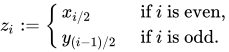
In mathematics, an interleave sequence is obtained by merging two sequences via an in shuffle. Let S {\displaystyle S} be a set, and let ( x i ) {\displaystyle (x_{i})} and ( y i ) {\displaystyle (y_{i})} , i = 0 , 1 , 2 , … , {\displaystyle i=0,1,2,\ldots ,} be two sequences in S . {\displaystyle S.} The interleave sequence is defined to be the sequence x 0 , y 0 , x 1 , y 1 , … {\displaystyle x_{0},y_{0},x_{1},y_{1},\dots } . Formally, it is the sequence ( z i ) , i = 0 , 1 , 2 , … {\displaystyle (z_{i}),i=0,1,2,\ldots } given by z i := { x i / 2 if i is even, y ( i − 1 ) / 2 if i is odd. {\displaystyle z_{i}:={\begin{cases}x_{i/2}&{\text{ if }}i{\text{ is even,}}\\y_{(i-1)/2}&{\text{ if }}i{\text{ is odd.}}\end{cases}}}
In mathematics, an interleave sequence is obtained by merging two sequences via an in shuffle.
Let be a set, and let and , be two sequences in The interleave sequence is defined to be the sequence . Formally, it is the sequence given by






Properties
[edit]- The interleave sequence is convergent if and only if the sequences and are convergent and have the same limit.[1]
- Consider two real numbers a and b greater than zero and smaller than 1. One can interleave the sequences of digits of a and b, which will determine a third number c, also greater than zero and smaller than 1. In this way one obtains an injection from the square (0, 1) × (0, 1) to the interval (0, 1). Different radixes give rise to different injections; the one for the binary numbers is called the Z-order curve or Morton code.[2]

References
[edit]- ^ Strichartz, Robert S. (2000), The Way of Analysis, Jones & Bartlett Learning, p. 78, ISBN 9780763714970.
- ^ Mamoulis, Nikos (2012), Spatial Data Management, Synthesis lectures on data management, vol. 21, Morgan & Claypool Publishers, pp. 22–23, ISBN 9781608458325.
This article incorporates material from Interleave sequence on PlanetMath, which is licensed under the Creative Commons Attribution/Share-Alike License.