Gnu code
In quantum information, the gnu code refers to a particular family of quantum error correcting codes, with the special property of being invariant under permutations of the qubits. Given integers g (the gap), n (the occupancy), and m (the length of the code), the two codewords are | 0 L ⟩ = ∑ ℓ even 0 ≤ ℓ ≤ n ( n ℓ ) 2 n − 1 | D g ℓ m ⟩ {\displaystyle |0_{\rm {L}}\rangle =\sum _{\ell \,{\textrm {even}} \atop 0\leq \ell \leq n}{\sqrt {\frac {n \choose \ell }{2^{n-1}}}}|D_{g\ell }^{m}\rangle } | 1 L ⟩ = ∑ ℓ odd 0 ≤ ℓ ≤ n ( n ℓ ) 2 n − 1 | D g ℓ m ⟩ {\displaystyle |1_{\rm {L}}\rangle =\sum _{\ell \,{\textrm {odd}} \atop 0\leq \ell \leq n}{\sqrt {\frac {n \choose \ell }{2^{n-1}}}}|D_{g\ell }^{m}\rangle } where | D k m ⟩ {\displaystyle |D_{k}^{m}\rangle } are the Dicke states consisting of a uniform superposition of all weight-k words on m qubits, e.g. | D 2 4 ⟩ = | 0011 ⟩ + | 0101 ⟩ + | 1001 ⟩ + | 0110 ⟩ + | 1010 ⟩ + | 1100 ⟩ 6 {\displaystyle |D_{2}^{4}\rangle ={\frac {|0011\rangle +|0101\rangle +|1001\rangle +|0110\rangle +|1010\rangle +|1100\rangle }{\sqrt {6}}}} The real parameter u = m g n {\displaystyle u={\frac {m}{gn}}} scales the length of the code. The number u {\displaystyle u} needs to be at least 1. The length m = g n u {\displaystyle m=gnu} , hence the name of the code. The distance of the code is the minimum of g {\displaystyle g} and n {\displaystyle n} . For g = n {\displaystyle g=n} and u ≥ 1 {\displaystyle u\geq 1} , the gnu code is capable of correcting g − 1 {\displaystyle g-1} erasure errors, or deletion errors. The code can also correct up to ⌊ ( g − 1 ) / 2 ⌋ {\displaystyle \lfloor (g-1)/2\rfloor } corrupted qubits from the property of the distance.
In quantum information, the gnu code refers to a particular family of quantum error correcting codes, with the special property of being invariant under permutations of the qubits. Given integers g (the gap), n (the occupancy), and m (the length of the code), the two codewords are
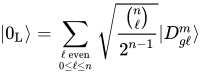

where are the Dicke states consisting of a uniform superposition of all weight-k words on m qubits, e.g.


The real parameter scales the length of the code. The number needs to be at least 1. The length , hence the name of the code. The distance of the code is the minimum of and . For and , the gnu code is capable of correcting erasure errors,[1] or deletion errors.[2] The code can also correct up to corrupted qubits from the property of the distance.


References
[edit]- ^ Ouyang, Yingkai (2014-12-10). "Permutation-invariant quantum codes". Physical Review A. 90 (6) 062317. arXiv:1302.3247. Bibcode:2014PhRvA..90f2317O. doi:10.1103/physreva.90.062317. ISSN 1050-2947. S2CID 119114455.
- ^ Ouyang, Yingkai (2021-02-04). "Permutation-invariant quantum coding for quantum deletion channels". arXiv:2102.02494v1 [quant-ph].
| General | |||||||||
|---|---|---|---|---|---|---|---|---|---|
| Theorems | |||||||||
| Quantum communication |
| ||||||||
| Quantum algorithms | |||||||||
| Quantum complexity theory | |||||||||
| Quantum processor benchmarks | |||||||||
| Quantum computing models | |||||||||
| Quantum error correction | |||||||||
| Physical implementations |
| ||||||||
| Quantum programming | |||||||||

