Flat function

In real analysis, a real function is defined to be flat at a point in the interior of its domain if and only if all its derivatives or partial derivatives exist at that point and equal 0 {\displaystyle 0} . A real function is locally constant (that is, constant in at least one neighbourhood) of a point in the interior of its domain if and only if the function is flat and analytic at that point. An example of a function that is flat only at an isolated point is f : R → R {\displaystyle f:\mathbb {R} \to \mathbb {R} } such that f ( 0 ) = 0 {\displaystyle f(0)=0} and that for all x ∈ R {\displaystyle x\in \mathbb {R} } , x ≠ 0 {\displaystyle x\neq 0} implies f ( x ) = e − 1 / x 2 {\displaystyle f(x)=e^{-1/x^{2}}} ; the function f {\displaystyle f} is flat only at 0 {\displaystyle 0} . Since f {\displaystyle f} is not analytic at 0 {\displaystyle 0} , the extension of f {\displaystyle f} to C {\displaystyle \mathbb {C} } is not holomorphic at 0 {\displaystyle 0} , since for complex functions, holomorphicity at a point implies analyticity at that point.
.jpeg)


In real analysis, a real function is defined to be flat at a point in the interior of its domain if and only if all its derivatives or partial derivatives exist at that point and equal .

A real function is locally constant (that is, constant in at least one neighbourhood) of a point in the interior of its domain if and only if the function is flat and analytic at that point.
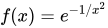
An example of a function that is flat only at an isolated point is such that and that for all , implies ; the function is flat only at .

Since is not analytic at , the extension of to is not holomorphic at , since for complex functions, holomorphicity at a point implies analyticity at that point.

Examples of construction of non-trivial flat functions
[edit]By a non-trivial flat function, what is meant is a function that, at least at one point in the interior of its domain, is flat but not locally constant.
Construction of univariate flat functions
[edit]Let be a positive real number and let (where is a neighbourhood of a point ) be such that and that for all , implies


Then is flat at .


Construction of multivariate flat functions
[edit]Let be flat at , and let (where , is an -dimensional real coordinate vector, and is a neighbourhood of ) be such that for all ,, where for all , denotes the Euclidean norm of .


Then is flat at .

Flatness of bump functions
[edit]A bump function is a function, with domain and codomain , such that it is smooth (infinitely continuously differentiable) on , and has bounded support, that is, the set of points in that are mapped to a non-zero value is a bounded set.


A bump function is flat and non-analytic at each boundary point of the closure of its support.
Let be a boundary point of the closure of the support of a bump function .


Proof of flatness of at
[edit]
Assume the existence of a such that a -th partial derivative of (call it ) at is a non-zero real number, say . Since is infinitely continuously differentiable at , then is continuous at . Since , . Then there would need to exist a positive real number such that for all such that , , or in other words, lies in the open interval


Since the open interval is non-empty and does not contain (whether or not is positive or negative, as long as ), this necessitates the existence of a neighbourhood of that is a subset of the support of , and hence also a subset of the closure of the support of , since everywhere outside the closure of the support of , evaluates to and hence evaluates to .

This contradicts that is a boundary point of the closure of the support of .
Hence, there does not exist any such that is a non-zero real number. In other words, for all , .


Hence, is flat at .
Proof of non-analyticity of at
[edit]Since is flat at (as shown above), the Taylor series of at is zero in a neighbourhood of .
Assume that is analytic at . Then there exists a neighbourhood of such that for all , .


Since is a boundary point of the closure of the support of , so is a boundary point of the support of (since boundary of the closure of a set is a subset of the boundary of the set). Hence, every neighbourhood of must contain at least one point such that . This contradicts the existence of a neighbourhood of such that for all , .


Hence, is non-analytic at .
Flatness of smooth interpolations
[edit]Let and be such that .


Let be an interval with non-empty interior, with supremum , and containing ; and let be an interval with non-empty interior, with infimum , and containing .


In the following, continuity, one-sided continuity, one-sided limits, differentiability and smoothness of a real coordinate vector-valued function are respectively given by continuity, one-sided continuity, one-sided limits, differentiability and smoothness of the function in each coordinate.
Let . Let be continuously differentiable at every point in the interior of , left-continuous at and have the left-hand limit of its derivatives of all orders be finite at ; also let for all . Let be continuously differentiable at every point in the interior of , right-continuous at and have the right-hand limit of its derivatives of all orders be finite at ; also let for all .


Let curves and be the images of the domains of and , respectively. Both and inhabit .


A smooth interpolation between and , between the points and , is the image of the domain of a function such that the left-hand limit of at is , the right-hand limit of at is , and for all , the left-hand limit of the -th derivative of at is equal to the right-hand limit of the -th derivative of at , and the right-hand limit of the -th derivative of at is equal to the left-hand limit of the -th derivative of at . A smooth interpolation between and is defined to have continuity (geometric continuity of all orders) with and .


Let be such that: for all , ; for all , ; and for all , .


If and are straight line segments, is necessarily flat at and . If and are non-collinear straight line segments, there necessarily exists a point in at which is non-analytic. If the end segments of the smooth interpolation are not straight-segment extensions of line segments and , is necessarily non-analytic at and .

![{\displaystyle [s_{1},s_{2}]}](https://wikimedia.org/api/rest_v1/media/math/render/svg/0f8fca3c95bdf474e9ff57f8c11496d4d3432e3b)
See also
[edit]- Bump function
- Continuous function
- Differentiable function
- Smoothness
- Analytic function
- Support (mathematics)
 | This mathematical analysis–related article is a stub. You can help Wikipedia by adding missing information. |