Dynamic structure factor
In condensed matter physics, the dynamic structure factor (or dynamical structure factor) is a mathematical function that contains information about inter-particle correlations and their time evolution. It is a generalization of the structure factor that considers correlations in both space and time. Experimentally, it can be accessed most directly by inelastic neutron scattering or X-ray Raman scattering. The dynamic structure factor is most often denoted S ( k → , ω ) {\displaystyle S({\vec {k}},\omega )} , where k → {\displaystyle {\vec {k}}} (sometimes q → {\displaystyle {\vec {q}}} ) is a wave vector (or wave number for isotropic materials), and ω {\displaystyle \omega } a frequency (sometimes stated as energy, ℏ ω {\displaystyle \hbar \omega } ). It is defined as: S ( k → , ω ) ≡ 1 2 π ∫ − ∞ ∞ F ( k → , t ) exp ( i ω t ) d t {\displaystyle S({\vec {k}},\omega )\equiv {\frac {1}{2\pi }}\int _{-\infty }^{\infty }F({\vec {k}},t)\exp(i\omega t)\,dt} Here F ( k → , t ) {\displaystyle F({\vec {k}},t)} , is called the intermediate scattering function and can be measured by neutron spin echo spectroscopy. The intermediate scattering function is the spatial Fourier transform of the van Hove function G ( r → , t ) {\displaystyle G({\vec {r}},t)} : F ( k → , t ) ≡ ∫ G ( r → , t ) exp ( − i k → ⋅ r → ) d r → {\displaystyle F({\vec {k}},t)\equiv \int G({\vec {r}},t)\exp(-i{\vec {k}}\cdot {\vec {r}})\,d{\vec {r}}} Thus we see that the dynamical structure factor is the spatial and temporal Fourier transform of van Hove's time-dependent pair correlation function. It can be shown (see below), that the intermediate scattering function is the correlation function of the Fourier components of the density ρ {\displaystyle \rho } : F ( k → , t ) = 1 N ⟨ ρ k → ( t ) ρ − k → ( 0 ) ⟩ {\displaystyle F({\vec {k}},t)={\frac {1}{N}}\langle \rho _{\vec {k}}(t)\rho _{-{\vec {k}}}(0)\rangle } The dynamic structure is exactly what is probed in coherent inelastic neutron scattering. The differential cross section is : d 2 σ d Ω d ω = a 2 ( E f E i ) 1 / 2 S ( k → , ω ) {\displaystyle {\frac {d^{2}\sigma }{d\Omega d\omega }}=a^{2}\left({\frac {E_{f}}{E_{i}}}\right)^{1/2}S({\vec {k}},\omega )} where a {\displaystyle a} is the scattering length.
In condensed matter physics, the dynamic structure factor (or dynamical structure factor) is a mathematical function that contains information about inter-particle correlations and their time evolution. It is a generalization of the structure factor that considers correlations in both space and time. Experimentally, it can be accessed most directly by inelastic neutron scattering or X-ray Raman scattering.
The dynamic structure factor is most often denoted , where (sometimes ) is a wave vector (or wave number for isotropic materials), and a frequency (sometimes stated as energy, ). It is defined as:[1]



Here , is called the intermediate scattering function and can be measured by neutron spin echo spectroscopy. The intermediate scattering function is the spatial Fourier transform of the van Hove function :[2][3]



Thus we see that the dynamical structure factor is the spatial and temporal Fourier transform of van Hove's time-dependent pair correlation function. It can be shown (see below), that the intermediate scattering function is the correlation function of the Fourier components of the density :


The dynamic structure is exactly what is probed in coherent inelastic neutron scattering. The differential cross section is :
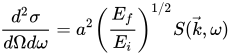
where is the scattering length.

The van Hove function
[edit]The van Hove function for a spatially uniform system containing point particles is defined as:[1]

![{\displaystyle G({\vec {r}},t)=\left\langle {\frac {1}{N}}\int \sum _{i=1}^{N}\sum _{j=1}^{N}\delta [{\vec {r}}'+{\vec {r}}-{\vec {r}}_{j}(t)]\delta [{\vec {r}}'-{\vec {r}}_{i}(0)]d{\vec {r}}'\right\rangle }](https://wikimedia.org/api/rest_v1/media/math/render/svg/d2d80f5138f40deabfa4340b95dbb4b2543cc260)
It can be rewritten as:

References
[edit]- ^ a b Hansen, J. P.; McDonald, I. R. (1986). Theory of Simple Liquids. Academic Press.
- ^ van Hove, L. (1954). "Correlations in Space and Time and Born Approximation Scattering in Systems of Interacting Particles". Physical Review. 95 (1): 249. Bibcode:1954PhRv...95..249V. doi:10.1103/PhysRev.95.249.
- ^ Vineyard, George H. (1958). "Scattering of Slow Neutrons by a Liquid". Physical Review. 110 (5): 999–1010. Bibcode:1958PhRv..110..999V. doi:10.1103/PhysRev.110.999. ISSN 0031-899X.
Further reading
[edit]- Ashcroft, Neil W.; Mermin, N. David (1976). Solid State Physics (Appendix N). Holt, Rinehart and Winston. ISBN 978-0-03-083993-1.
- Lovesey, Stephen W. (1986). Theory of Neutron Scattering from Condensed Matter - Volume I: Nuclear Scattering. Oxford University Press. ISBN 9780198520283.
 | This condensed matter physics-related article is a stub. You can help Wikipedia by adding missing information. |
 | This scattering–related article is a stub. You can help Wikipedia by adding missing information. |