Dynamic amplification factor
Dynamic Amplification Factor (DAF) or Dynamic Increase Factor (DIF), is a dimensionless number which describes how many times the deflections or stresses should be multiplied to the deflections or stresses caused by the static loads when a dynamic load is applied on to a structure. When lifting an object during a sub-sea operation, the DAF is calculated based on dynamic hydraulic forces or on snap-forces. D A F = F t o t a l M g {\displaystyle DAF={\frac {F_{total}}{Mg}}} Where: M {\displaystyle M} is the mass of the object in air (kg) g {\displaystyle g} is the acceleration of gravity (9.81m/s2) F t o t a l {\displaystyle F_{total}} is the largest of F s t a t i c − m a x + F h y d {\displaystyle {F_{static-max}+F_{hyd}}} or F s t a t i c − m a x + F s n a p {\displaystyle F_{static-max}+F_{snap}} (N)
Dynamic Amplification Factor (DAF) or Dynamic Increase Factor (DIF), is a dimensionless number which describes how many times the deflections or stresses should be multiplied to the deflections or stresses caused by the static loads when a dynamic load is applied on to a structure.[1]
When lifting an object during a sub-sea operation, the DAF is calculated based on dynamic hydraulic forces or on snap-forces. [2]
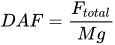
Where:
- is the mass of the object in air (kg)
- is the acceleration of gravity (9.81m/s2)
- is the largest of or (N)




References
[edit]- ^ Dynamics of structures by Anil K Chopra
- ^ Modelling and analysis of marine operation Archived 2016-03-04 at the Wayback Machine, DNV-RP-H103, April 2011
 | This physics-related article is a stub. You can help Wikipedia by adding missing information. |