Division polynomials
In mathematics, the division polynomials provide a way to calculate multiples of points on elliptic curves and to study the fields generated by torsion points. They play a central role in the study of counting points on elliptic curves in Schoof's algorithm.
In mathematics, the division polynomials provide a way to calculate multiples of points on elliptic curves and to study the fields generated by torsion points. They play a central role in the study of counting points on elliptic curves in Schoof's algorithm.
Definition
[edit]The set of division polynomials is a sequence of polynomials in
Z
[
x
,
y
,
A
,
B
]
{\displaystyle \mathbb {Z} [x,y,A,B]}
![{\displaystyle \mathbb {Z} [x,y,A,B]}](https://wikimedia.org/api/rest_v1/media/math/render/svg/d40cb4eb2017e4427fd645d005447eac83a110fb)

-
ψ
0
=
0
{\displaystyle \psi _{0}=0}
-
ψ
0
=
0
{\displaystyle \psi _{0}=0}

-
ψ
1
=
1
{\displaystyle \psi _{1}=1}
-
ψ
1
=
1
{\displaystyle \psi _{1}=1}

-
ψ
2
=
2
y
{\displaystyle \psi _{2}=2y}
-
ψ
2
=
2
y
{\displaystyle \psi _{2}=2y}

-
ψ
3
=
3
x
4
+
6
A
x
2
+
12
B
x
−
A
2
{\displaystyle \psi _{3}=3x^{4}+6Ax^{2}+12Bx-A^{2}}
-
ψ
3
=
3
x
4
+
6
A
x
2
+
12
B
x
−
A
2
{\displaystyle \psi _{3}=3x^{4}+6Ax^{2}+12Bx-A^{2}}

-
ψ
4
=
4
y
(
x
6
+
5
A
x
4
+
20
B
x
3
−
5
A
2
x
2
−
4
A
B
x
−
8
B
2
−
A
3
)
{\displaystyle \psi _{4}=4y(x^{6}+5Ax^{4}+20Bx^{3}-5A^{2}x^{2}-4ABx-8B^{2}-A^{3})}
-
ψ
4
=
4
y
(
x
6
+
5
A
x
4
+
20
B
x
3
−
5
A
2
x
2
−
4
A
B
x
−
8
B
2
−
A
3
)
{\displaystyle \psi _{4}=4y(x^{6}+5Ax^{4}+20Bx^{3}-5A^{2}x^{2}-4ABx-8B^{2}-A^{3})}

-
⋮
{\displaystyle \vdots }
-
⋮
{\displaystyle \vdots }

-
ψ
2
m
+
1
=
ψ
m
+
2
ψ
m
3
−
ψ
m
−
1
ψ
m
+
1
3
for
m
≥
2
{\displaystyle \psi _{2m+1}=\psi _{m+2}\psi _{m}^{3}-\psi _{m-1}\psi _{m+1}^{3}{\text{ for }}m\geq 2}
-
ψ
2
m
+
1
=
ψ
m
+
2
ψ
m
3
−
ψ
m
−
1
ψ
m
+
1
3
for
m
≥
2
{\displaystyle \psi _{2m+1}=\psi _{m+2}\psi _{m}^{3}-\psi _{m-1}\psi _{m+1}^{3}{\text{ for }}m\geq 2}

-
ψ
2
m
=
(
ψ
m
2
y
)
⋅
(
ψ
m
+
2
ψ
m
−
1
2
−
ψ
m
−
2
ψ
m
+
1
2
)
for
m
≥
3
{\displaystyle \psi _{2m}=\left({\frac {\psi _{m}}{2y}}\right)\cdot (\psi _{m+2}\psi _{m-1}^{2}-\psi _{m-2}\psi _{m+1}^{2}){\text{ for }}m\geq 3}
-
ψ
2
m
=
(
ψ
m
2
y
)
⋅
(
ψ
m
+
2
ψ
m
−
1
2
−
ψ
m
−
2
ψ
m
+
1
2
)
for
m
≥
3
{\displaystyle \psi _{2m}=\left({\frac {\psi _{m}}{2y}}\right)\cdot (\psi _{m+2}\psi _{m-1}^{2}-\psi _{m-2}\psi _{m+1}^{2}){\text{ for }}m\geq 3}

The polynomial
ψ
n
{\displaystyle \psi _{n}}

Properties
[edit]- In practice, one sets
y
2
=
x
3
+
A
x
+
B
{\displaystyle y^{2}=x^{3}+Ax+B}
, and then ψ 2 m + 1 ∈ Z [ x , A , B ] {\displaystyle \psi _{2m+1}\in \mathbb {Z} [x,A,B]}
and ψ 2 m ∈ 2 y Z [ x , A , B ] {\displaystyle \psi _{2m}\in 2y\mathbb {Z} [x,A,B]}
.
- The division polynomials form a generic elliptic divisibility sequence over the ring
Q
[
x
,
y
,
A
,
B
]
/
(
y
2
−
x
3
−
A
x
−
B
)
{\displaystyle \mathbb {Q} [x,y,A,B]/(y^{2}-x^{3}-Ax-B)}
.
- If an elliptic curve
E
{\displaystyle E}
is given in the Weierstrass form y 2 = x 3 + A x + B {\displaystyle y^{2}=x^{3}+Ax+B}
, i.e. A , B ∈ K {\displaystyle A,B\in K}
, one can use these values of A , B {\displaystyle A,B}
and consider the division polynomials in the coordinate ring of E {\displaystyle E}
are the x {\displaystyle x}
-coordinates of the points of E [ 2 n + 1 ] ∖ { O } {\displaystyle E[2n+1]\setminus \{O\}}
, where E [ 2 n + 1 ] {\displaystyle E[2n+1]}
is the ( 2 n + 1 ) th {\displaystyle (2n+1)^{\text{th}}}
torsion subgroup of E {\displaystyle E}
are the x {\displaystyle x}
.
- Given a point
P
=
(
x
P
,
y
P
)
{\displaystyle P=(x_{P},y_{P})}
on the elliptic curve E : y 2 = x 3 + A x + B {\displaystyle E:y^{2}=x^{3}+Ax+B}
over some field K {\displaystyle K}
in terms of division polynomials:
-
n
P
=
(
ϕ
n
(
x
)
ψ
n
2
(
x
)
,
ω
n
(
x
,
y
)
ψ
n
3
(
x
,
y
)
)
=
(
x
−
ψ
n
−
1
ψ
n
+
1
ψ
n
2
(
x
)
,
ψ
2
n
(
x
,
y
)
2
ψ
n
4
(
x
)
)
{\displaystyle nP=\left({\frac {\phi _{n}(x)}{\psi _{n}^{2}(x)}},{\frac {\omega _{n}(x,y)}{\psi _{n}^{3}(x,y)}}\right)=\left(x-{\frac {\psi _{n-1}\psi _{n+1}}{\psi _{n}^{2}(x)}},{\frac {\psi _{2n}(x,y)}{2\psi _{n}^{4}(x)}}\right)}
-
n
P
=
(
ϕ
n
(
x
)
ψ
n
2
(
x
)
,
ω
n
(
x
,
y
)
ψ
n
3
(
x
,
y
)
)
=
(
x
−
ψ
n
−
1
ψ
n
+
1
ψ
n
2
(
x
)
,
ψ
2
n
(
x
,
y
)
2
ψ
n
4
(
x
)
)
{\displaystyle nP=\left({\frac {\phi _{n}(x)}{\psi _{n}^{2}(x)}},{\frac {\omega _{n}(x,y)}{\psi _{n}^{3}(x,y)}}\right)=\left(x-{\frac {\psi _{n-1}\psi _{n+1}}{\psi _{n}^{2}(x)}},{\frac {\psi _{2n}(x,y)}{2\psi _{n}^{4}(x)}}\right)}
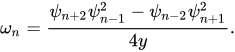
- where
ϕ
n
{\displaystyle \phi _{n}}
and ω n {\displaystyle \omega _{n}}
are defined by:
-
ϕ
n
=
x
ψ
n
2
−
ψ
n
+
1
ψ
n
−
1
,
{\displaystyle \phi _{n}=x\psi _{n}^{2}-\psi _{n+1}\psi _{n-1},}
-
ω
n
=
ψ
n
+
2
ψ
n
−
1
2
−
ψ
n
−
2
ψ
n
+
1
2
4
y
.
{\displaystyle \omega _{n}={\frac {\psi _{n+2}\psi _{n-1}^{2}-\psi _{n-2}\psi _{n+1}^{2}}{4y}}.}
-
ϕ
n
=
x
ψ
n
2
−
ψ
n
+
1
ψ
n
−
1
,
{\displaystyle \phi _{n}=x\psi _{n}^{2}-\psi _{n+1}\psi _{n-1},}


Using the relation between
ψ
2
m
{\displaystyle \psi _{2m}}


![{\displaystyle K[x]}](https://wikimedia.org/api/rest_v1/media/math/render/svg/8a9e6c2ac2830d6a9abe078b47450777c41d69a9)
Let
p
>
3
{\displaystyle p>3}


René Schoof observed that working modulo the
ℓ
{\displaystyle \ell }
See also
[edit]References
[edit]- A. Enge: Elliptic Curves and their Applications to Cryptography: An Introduction. Kluwer Academic Publishers, Dordrecht, 1999.
- N. Koblitz: A Course in Number Theory and Cryptography, Graduate Texts in Math. No. 114, Springer-Verlag, 1987. Second edition, 1994
- Müller : Die Berechnung der Punktanzahl von elliptischen kurven über endlichen Primkörpern. Master's Thesis. Universität des Saarlandes, Saarbrücken, 1991.
- G. Musiker: Schoof's Algorithm for Counting Points on
E
(
F
q
)
{\displaystyle E(\mathbb {F} _{q})}
. Available at https://www-users.cse.umn.edu/~musiker/schoof.pdf
- Schoof: Elliptic Curves over Finite Fields and the Computation of Square Roots mod p. Math. Comp., 44(170):483–494, 1985. Available at http://www.mat.uniroma2.it/~schoof/ctpts.pdf
- R. Schoof: Counting Points on Elliptic Curves over Finite Fields. J. Theor. Nombres Bordeaux 7:219–254, 1995. Available at http://www.mat.uniroma2.it/~schoof/ctg.pdf
- L. C. Washington: Elliptic Curves: Number Theory and Cryptography. Chapman & Hall/CRC, New York, 2003.
- J. Silverman: The Arithmetic of Elliptic Curves, Springer-Verlag, GTM 106, 1986.
Topics in algebraic curves | |||||||||||
|---|---|---|---|---|---|---|---|---|---|---|---|
| Rational curves | |||||||||||
| Elliptic curves |
| ||||||||||
| Higher genus | |||||||||||
| Plane curves | |||||||||||
| Riemann surfaces | |||||||||||
| Constructions | |||||||||||
| Structure of curves |
| ||||||||||