Completely positive map
In mathematics a positive map is a map between C*-algebras that sends positive elements to positive elements. A completely positive map is one that satisfies a stronger, more robust condition.
 | This article needs additional citations for verification. Please help improve this article by adding citations to reliable sources. Unsourced material may be challenged and removed. Find sources: "Completely positive map" – news · newspapers · books · scholar · JSTOR (July 2020) (Learn how and when to remove this message) |
In mathematics a positive map is a map between C*-algebras that sends positive elements to positive elements. A completely positive map is one that satisfies a stronger, more robust condition.
Definition
[edit]Let
A
{\displaystyle A}



Any linear map
ϕ
:
A
→
B
{\displaystyle \phi :A\to B}
-
id
⊗
ϕ
:
C
k
×
k
⊗
A
→
C
k
×
k
⊗
B
{\displaystyle {\textrm {id}}\otimes \phi :\mathbb {C} ^{k\times k}\otimes A\to \mathbb {C} ^{k\times k}\otimes B}

in a natural way. If
C
k
×
k
⊗
A
{\displaystyle \mathbb {C} ^{k\times k}\otimes A}


-
(
a
11
⋯
a
1
k
⋮
⋱
⋮
a
k
1
⋯
a
k
k
)
↦
(
ϕ
(
a
11
)
⋯
ϕ
(
a
1
k
)
⋮
⋱
⋮
ϕ
(
a
k
1
)
⋯
ϕ
(
a
k
k
)
)
.
{\displaystyle {\begin{pmatrix}a_{11}&\cdots &a_{1k}\\\vdots &\ddots &\vdots \\a_{k1}&\cdots &a_{kk}\end{pmatrix}}\mapsto {\begin{pmatrix}\phi (a_{11})&\cdots &\phi (a_{1k})\\\vdots &\ddots &\vdots \\\phi (a_{k1})&\cdots &\phi (a_{kk})\end{pmatrix}}.}
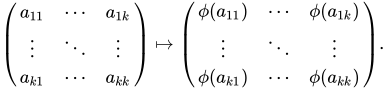
We then say
ϕ
{\displaystyle \phi }

Properties
[edit]- Positive maps are monotone, i.e.
a
1
≤
a
2
⟹
ϕ
(
a
1
)
≤
ϕ
(
a
2
)
{\displaystyle a_{1}\leq a_{2}\implies \phi (a_{1})\leq \phi (a_{2})}
for all self-adjoint elements a 1 , a 2 ∈ A s a {\displaystyle a_{1},a_{2}\in A_{sa}}
.
- Since
−
‖
a
‖
A
1
A
≤
a
≤
‖
a
‖
A
1
A
{\displaystyle -\|a\|_{A}1_{A}\leq a\leq \|a\|_{A}1_{A}}
for all self-adjoint elements a ∈ A s a {\displaystyle a\in A_{sa}}
, every positive map is automatically continuous with respect to the C*-norms and its operator norm equals ‖ ϕ ( 1 A ) ‖ B {\displaystyle \|\phi (1_{A})\|_{B}}
. A similar statement with approximate units holds for non-unital algebras.
- The set of positive functionals
→
C
{\displaystyle \to \mathbb {C} }
is the dual cone of the cone of positive elements of A {\displaystyle A}
Examples
[edit]- Every *-homomorphism is completely positive.[1]
- For every linear operator
V
:
H
1
→
H
2
{\displaystyle V:H_{1}\to H_{2}}
between Hilbert spaces, the map L ( H 1 ) → L ( H 2 ) , A ↦ V A V ∗ {\displaystyle L(H_{1})\to L(H_{2}),\ A\mapsto VAV^{\ast }}
is completely positive.[2] Stinespring's theorem says that all completely positive maps are compositions of *-homomorphisms and these special maps.
- Every positive functional
ϕ
:
A
→
C
{\displaystyle \phi :A\to \mathbb {C} }
(in particular every state) is automatically completely positive.
- Given the algebras
C
(
X
)
{\displaystyle C(X)}
and C ( Y ) {\displaystyle C(Y)}
of complex-valued continuous functions on compact Hausdorff spaces X , Y {\displaystyle X,Y}
, every positive map C ( X ) → C ( Y ) {\displaystyle C(X)\to C(Y)}
is completely positive.
- The transposition of matrices is a standard example of a positive map that fails to be 2-positive. Let T denote this map on
C
n
×
n
{\displaystyle \mathbb {C} ^{n\times n}}
. The following is a positive matrix in C 2 × 2 ⊗ C 2 × 2 {\displaystyle \mathbb {C} ^{2\times 2}\otimes \mathbb {C} ^{2\times 2}}
: [ ( 1 0 0 0 ) ( 0 1 0 0 ) ( 0 0 1 0 ) ( 0 0 0 1 ) ] = [ 1 0 0 1 0 0 0 0 0 0 0 0 1 0 0 1 ] . {\displaystyle {\begin{bmatrix}{\begin{pmatrix}1&0\\0&0\end{pmatrix}}&{\begin{pmatrix}0&1\\0&0\end{pmatrix}}\\{\begin{pmatrix}0&0\\1&0\end{pmatrix}}&{\begin{pmatrix}0&0\\0&1\end{pmatrix}}\end{bmatrix}}={\begin{bmatrix}1&0&0&1\\0&0&0&0\\0&0&0&0\\1&0&0&1\\\end{bmatrix}}.}
The image of this matrix under I 2 ⊗ T {\displaystyle I_{2}\otimes T}
is [ ( 1 0 0 0 ) T ( 0 1 0 0 ) T ( 0 0 1 0 ) T ( 0 0 0 1 ) T ] = [ 1 0 0 0 0 0 1 0 0 1 0 0 0 0 0 1 ] , {\displaystyle {\begin{bmatrix}{\begin{pmatrix}1&0\\0&0\end{pmatrix}}^{T}&{\begin{pmatrix}0&1\\0&0\end{pmatrix}}^{T}\\{\begin{pmatrix}0&0\\1&0\end{pmatrix}}^{T}&{\begin{pmatrix}0&0\\0&1\end{pmatrix}}^{T}\end{bmatrix}}={\begin{bmatrix}1&0&0&0\\0&0&1&0\\0&1&0&0\\0&0&0&1\\\end{bmatrix}},}
which is clearly not positive, having determinant −1. Moreover, the eigenvalues of this matrix are 1,1,1 and −1. (This matrix happens to be the Choi matrix of T, in fact.) Incidentally, a map Φ is said to be co-positive if the composition Φ ∘ {\displaystyle \circ }
T is positive. The transposition map itself is a co-positive map.
See also
[edit]References
[edit]- ^ K. R. Davidson: C*-Algebras by Example, American Mathematical Society (1996), ISBN 0-821-80599-1, Thm. IX.4.1
- ^ R.V. Kadison, J. R. Ringrose: Fundamentals of the Theory of Operator Algebras II, Academic Press (1983), ISBN 0-1239-3302-1, Sect. 11.5.21