Combinant
In the mathematical theory of probability, the combinants cn of a random variable X are defined via the combinant-generating function G(t), which is defined from the moment generating function M(z) as G X ( t ) = M X ( log ( 1 + t ) ) {\displaystyle G_{X}(t)=M_{X}(\log(1+t))} which can be expressed directly in terms of a random variable X as G X ( t ) := E [ ( 1 + t ) X ] , t ∈ R , {\displaystyle G_{X}(t):=E\left[(1+t)^{X}\right],\quad t\in \mathbb {R} ,} wherever this expectation exists. The nth combinant can be obtained as the nth derivatives of the logarithm of combinant generating function evaluated at –1 divided by n factorial: c n = 1 n ! ∂ n ∂ t n log ( G ( t ) ) | t = − 1 {\displaystyle c_{n}={\frac {1}{n!}}{\frac {\partial ^{n}}{\partial t^{n}}}\log(G(t)){\bigg |}_{t=-1}} Important features in common with the cumulants are: the combinants share the additivity property of the cumulants; for infinite divisibility (probability) distributions, both sets of moments are strictly positive.
 | This article relies largely or entirely on a single source. (March 2024) |
In the mathematical theory of probability, the combinants cn of a random variable X are defined via the combinant-generating function G(t), which is defined from the moment generating function M(z) as

which can be expressed directly in terms of a random variable X as
![{\displaystyle G_{X}(t):=E\left[(1+t)^{X}\right],\quad t\in \mathbb {R} ,}](https://wikimedia.org/api/rest_v1/media/math/render/svg/92d1df6664083a3822fb3dc54a383f4e1e18f1f8)
wherever this expectation exists.
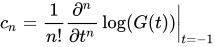
The nth combinant can be obtained as the nth derivatives of the logarithm of combinant generating function evaluated at –1 divided by n factorial:
Important features in common with the cumulants are:
- the combinants share the additivity property of the cumulants;
- for infinite divisibility (probability) distributions, both sets of moments are strictly positive.
References
[edit]- Kittel, W.; De Wolf, E. A. Soft Multihadron Dynamics. pp. 306 ff. ISBN 978-9812562951. Google Books
Theory of probability distributions | ||
|---|---|---|
 | ||
 | This probability-related article is a stub. You can help Wikipedia by adding missing information. |