Collision frequency
Collision frequency describes the rate of collisions between two atomic or molecular species in a given volume, per unit time. In an ideal gas, assuming that the species behave like hard spheres, the collision frequency between entities of species A and species B is Z = N A N B σ AB 8 k B T π μ AB , {\displaystyle Z=N_{\text{A}}N_{\text{B}}\sigma _{\text{AB}}{\sqrt {\frac {8k_{\text{B}}T}{\pi \mu _{\text{AB}}}}},} where N A {\displaystyle N_{\text{A}}} is the number of A particles in the volume, N B {\displaystyle N_{\text{B}}} is the number of B particles in the volume, σ AB {\displaystyle \sigma _{\text{AB}}} is the collision cross section, the "effective area" seen by two colliding molecules (for hard spheres, σ AB = π ( r A + r B ) 2 {\displaystyle \sigma _{\text{AB}}=\pi (r_{\text{A}}+r_{\text{B}})^{2}} , where r A {\displaystyle r_{\text{A}}} is the radius of A, and r B {\displaystyle r_{\text{B}}} is the radius of B), k B {\displaystyle k_{\text{B}}} is the Boltzmann constant, T {\displaystyle T} is the thermodynamic temperature, μ AB = m A m B m A + m B {\displaystyle \mu _{\text{AB}}={\frac {m_{\text{A}}m_{\text{B}}}{m_{\text{A}}+m_{\text{B}}}}} is the reduced mass of A and B particles.
Collision frequency describes the rate of collisions between two atomic or molecular species in a given volume, per unit time. In an ideal gas, assuming that the species behave like hard spheres, the collision frequency between entities of species A and species B is[1][better source needed] where
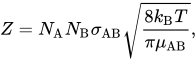
- is the number of A particles in the volume,
- is the number of B particles in the volume,
- is the collision cross section, the "effective area" seen by two colliding molecules (for hard spheres, , where is the radius of A, and is the radius of B),
- is the Boltzmann constant,
- is the thermodynamic temperature,
- is the reduced mass of A and B particles.





Collision in diluted solution
[edit]In the case of equal-size particles at a concentration in a solution of viscosity , an expression for collision frequency , where is the volume in question, and is the number of collisions per second, can be written as[2] where


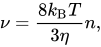
- is the Boltzmann constant,
- is the absolute temperature,
- is the viscosity of the solution,
- is the number density.

Here the frequency is independent of particle size, a result noted as counter-intuitive. For particles of different size, more elaborate expressions can be derived for estimating .[2]
References
[edit]- ^ "Collision Frequency". LibreTexts Chemistry. 2 October 2013.
- ^ a b Debye, P. (1942). "Reaction Rates in Ionic Solutions". Transactions of the Electrochemical Society. 82 (1): 265–272. doi:10.1149/1.3071413. ISSN 0096-4743.