Band model

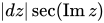
The band model is a conformal model of the hyperbolic plane. The band model employs a portion of the Euclidean plane between two parallel lines. Distance is preserved along one line through the middle of the band. Assuming the band is given by { z ∈ C : | Im z | < π / 2 } {\displaystyle \{z\in \mathbb {C} :\left|\operatorname {Im} z\right|<\pi /2\}} , the metric is given by | d z | sec ( Im z ) {\displaystyle |dz|\sec(\operatorname {Im} z)} . Geodesics include the line along the middle of the band, and any open line segment perpendicular to boundaries of the band connecting the sides of the band. Every end of a geodesic either meets a boundary of the band at a right angle or is asymptotic to the midline; the midline itself is the only geodesic that does not meet a boundary. Lines parallel to the boundaries of the band within the band are hypercycles whose common axis is the line through the middle of the band.

The band model is a conformal model of the hyperbolic plane. The band model employs a portion of the Euclidean plane between two parallel lines.[1] Distance is preserved along one line through the middle of the band. Assuming the band is given by , the metric is given by .


Geodesics include the line along the middle of the band, and any open line segment perpendicular to boundaries of the band connecting the sides of the band. Every end of a geodesic either meets a boundary of the band at a right angle or is asymptotic to the midline; the midline itself is the only geodesic that does not meet a boundary.[2] Lines parallel to the boundaries of the band within the band are hypercycles whose common axis is the line through the middle of the band.
See also
[edit]References
[edit]- ^ Hubbard, John H. (2006). "2" (PDF). Teichmüller Theory and Applications to Geometry, Topology, and Dynamics. Ithaca, NY: Matrix Editions. p. 25. ISBN 9780971576629. OCLC 57965863.
- ^ Bowman, Joshua. "612 CLASS LECTURE: HYPERBOLIC GEOMETRY" (PDF). Retrieved August 12, 2018.
External links
[edit]
 | This hyperbolic geometry-related article is a stub. You can help Wikipedia by adding missing information. |