In recreational mathematics, an almost integer (or near-integer) is any number that is not an integer but is very close to one. Almost integers may be considered interesting when they arise in some context in which they are unexpected.
Any number that is not an integer but is very close to one
Ed Pegg Jr. noted that the length d equals
(
61421
−
23
5831385
)
/
120
{\displaystyle {\sqrt {\left(61421-23{\sqrt {5831385}}\right)/\,120}}}
, which is very close to
7
{\displaystyle 7}
(approximately
7.0000000857
{\displaystyle 7.0000000857}
)[1]
In recreational mathematics, an almost integer (or near-integer) is any number that is not an integer but is very close to one. Almost integers may be considered interesting when they arise in some context in which they are unexpected.
Almost integers relating to the golden ratio and Fibonacci numbers
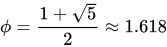
Some examples of almost integers are high powers of the golden ratio
ϕ
=
1
+
5
2
≈
1.618
{\displaystyle \phi ={\frac {1+{\sqrt {5}}}{2}}\approx 1.618}
, for example:
and the reason for the squares is due to certain Eisenstein series. The constant
e
π
163
{\displaystyle e^{\pi {\sqrt {163}}}}
is sometimes referred to as Ramanujan's constant.
Almost integers that involve the mathematical constants π and e have often puzzled mathematicians. An example is:
e
π
−
π
=
19.99909
99791
89
…
{\displaystyle e^{\pi }-\pi =19.99909\,99791\,89\ldots }
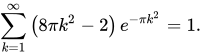
This can be explained using a sum related to Jacobi theta functions as follows:
∑
k
=
1
∞
(
8
π
k
2
−
2
)
e
−
π
k
2
=
1.
{\displaystyle \sum _{k=1}^{\infty }\left(8\pi k^{2}-2\right)e^{-\pi k^{2}}=1.}
The first term dominates since the sum of the terms for
k
≥
2
{\displaystyle k\geq 2}
total
∼
0.00034
36.
{\displaystyle \sim 0.00034\,36.}
The sum can therefore be truncated to
(
8
π
−
2
)
e
−
π
≈
1
,
{\displaystyle \left(8\pi -2\right)e^{-\pi }\approx 1,}
where solving for
e
π
{\displaystyle e^{\pi }}
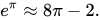
gives
e
π
≈
8
π
−
2.
{\displaystyle e^{\pi }\approx 8\pi -2.}
Rewriting the approximation for
e
π
{\displaystyle e^{\pi }}
and using the approximation for
7
π
≈
22
{\displaystyle 7\pi \approx 22}
gives
e
π
≈
π
+
7
π
−
2
≈
π
+
22
−
2
=
π
+
20.
{\displaystyle e^{\pi }\approx \pi +7\pi -2\approx \pi +22-2=\pi +20.}
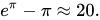
Thus, rearranging terms gives
e
π
−
π
≈
20.
{\displaystyle e^{\pi }-\pi \approx 20.}
Ironically, the crude approximation for
7
π
{\displaystyle 7\pi }
yields an additional order of magnitude of precision.[1]
Another example involving these constants is:
e
+
π
+
e
π
+
e
π
+
π
e
=
59.99945
90558
…
{\displaystyle e+\pi +e\pi +e^{\pi }+\pi ^{e}=59.99945\,90558\ldots }


![{\displaystyle {\begin{aligned}\phi ^{17}&={\frac {3571+1597{\sqrt {5}}}{2}}\approx 3571.00028\\[6pt]\phi ^{18}&=2889+1292{\sqrt {5}}\approx 5777.999827\\[6pt]\phi ^{19}&={\frac {9349+4181{\sqrt {5}}}{2}}\approx 9349.000107\end{aligned}}}](https://wikimedia.org/api/rest_v1/media/math/render/svg/517ac892a0426835ff7e4378faf421aeef1d9fdd)