Legendresche Chi-Funktion
Die legendresche Chi-Funktion (nach Adrien-Marie Legendre) ist eine spezielle Funktion in der Mathematik.
Die legendresche Chi-Funktion (nach Adrien-Marie Legendre) ist eine spezielle Funktion in der Mathematik.
Definition
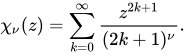
[Bearbeiten | Quelltext bearbeiten]Die legendresche Chi-Funktion ist folgendermaßen definiert:
-
χ
ν
(
z
)
=
∑
k
=
0
∞
z
2
k
+
1
(
2
k
+
1
)
ν
.
{\displaystyle \chi _{\nu }(z)=\sum _{k=0}^{\infty }{\frac {z^{2k+1}}{(2k+1)^{\nu }}}.}
Sie lässt sich auch mit dem Polylogarithmus
L
i
ν
(
z
)
{\displaystyle \mathrm {Li} _{\nu }(z)}

-
χ
ν
(
z
)
=
1
2
[
Li
ν
(
z
)
−
Li
ν
(
−
z
)
]
{\displaystyle \chi _{\nu }(z)={\frac {1}{2}}\left[\operatorname {Li} _{\nu }(z)-\operatorname {Li} _{\nu }(-z)\right]}
-
χ
ν
(
z
)
=
Li
ν
(
z
)
−
1
2
ν
Li
ν
(
z
2
)
{\displaystyle \chi _{\nu }(z)=\operatorname {Li} _{\nu }(z)-{\frac {1}{2^{\nu }}}\operatorname {Li} _{\nu }(z^{2})}
![{\displaystyle \chi _{\nu }(z)={\frac {1}{2}}\left[\operatorname {Li} _{\nu }(z)-\operatorname {Li} _{\nu }(-z)\right]}](https://wikimedia.org/api/rest_v1/media/math/render/svg/292837ba0f3e90cb27a3fd71f1f826eb7dbc944a)

Die Reihendarstellungen entsprechen den geschlossenen Ausdrücken:
-
χ
−
1
(
x
)
=
x
(
1
+
x
2
)
(
1
−
x
2
)
2
{\displaystyle \chi _{-1}\left(x\right)={\frac {x\left(1+x^{2}\right)}{\left(1-x^{2}\right)^{2}}}}
-
χ
0
(
x
)
=
x
1
−
x
2
{\displaystyle \chi _{0}\left(x\right)={\frac {x}{1-x^{2}}}}
-
χ
1
(
x
)
=
arctanh
(
x
)
=
1
2
ln
(
1
+
x
1
−
x
)
{\displaystyle \chi _{1}(x)=\operatorname {arctanh} (x)={\frac {1}{2}}\ln \left({\frac {1+x}{1-x}}\right)}


Für große
ν
{\displaystyle \nu }


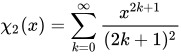
Funktion für v = 2:
-
χ
2
(
x
)
=
∑
k
=
0
∞
x
2
k
+
1
(
2
k
+
1
)
2
{\displaystyle \chi _{2}(x)=\sum _{k=0}^{\infty }{\frac {x^{2k+1}}{(2k+1)^{2}}}}
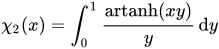
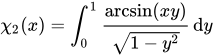
Folgende Darstellungen als Integrale hat diese Funktion:
-
χ
2
(
x
)
=
∫
0
1
artanh
(
x
y
)
y
d
y
{\displaystyle \chi _{2}(x)=\int _{0}^{1}{\frac {\operatorname {artanh} (xy)}{y}}\,\mathrm {d} y}
-
χ
2
(
x
)
=
∫
0
1
arcsin
(
x
y
)
1
−
y
2
d
y
{\displaystyle \chi _{2}(x)=\int _{0}^{1}{\frac {\operatorname {arcsin} (xy)}{\sqrt {1-y^{2}}}}\,\mathrm {d} y}
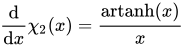
Folgende Ableitung hat diese Funktion:
-
d
d
x
χ
2
(
x
)
=
artanh
(
x
)
x
{\displaystyle {\frac {\mathrm {d} }{\mathrm {d} x}}\chi _{2}(x)={\frac {\operatorname {artanh} (x)}{x}}}
Spezielle Werte
[Bearbeiten | Quelltext bearbeiten]Beweis für den Chi-2-Funktionswert von Eins
[Bearbeiten | Quelltext bearbeiten]Es gilt folgende Ableitung:
-
d
d
y
1
x
[
artanh
(
x
)
−
artanh
(
x
1
−
y
2
1
−
x
2
y
2
)
]
=
y
(
1
−
x
2
y
2
)
(
1
−
y
2
)
{\displaystyle {\frac {\mathrm {d} }{\mathrm {d} y}}\,{\frac {1}{x}}{\biggl [}\operatorname {artanh} (x)-\operatorname {artanh} {\biggl (}{\frac {x\,{\sqrt {1-y^{2}}}}{\sqrt {1-x^{2}y^{2}}}}{\biggr )}{\biggr ]}={\frac {y}{\sqrt {(1-x^{2}y^{2})(1-y^{2})}}}}
![{\displaystyle {\frac {\mathrm {d} }{\mathrm {d} y}}\,{\frac {1}{x}}{\biggl [}\operatorname {artanh} (x)-\operatorname {artanh} {\biggl (}{\frac {x\,{\sqrt {1-y^{2}}}}{\sqrt {1-x^{2}y^{2}}}}{\biggr )}{\biggr ]}={\frac {y}{\sqrt {(1-x^{2}y^{2})(1-y^{2})}}}}](https://wikimedia.org/api/rest_v1/media/math/render/svg/f14ffda4a377fe036f82015286372a6beb31911b)
Deswegen gilt auch folgendes Integral:
-
1
x
artanh
(
x
)
=
∫
0
1
y
(
1
−
x
2
y
2
)
(
1
−
y
2
)
d
y
{\displaystyle {\frac {1}{x}}\operatorname {artanh} (x)=\int _{0}^{1}{\frac {y}{\sqrt {(1-x^{2}y^{2})(1-y^{2})}}}\,\mathrm {d} y}

Durch Bildung der Ursprungsstammfunktion bezüglich x entsteht diese bereits im Definitionsabschnitt genannte Formel:
-
χ
2
(
x
)
=
∫
0
1
arcsin
(
x
y
)
1
−
y
2
d
y
{\displaystyle \chi _{2}(x)=\int _{0}^{1}{\frac {\operatorname {arcsin} (xy)}{\sqrt {1-y^{2}}}}\,\mathrm {d} y}
Exemplarisch eingesetzt wird der Wert
x
=
1
{\displaystyle x=1}

-
χ
2
(
1
)
=
∫
0
1
arcsin
(
y
)
1
−
y
2
d
y
=
[
1
2
arcsin
(
y
)
2
]
y
=
0
y
=
1
=
π
2
8
{\displaystyle \chi _{2}(1)=\int _{0}^{1}{\frac {\operatorname {arcsin} (y)}{\sqrt {1-y^{2}}}}\,\mathrm {d} y={\biggl [}{\frac {1}{2}}\arcsin(y)^{2}{\biggr ]}_{y=0}^{y=1}={\frac {\pi ^{2}}{8}}}
![{\displaystyle \chi _{2}(1)=\int _{0}^{1}{\frac {\operatorname {arcsin} (y)}{\sqrt {1-y^{2}}}}\,\mathrm {d} y={\biggl [}{\frac {1}{2}}\arcsin(y)^{2}{\biggr ]}_{y=0}^{y=1}={\frac {\pi ^{2}}{8}}}](https://wikimedia.org/api/rest_v1/media/math/render/svg/886776dd31b2d995d3c9c87fea4d6e1a9c5335ce)
Theorem für tangentielle Gegenstücke
[Bearbeiten | Quelltext bearbeiten]Folgende Formel dient für die Werte 0 < x < 1 zur Ermittlung der Chi-Funktionswerte:
-
χ
2
(
x
)
+
χ
2
(
1
−
x
1
+
x
)
=
π
2
8
−
2
artanh
(
x
)
artanh
(
1
−
x
1
+
x
)
{\displaystyle \chi _{2}(x)+\chi _{2}{\bigl (}{\frac {1-x}{1+x}}{\bigr )}={\frac {\pi ^{2}}{8}}-2\operatorname {artanh} (x)\operatorname {artanh} {\bigl (}{\frac {1-x}{1+x}}{\bigr )}}

Beispielsweise gilt:
-
χ
2
(
1
2
)
+
χ
2
(
1
3
)
=
π
2
8
−
2
artanh
(
1
2
)
artanh
(
1
3
)
{\displaystyle \chi _{2}{\bigl (}{\frac {1}{2}}{\bigr )}+\chi _{2}{\bigl (}{\frac {1}{3}}{\bigr )}={\frac {\pi ^{2}}{8}}-2\operatorname {artanh} {\bigl (}{\frac {1}{2}}{\bigr )}\operatorname {artanh} {\bigl (}{\frac {1}{3}}{\bigr )}}

Mit Hilfe genannten allgemeinen Formel für tangentielle Gegenstücke und mit Hilfe des Dilogarithmus können folgende Funktionswerte ermittelt werden:
-
χ
2
(
1
)
=
1
8
π
2
χ
2
(
−
1
)
=
−
1
8
π
2
χ
2
(
2
−
1
)
=
1
16
π
2
−
1
4
[
ln
(
2
+
1
)
]
2
χ
2
(
Φ
−
1
)
=
1
12
π
2
−
3
4
[
ln
(
Φ
)
]
2
χ
2
(
Φ
−
3
)
=
1
24
π
2
−
3
4
[
ln
(
Φ
)
]
2
χ
2
(
i
)
=
i
⋅
G
{\displaystyle {\begin{matrix}\chi _{2}(1)&=&{\frac {1}{8}}\pi ^{2}\\\chi _{2}(-1)&=&-{\frac {1}{8}}\pi ^{2}\\\chi _{2}({\sqrt {2}}-1)&=&{\frac {1}{16}}\pi ^{2}-{\frac {1}{4}}{\bigl [}\ln({\sqrt {2}}+1){\bigr ]}^{2}\\\chi _{2}(\Phi ^{-1})&=&{\frac {1}{12}}\pi ^{2}-{\frac {3}{4}}{\bigl [}\ln(\Phi ){\bigr ]}^{2}\\\chi _{2}(\Phi ^{-3})&=&{\frac {1}{24}}\pi ^{2}-{\frac {3}{4}}{\bigl [}\ln(\Phi ){\bigr ]}^{2}\\\chi _{2}(\mathrm {i} )&=&\mathrm {i} \cdot G\end{matrix}}}
![{\displaystyle {\begin{matrix}\chi _{2}(1)&=&{\frac {1}{8}}\pi ^{2}\\\chi _{2}(-1)&=&-{\frac {1}{8}}\pi ^{2}\\\chi _{2}({\sqrt {2}}-1)&=&{\frac {1}{16}}\pi ^{2}-{\frac {1}{4}}{\bigl [}\ln({\sqrt {2}}+1){\bigr ]}^{2}\\\chi _{2}(\Phi ^{-1})&=&{\frac {1}{12}}\pi ^{2}-{\frac {3}{4}}{\bigl [}\ln(\Phi ){\bigr ]}^{2}\\\chi _{2}(\Phi ^{-3})&=&{\frac {1}{24}}\pi ^{2}-{\frac {3}{4}}{\bigl [}\ln(\Phi ){\bigr ]}^{2}\\\chi _{2}(\mathrm {i} )&=&\mathrm {i} \cdot G\end{matrix}}}](https://wikimedia.org/api/rest_v1/media/math/render/svg/87ccbd68137db24c64afba1d167533bceca0e293)
mit der imaginären Einheit
i
{\displaystyle {\rm {i}}}



Spezialfälle und Verallgemeinerungen
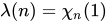
[Bearbeiten | Quelltext bearbeiten]Zu den Spezialfällen gehören die Dirichletsche Lambda-Funktion
λ
{\displaystyle \lambda }

-
λ
(
n
)
=
χ
n
(
1
)
{\displaystyle \lambda (n)=\chi _{n}(1)\,}
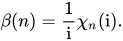
und die dirichletsche Beta-Funktion
β
{\displaystyle \beta }

-
β
(
n
)
=
1
i
χ
n
(
i
)
.
{\displaystyle \beta (n)={\frac {1}{\rm {i}}}\chi _{n}(\mathrm {i} ).}
Die transzendente lerchsche Zeta-Funktion verallgemeinert die legendresche Chi-Funktion:
-
χ
n
(
z
)
=
2
−
n
z
Φ
(
z
2
,
n
,
1
2
)
.
{\displaystyle \chi _{n}(z)=2^{-n}z\,\Phi (z^{2},n,{\tfrac {1}{2}}).}

Siehe auch
[Bearbeiten | Quelltext bearbeiten]Referenzen
[Bearbeiten | Quelltext bearbeiten]- Eric W. Weisstein: Legendre's Chi Function. In: MathWorld (englisch).
- Djurdje Cvijović und Jacek Klinowski, "Values of the Legendre chi and Hurwitz zeta functions at rational arguments", Math. of Comp. 68 (1999), 1623–1630.